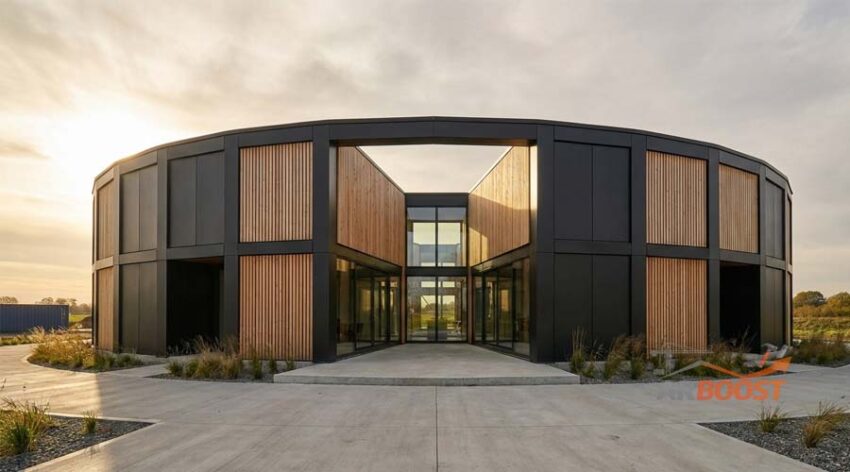
When the neighbors first saw the cranes unloading old shipping containers onto the empty plot, they assumed it was temporary.
Maybe storage. Maybe a workshop.

But when the containers began forming a perfect circle, people slowed their cars. Some took photos. Others quietly wondered if this was going to become an expensive mistake.
Because building a house is hard enough.
Building a round one out of steel cargo boxes? That sounds reckless.
And yet, that’s exactly what happened.
Instead of stacking containers into a typical block-shaped structure, the architects arranged them radially — each one slightly angled, forming a continuous ring. Precision was everything. The curvature had to be exact. The load distribution had to be recalculated. Steel was cut, reinforced, welded. It was less like assembling a house and more like engineering a sculpture.
During construction, it looked raw and industrial. Exposed beams. Temporary supports. Open cutouts where windows would eventually wrap the inner courtyard. Rain pooled on unfinished concrete. It didn’t look like a dream home.

It looked like an experiment.
But slowly, something extraordinary took shape.
At the center of the circular structure, they carved out a private courtyard — the heart of the home. Every major living space faces inward. Floor-to-ceiling glass panels replaced steel walls, turning what could have been dark container interiors into light-filled, open rooms.
From the outside, the finished home feels strong and minimal — matte black steel, vertical wooden cladding, subtle landscaping. It doesn’t scream for attention. It sits grounded, geometric, intentional.
From the inside, it’s unexpectedly warm.

Curved hallways guide you naturally from one space to another. Bedrooms follow the arc of the ring. The living room opens fully to the courtyard, where sunlight moves across the walls throughout the day. Morning coffee happens in complete privacy. At night, soft lighting reflects against glass, and the courtyard feels like an outdoor room with no ceiling.
The steel structure that once crossed oceans now holds family dinners, quiet conversations, and barefoot walks across oak floors.
The round shape isn’t just visual drama — it creates protection from wind, enhances structural rigidity, and generates a natural sense of enclosure without feeling trapped. It feels safe, but never closed.
And perhaps that’s what surprises people most.

It doesn’t feel like containers.
It feels like architecture.
The kind that makes you stop scrolling and look twice.
Wait until you see how it looked during construction — and then what it became.