For most of my life, I believed growing old meant gradually disappearing. Not all at once, not dramatically—just quietly, piece by piece. Friends pass away. Children move on. The phone rings less and less. Eventually the only sound left in the house is the ticking of the hallway clock.
By the time I reached ninety-one, that was the life I had settled into.
My husband had been gone for decades. The children we raised had moved across the country, building lives and families of their own. At first there were visits. Then there were phone calls. Eventually there were only occasional messages. And then even those stopped.
Birthdays became simple affairs: a cupcake from the grocery store, the television murmuring in the background, and the quiet feeling that another year had passed with no one noticing.
Holidays weren’t much different. A frozen dinner. Old reruns. The creak of the house settling into the night.
That kind of loneliness does something strange to a person. It makes you feel transparent, like you’ve become part of the furniture.
Then one day, a boy moved in next door.
His name was Jack.
He was twelve years old—tall and skinny in that awkward way kids get before they grow into themselves. He wore his baseball cap backward and carried a skateboard everywhere like it was attached to him.
Every afternoon I would see him out on the sidewalk practicing tricks. He’d fall, pick himself up, try again. Other children on the street would eventually hear their parents calling them inside.
“Dinner!”
“Homework!”
But no one ever called for Jack.
His house stayed dark most evenings. No car in the driveway. No lights glowing through the curtains.
At first I told myself it wasn’t my business. I was simply an observant neighbor, nothing more.
That story held up until the night I heard him crying.
It was late, and I had woken up suddenly to a faint sound. At first I thought it was the pipes in the walls. Then I heard it again—soft, broken sobs.
I walked slowly to the front window and pulled the curtain aside.
Jack was sitting alone on his porch.
He wore only a T-shirt even though the night air was cold. His knees were pulled against his chest and his shoulders shook as he cried. The porch light was off. The house behind him was completely dark.
Before I could talk myself out of it, I opened my door and stepped outside.
“Jack?” I called gently. “Honey, are you alright?”
He startled like I had caught him doing something wrong.
“I’m fine,” he said quickly, his voice cracking.
“Are you cold?” I asked. “Is your mom home?”
He stared at me for a moment, grabbed his hat from the steps, and rushed inside, slamming the door behind him.
The sound echoed down the street.
I stood there for a moment in my robe and slippers, feeling suddenly very old and very useless.
The next day, I couldn’t stop watching his house.
Usually he would appear outside after school with his skateboard. That afternoon he didn’t.
Four o’clock passed. Then five. Then six.
By seven my stomach felt like it had tied itself into a knot.
To keep my hands busy, I baked an apple pie—the one recipe I could still make without looking it up.
When it cooled, I carried it next door and knocked.
“Jack?” I called. “It’s Mrs. Doyle. I brought pie.”
No answer.
I knocked again.
“Sweetheart, you don’t have to open the door. Just say something so I know you’re okay.”
Silence.
The next morning, I took a taxi to the police station.
The officer at the front desk looked young enough to still be in school himself.
“I’m worried about a boy on my street,” I told him. “I might be wrong, and I hope I am. But if I’m right and I say nothing… I couldn’t live with that.”
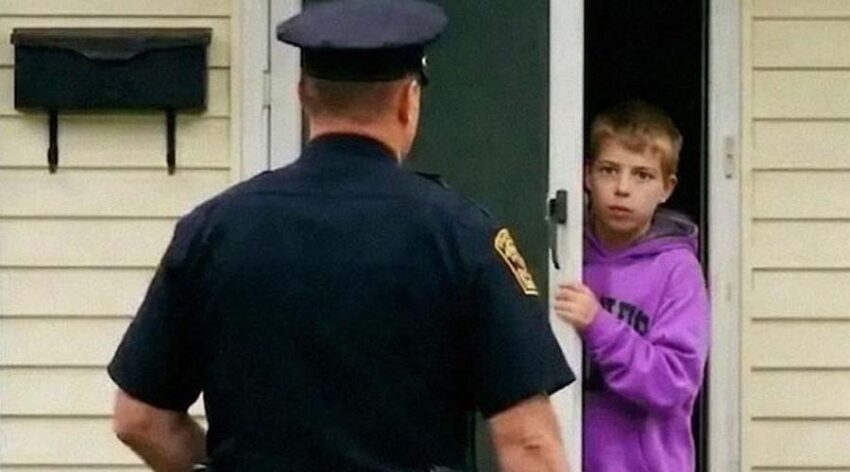
Later that afternoon, Officer Murray came with me to Jack’s house.
When the door finally opened a crack, Jack peeked out cautiously.
“Is your mom home?” the officer asked.
“She’s working,” Jack replied.
Inside the house, things felt wrong immediately.
There was almost no furniture. The kitchen sink overflowed with dishes. A burned pot sat on the stove.
In the bedroom there was only a mattress on the floor, a thin blanket, and a backpack beside a skateboard.
Officer Murray knelt down in front of Jack.
“How long have you been here alone?”
Jack stared at the floor.
“A week,” he muttered. “Maybe nine days.”
My heart nearly stopped.
He explained that his mother had gone to care for his sick grandparents in another state. She had intended to return quickly, but things kept getting worse.
“I’m almost thirteen,” Jack added, like that made it acceptable.
“Please don’t take me away,” he whispered. “I don’t want to live with strangers.”
The officer glanced at me.
“Mrs. Doyle… you live alone, correct?”
“Yes.”
“Would you be willing to let Jack stay with you temporarily while we sort this out?”
I didn’t even hesitate.
“Of course.”
Jack blinked at me.
“You’d want me there?”
“I’ve had too much quiet in my house,” I said. “I think a little noise would do me good.”
Over the next week, there were visits from social workers, phone calls with Jack’s mother, and plenty of paperwork.
In the end, it was agreed that Jack could stay with me temporarily until his mother returned.
He moved into my guest room with his backpack, game console, and skateboard.
The first morning I made oatmeal.
He complained loudly about it—and then ate the whole bowl.
Soon we had a routine.
I watched for him after school. He raided my refrigerator like a raccoon. We did homework together at the kitchen table.
The house stopped sounding like a tomb.
Weeks later, his mother returned. She cried when she saw him and apologized again and again.
Things weren’t perfect after that, but they improved.
Jack spent time at both houses. Most afternoons he still ended up at my kitchen table.
Over the years he grew taller, his voice deepened, and he began carrying my groceries inside while scolding me for climbing on chairs.
Then, one day, the doctor gave me news I expected but never quite prepare for.
Cancer.
“At your age,” he said gently, “we focus on comfort.”
I went home and opened my will.
It still listed my children—children who hadn’t visited in years.
I picked up a pen and changed it.
Everything I had—my small savings, my jewelry, and my house—I left to Jack and his mother.
When I told Jack, he looked stunned.
“Why us?” he asked.
“Because when I felt invisible,” I told him, “you sat on my couch, ate my terrible oatmeal, and let me be your grandma.”
He hugged me so tightly my ribs creaked.
“Too late,” he said. “You’re stuck with me now.”
I don’t know how much time I have left.
But I do know this.
I won’t leave the world as a ghost in an empty house.
There will always be skateboard marks on the front steps. Pencil lines on the wall where we measured Jack’s height. Laughter echoing in rooms that once held only silence.
All because one night I heard a boy crying—and decided not to look away.