
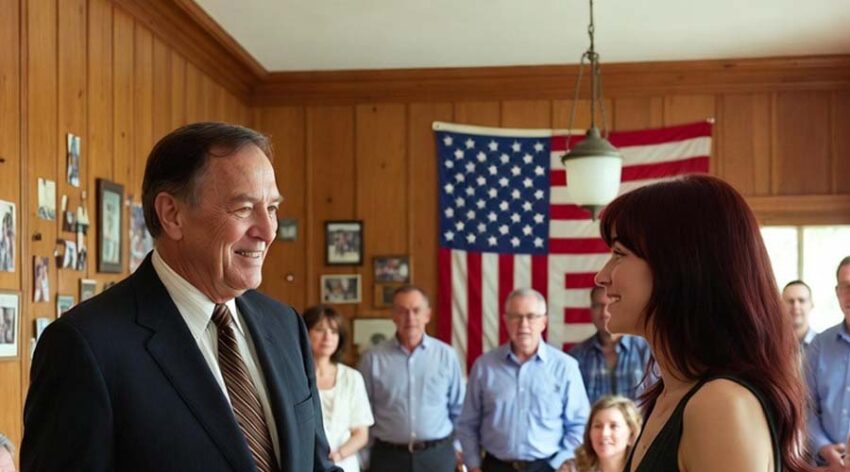
For a long time, I thought the worst thing my father ever said to me was, “Good. One less mouth.”
Turns out it wasn’t. The worst thing he ever did was press his hand flat against the gold‑wrapped box I’d carried three thousand miles and shove it off the table in front of sixty people.
The box hit the floor with a dull thud. One corner of the wrapping split, just enough for a flash of white paper to show through. The room inhaled all at once.
Forks paused halfway to mouths. The laptop slideshow kept flickering through old photos of my parents while the present stopped breathing. “We don’t want any cheap thing from you,” Dad said, loud enough for the cousins at the back and the neighbors by the door.
“You disappear for years and think a box fixes everything?”
My fingers tightened around the torn corner before I even bent down. I could feel every stare in that little Ohio living room pressing against my shoulders like hands. I picked up the box.
If you had been there, you might have thought the story started in that moment. It didn’t. It started five years earlier, with a phone call and a foreclosure notice I wasn’t supposed to know about.
My name is Flora Rose Mitchell. I’m thirty‑one years old, and I grew up in Harden, Ohio. Population four thousand on a good day, three thousand nine hundred and something on the days when people like me finally packed their whole lives into two suitcases and drove away down Route 31.
My father, Gerald Mitchell, fixed pipes and banged on boilers for a living. My mother, Judith, worked part‑time at the grocery store out on the highway, the one with the faded mural of a smiling tomato that’s been there since the eighties. My older sister, Vivien, four years ahead of me in school and about a hundred miles ahead of me in our parents’ hearts, was the sun the whole house orbited around.
I don’t say that to be dramatic. I say it because that’s simply how the gravity worked in our kitchen. Growing up, Vivien’s report cards arrived in flurries of exclamation points.
She walked into the house waving them like flags, talking before she even took off her shoes. “AP English, A plus. Chemistry, A minus but Mrs.
Perry said I’m the only one who actually gets the labs. Mr. Dawson said he’s never had a student like me—”
Dad would take the paper, squint at it like it was a blueprint, then grin and shake it in the air.
“That’s my girl,” he’d say, voice booming big enough for the neighbors to hear through the open windows. Mine went on the counter. Same grades.
Same letters. Different volume. I’d set my report card right beside hers, edge to edge, and wait.
Sometimes Mom picked it up and smiled and said, “Good job, honey,” before tucking it in a folder in the hall closet. Sometimes no one said anything at all. We’d clear dinner dishes, wipe counters, pack leftovers, and my A’s would sit under the under‑cabinet light until the bulb cooled and the kitchen went dark.
There was a joke Dad liked to tell at family barbecues. He’d wrap one arm around Vivien’s shoulders, point his beer can at her, then wave it in my direction. “Vivien got the brains,” he’d announce.
“And Flora got… well, Flora’s Flora.”
People laughed every time. Uncles, cousins, the neighbor from across the street who only came for the potato salad. Even Mom smiled, though she always looked at the ground when she did it.
I laughed too. I was eight years old the first time he told that joke. I was eighteen the last time.
The words never changed. Neither did the way everyone laughed like it was the first time they’d heard it. If you repeat something long enough, people stop hearing it as a joke and start hearing it as a fact.
By the time I finished high school, it was decided, without anyone actually saying it out loud, who we all were. Vivien was the bright one, the responsible one, the one who would stay close. I was… Flora.
Nice enough. Helpful. Background.
I went to nursing school two hours away and drove home on weekends when my schedule allowed. I learned how to read vital signs and how to keep my voice steady when someone else’s world was falling apart. Meanwhile, things at home stayed exactly the same.
At least, that’s what I thought. The morning I left for Denver, the sky over Harden was the color of dishwater. June humidity stuck my T‑shirt to my back as I lugged my suitcase down the hallway for the last time.
I stopped in the kitchen doorway, car keys in my hand. Dad was under the sink, half his body disappeared into the cabinet, wrench glinting in his fist. “Bye, Dad,” I said.
He didn’t pull his head out. “Good,” he said. “One less mouth.”
June fifteenth.
My birthday. I’d like to tell you I said something sharp back, some line that sliced clean through every careless comment he’d ever made. I didn’t.
I just stood there for a beat, memorizing the oil stain on the back of his work shirt, the chipped paint on the cabinet door, the drip drip drip of the pipe he was fixing. Then I walked out to my car and drove west until Ohio turned into flat Indiana fields in my rearview mirror. I didn’t leave because I stopped loving them.
I left because staying meant disappearing completely. Denver was bigger, louder, brighter in ways Harden would never be. The hospital where I got my first job as a nurse took up three city blocks.
On some nights, the mountains cut a sharp line against the sunset, this jagged purple reminder that the world was larger than the four walls of my childhood kitchen. For the first year, I called home every Sunday at seven p.m. on the dot.
I’d sit on my tiny apartment balcony with a mug of tea, the city lights making constellations out of office windows, and dial the old landline number so ingrained in my fingers I didn’t have to look at the keypad. Sometimes Mom picked up. We’d talk about church gossip, who’d had a baby, who’d moved away.
I’d tell her about the hospital without telling her too much, sanitizing the details so she wouldn’t hear the things I couldn’t unsee. Dad never came to the phone. By the second year, the rings dragged out longer.
Sometimes it went to voicemail. Sometimes Vivien would text back instead of Mom calling, little messages that landed like crumbs. They’re busy.
They’re tired. You know how Dad is. Don’t take it so personally.
I mailed birthday presents. Christmas packages. A scarf I knit for Mom with my own sore hands over three weekends, soft gray wool I picked because it matched the coat she’d had since before I was born.
I wrapped it carefully and tucked a note between the folds. I never heard a word. One night, after yet another call that went ringing into the void, I messaged Vivien.
“Did they… get the scarf?”
Her typing dots appeared. Disappeared. Then finally:
“I think they threw it away without opening it.
Flora, I’m sorry.”
I stared at those two sentences until my phone screen dimmed. Something heavy settled right under my ribs. That’s the thing about being the quiet one.
People assume your feelings are quiet too. A few months later, my mom’s younger sister, Martha, called me the day before Thanksgiving. Aunt Martha has the kind of voice that always sounds like she’s in the middle of a story, even when she’s just talking about the weather.
We were chatting about nothing and everything—her arthritis, my night shifts, the way Harden’s Main Street still smelled like fryer oil and exhaust—when she said, almost offhand, “Your mom just loves that scarf you sent, by the way. Wears it to church every Sunday.”
I went still. “Martha… Vivien told me they threw it away.”
There was a pause long enough for me to hear the hum of Aunt Martha’s fridge through the phone.
“That’s not what happened,” she said carefully. I could have pushed. I could have asked, “Then what did happen?” But some instinct I didn’t have words for yet told me to file that away instead.
A crack in the story I’d been fed. Narrow, but enough for light to slip through. After that, I started paying closer attention.
To the things Vivien told me, to the timeline of who said what to whom. Little mismatches started sticking out like furniture that had been nudged half an inch. “Flora, they just don’t think about you that much,” Vivien had said once, her voice full of something that sounded like sympathy and tasted like metal.
“I’m sorry.”
She said those words a lot. “I’m sorry.” They almost never matched her face. Five years ago, on a Tuesday in March, my phone buzzed in the ICU hallways between beeping monitors and the soft shuffle of rubber soles.
I checked the caller ID and stepped into the alcove by the supply closet. Aunt Martha. “Hey, Aunt M,” I said, tucking the phone between my shoulder and ear while I scanned a patient chart.
Her voice was tight. “Honey, I need to tell you something, and I hate that I’m the one that has to, but here we are.”
I set the chart down. “Your parents are three months behind on their mortgage,” she said.
“The bank sent a final notice. They could lose the house by summer.”
The hallway noise dimmed around me. “How bad is it?” I asked, already knowing the answer.
“Bad. Your dad won’t talk about it. You know how he is.
And your mom…” She sighed into the phone. “She just keeps saying Vivien promised she’d handle it.”
“Does Vivien know?” I asked, even though Martha had just answered that. “She told them she’d take care of it,” Martha said.
“But I haven’t seen any payments go through, and I’m the one who drives your mother to the bank every Friday. I thought you should know.”
That night, I sat on my secondhand couch in my little Denver apartment and stared at the blank television screen until my own reflection blurred. Then I picked up my phone and called First National Bank in Harden.
“Mortgage department, this is Dave Keller,” a calm male voice said after I’d been transferred twice. “Hi, Mr. Keller,” I said.
“My name is Flora Mitchell. My parents are Gerald and Judith Mitchell, on Maple Drive. I just… I heard they’re behind on their mortgage.
I was wondering if you could tell me what the situation is.”
There was the sound of typing, muted office noise in the background. “Yes, Ms. Mitchell,” he said after a moment.
“I see the account here. They’re three months past due. We’ve sent a final notice.
Foreclosure proceedings would start in about sixty days if nothing changes.”
My stomach clenched. “Has anyone called about making a payment plan?” I asked. “Actually,” he said, “someone did call last week.
Claimed to be a family member who would handle it. Spoke confidently. But… no payments have posted.
No follow‑up.”
I didn’t have to ask who that someone was. I closed my eyes. “If I wanted to set up automatic payments,” I said, “could I do that from my account?
Without their knowledge?”
He hesitated. “You’re not on the mortgage, Ms. Mitchell.”
“I know,” I said.
“But I’m their daughter. I don’t want them to lose the house. And I don’t want them to know it’s me.”
There was another pause, longer this time.
“We can accept payments from a third party,” he said finally. “If that’s what you’re asking. But your name would still appear on transaction histories.”
“Can you make a note not to discuss that with them?” I asked.
“Or with anyone else? I don’t want… drama.”
He exhaled slowly. “I can’t guarantee what people talk about in their own kitchens.
But I can tell you I won’t be volunteering your name. How much were you thinking of sending?”
“How much do they owe a month?”
“Two thousand three hundred,” he said. $2,300.
He said it like it was just a number. A line on a spreadsheet. It was more than my Denver rent.
I looked at my bank app. At my student loans. At my grocery budget, which already involved more rice and beans than I liked to admit.
“I’ll cover it,” I said. My voice didn’t shake, even though my insides did. “Every month.
Set an automatic transfer for the full amount.”
“Are you sure?” Dave asked. “Yes,” I said. “And please don’t tell them it’s me.”
Invisible love is still love.
For the next five years, on the same day each month, $2,300 left my account and landed in theirs. I picked up extra shifts. I volunteered for holidays and weekends when everyone else was begging to be off.
I took on the jobs no one wanted—the confused patients who tried to swing at you, the families who needed someone to sit and explain what all the numbers meant. I came home smelling like antiseptic and coffee and exhaustion. I stopped buying coffee on the way to work.
I bought clothes at Goodwill and pretended it was a quirky aesthetic choice instead of necessity. My couch came from a garage sale, my kitchen table from an estate sale where the cashier wrote the price directly on the wood in pencil. Lightning never struck.
The ground never swallowed me whole. The sky didn’t open and rain down gratitude. My parents didn’t call.
Tommy figured it out three months in. Tommy Reed worked construction. He had steady hands, a quiet voice, and this way of noticing things that made you feel like he’d been given extra senses.
We’d met when his crew was doing work on the hospital’s west wing. He asked me to coffee; I said yes and then immediately suggested we go somewhere cheap. He didn’t press it when I always chose the cheapest thing on the menu.
He didn’t say anything when I started filling half my grocery cart with gas‑station ramen. One night, he came over while I was at work and used my laptop to look up a recipe. He closed the recipe tab and saw the spreadsheet behind it.
When I got home, the apartment smelled like garlic and simmering tomatoes. He handed me a bowl of pasta, then sat across from me at the wobbly table. “It’s the house, isn’t it?” he asked.
I froze with my fork halfway to my mouth. “Their house back in Ohio,” he continued. “The mortgage.
You’re paying it.”
I set the fork down. “Please don’t tell me I’m wrong,” he said gently. “Because I saw the numbers, Flo.”
No one back home had ever called me Flo.
Somehow, in his mouth, it didn’t sound like a diminishment. “Yes,” I said. “It’s… a long story.”
He nodded.
“Then we’ve got time.”
I told him about the foreclosure notice, about Dave Keller, about the anonymous payments. I didn’t tell him about the scarf or the “one less mouth” comment. Some pieces still felt too raw to turn into words.
When I finished, I braced myself for the lecture I was sure was coming. That I was being taken advantage of. That my parents didn’t deserve it.
That I should cut them off. Tommy took a breath. “Okay,” he said simply.
“I’ll fix the porch railing myself so we don’t have to hire anyone.”
He said it like we were a team. Like my decision was his decision too. That was Tommy.
No big speeches. Just lumber and a level and making the load a little lighter where he could. Years blurred and sharpened around that payment.
Payday. Rent. Groceries.
Loans. Mortgage. You’d be amazed how much of your life can be measured in automatic withdrawals.
The balance on my parents’ mortgage crept down, a reverse countdown. One hundred forty thousand. One hundred ten.
Eighty. Sixty. Forty.
Each drop a small quiet victory that no one celebrated. My parents’ lives, from what I could gather through Aunt Martha, stayed more or less the same. Mom still worked at the grocery store.
Dad still fixed pipes. Holidays came and went. I didn’t go home.
At first, it was because of shifts and money and the logistics of flying across the country on a nurse’s salary. Later, it was because the invitations changed. Year three, Vivien texted me the week before Thanksgiving.
“Mom’s not feeling great. Probably better if you don’t come this year. Less stress,” she wrote.
For Christmas: “Dad doesn’t want any drama. Maybe just call.”
By Easter, there wasn’t even a text. Just pictures on Facebook of crowded tables and Dad’s “famous” carved ham, cousins squeezed together on sagging couches, tagged locations at my parents’ address.
Everyone was there. Everyone except me. Through Martha, I heard the rest.
One year into my secret mortgage project, she called with her voice pitched low, the way people talk in church when they don’t want to draw eyes. “They think Vivien’s paying it,” she said. I sank onto my couch.
“What do you mean?”
“Your daddy stood up at Thanksgiving,” Martha said. “Right there at the head of the table with his carving knife still in his hand, and he raised his glass and said, ‘To Vivien, the only one who really cares about this family.’”
I could picture it. The yellowed overhead light, the fogged windows, the condiments clustered at the center of the table.
Vivien, soaking in the praise. “She told them she was paying the mortgage?” I asked. “She told them,” Martha said slowly, “that she took care of it.
All of it. Your mama cried. Your dad put her name on their checking account.
On the savings. On the insurance paperwork.”
My free hand curled into a fist around nothing. “She’s positioning herself, honey,” Martha said.
“And they’re handing her the keys, because they think she saved the house.”
The $2,300 that left my account every month had grown into something larger in my chest. Not just a number, but a story—a story about who I was and how I loved. And now that story had someone else’s name on it.
I told myself it didn’t matter. “As long as the house is safe,” I said into the phone, half to Martha, half to myself, “I don’t care who gets the credit.”
That held until Martha told me something else. “Your daddy told Bobby last week,” she said.
“Exact words. ‘I raised one good daughter and one stranger.’”
I pressed my head back against the couch cushion and closed my eyes. One good daughter.
One stranger. Numbers and labels. That’s what I’d become to him.
The payments kept going. I didn’t stop. I didn’t call to confront him.
I didn’t name myself. Some part of me still believed that if I stayed quiet enough, steady enough, someday they’d look down and see who’d been holding the floor up the whole time. The final payment cleared in September.
Five years. Sixty transfers. One hundred thirty‑seven thousand four hundred twelve dollars.
The house on Maple Drive was officially free and clear, title in Gerald and Judith’s names alone. I thought that would be the end of it. An internal finish line only I would ever notice.
Two weeks later, I was scrolling through Facebook on a Sunday morning, the kind of lazy day where you’re still in pajamas at ten a.m., when a post stopped my thumb. Vivien had uploaded a photo of my parents in front of the house, arms looped together, both of them grinning. A banner was taped crookedly over the door in the background.
“Planning Mom and Dad’s 40th anniversary!” the caption read. “Family only, October 14th. So grateful I could give back to the people who sacrificed everything for us.
Can’t wait to celebrate.”
Forty‑year anniversary. Family only. The comments were full of heart emojis and “They deserve it!” and “You’re such a good daughter, Viv!”
I stared at the screen until the letters blurred.
Then I picked up my phone and called her. She answered on the fourth ring, voice bright. “Flora!
Hi.”
“I saw the post,” I said. “When should I book my flight?”
There was a pause long enough to hear the background clatter wherever she was. Maybe the grocery store.
Maybe my parents’ kitchen. “Oh,” she said. “I didn’t think you’d want to come.”
“It’s their fortieth anniversary, Vivien,” I said.
“Of course I want to come.”
“Well, it’s just… Dad’s worried it might be awkward.”
“Did he say that? Or did you?”
Another pause. Longer.
“I’m trying to protect everyone,” she said finally. “You haven’t really been around. People will have questions.”
“Let them ask,” I said.
My hand shook so hard I had to sit on it. “I’ll be there.”
I hung up before she could answer. That night, lying awake next to Tommy in the dark, I stared at the faint line of the ceiling fan and thought about what I could possibly bring to that party.
A check? A speech? Nothing?
Tommy rolled toward me, voice thick with sleep. “You’re going,” he murmured. “I’m going,” I said.
“What are you bringing?”
I thought about it for exactly one second. “The truth,” I said. He didn’t ask me what I meant.
I think he already knew. The next morning, on my break at the hospital, I called Dave Keller. “Dave, it’s Flora Mitchell,” I said.
“Ms. Mitchell,” he said, warmth in his voice now. “I was just telling someone last week this is one of the most selfless things I’ve seen in twenty years of banking.
Congratulations on paying it off.”
“That’s actually why I’m calling,” I said. “I need the original mortgage satisfaction certificate. And a full payment history for the last five years.
Every transfer, every date, every amount. With my name on it.”
He was quiet for a moment. “You’re sure?” he asked.
“It’ll show everything.”
“That’s exactly the point.”
“All right,” he said. “Give me a few days. I’ll have it printed, notarized, and mailed out.”
When the manila envelope arrived, it was heavier than I expected.
Inside, the certificate with the bank’s raised seal, embossed and official, and sixty pages of transaction records. My name. My account.
My money. I sat at my kitchen table with a pen and a blank sheet of white paper and wrote a letter to my parents. I started three times and threw away three drafts.
On the fourth, I wrote slower. Mom and Dad,
I know you think I left because I didn’t care. I left because I needed to be somewhere strong enough to take care of you from a distance.
I wrote about the foreclosure notice. About the payments. About how love had looked, for me, like saying yes to extra shifts and no to vacations.
About how I’d kept quiet because I thought the house mattered more than the story about who saved it. I kept the letter to one page. Not because there wasn’t more to say, but because I knew my father’s patience with words that required him to sit still and feel things.
When I copied the letter onto a fresh sheet of paper, my hands were steady. I bought a sturdy box from the craft store, one with clean corners and a lid that fit snugly. I lined it with tissue paper like it was something fragile.
I put the certificate and the payment history and the letter inside. Then I wrapped the whole box in gold paper. Gold was the color of their wedding.
Mom had shown me pictures of the cake so many times when I was a kid—white frosting with gold ribbon around each tier, tiny flecks of edible glitter she’d saved up for. She kept one of those ribbons in her jewelry box for decades, folded and refolded until the crease lines became part of the fabric. If anything could cut through five years of distance, I thought, it might be that color.
The morning of my flight, Tommy drove me to the Denver airport while the sky was still the washed‑out blue of early fall. He pulled up to the departures drop‑off and put the truck in park. “You don’t have to do this,” he said.
“I know,” I said. “But I can’t keep funding their life from the shadows while someone else tells my story for me.”
He nodded once and got out, walked around to my side, and opened the door. He took my carry‑on, then glanced at the gold‑wrapped box in my arms.
“Whatever happens in that house,” he said, “you already did the right thing. For five years straight.”
I kissed him, shouldered my bag, and walked into the terminal with the box tucked carefully against my chest. I didn’t know then that I’d be back in that same spot less than twenty‑four hours later without it.
The flight from Denver to Columbus took a little over three hours. I spent most of it running my thumb along one edge of the gold wrapping, feeling for any place the tape might give. The stranger in the seat beside me asked if it was a wedding present.
I smiled and said, “Anniversary.”
He nodded like that made it even nicer. At the rental car counter, I picked the cheapest economy car available, a gray sedan with a coffee stain on the passenger seat and a rattle when you turned the key too fast. I drove east on the interstate, past billboards for fireworks and outlet malls, until the exits started looking familiar.
Route 31. The gas station that had been “closing soon” since I was in middle school. The billboard for a personal injury attorney whose face hadn’t changed in twenty years even if his hairline had.
By the time I turned onto Maple Drive, the sun was low enough to stretch the trees’ shadows across the cracked pavement. The house looked the same from the street. Brown siding.
Chain‑link fence. The maple tree I climbed as a kid still leaning slightly over the yard like it was eavesdropping on the neighborhood. Today, there were balloons tied to the mailbox.
A banner strung across the porch read “Happy 40th, Gerald & Judith” in looping letters. Cars lined both sides of the street. I parked at the far end of the block and sat there with the engine off, the gold box on the passenger seat.
From here, the house was just close enough that I could hear the muffled thump of music and the occasional burst of laughter. I smoothed a crease in the wrapping paper with my thumb. What if they tell you to leave?
a small voice whispered. Then at least I’ll have stopped pretending I wasn’t already gone, I thought back. I got out of the car, locked it, and walked toward the house.
Thirty yards. That’s all it was. It felt like three thousand.
Inside, the living room had been rearranged into a banquet hall version of itself. Folding tables formed an L‑shape covered in white plastic tablecloths. Borrowed chairs hugged the walls.
Flower arrangements—fake, but arranged with real care—sat beside Crock‑Pots and casserole dishes. A laptop in the corner played a slideshow of photos. My parents on their wedding day, young and awkward and radiant.
Mom holding Vivien as a toddler. Dad teaching Vivien how to ride a bike. Vivien at prom.
Vivien at graduation. I was in some of the photos, too. Just… less.
A few heads turned as the screen door creaked shut behind me. “Flora,” Mrs. Patterson from next door exclaimed.
“My goodness, look at you. We haven’t seen you in years.”
She said it loud enough that half the room heard. Conversations faltered.
Someone turned the music down. Forks hovered in mid‑air. I shifted the box in my hands and tried not to grip it like a life raft.
Across the room, Aunt Martha stood near the doorway to the kitchen with a glass of iced tea. Her eyes landed on the box first, then on my face. They widened, then sharpened.
Are you sure? her look asked. I gave the smallest nod I could manage.
She set her glass down carefully on the nearest surface and straightened, her shoulders squaring like a woman who’d decided something a long time ago and had been waiting for her moment. Vivien was at the head of the table, a champagne flute in her hand, mid‑speech. “…and I’m just so grateful I’ve been able to give back to you both,” she was saying, voice thick with emotion.
“Especially with the house. Everything I’ve done, I’ve done out of love.”
Glasses lifted. People murmured their approval.
Dad sat in pride at the center of it all, his chest puffed slightly, one hand resting over Mom’s. He nodded along, king of a very small, very specific kingdom. Then Vivien’s gaze slid over the room and snagged on me.
The change in her expression was tiny but unmistakable. A slight tightening around the mouth. A quick flare of something in her eyes before the bright party‑host smile snapped back into place.
She excused herself from whoever she’d been talking to and crossed the room toward me, heels silent on the worn hardwood. She didn’t hug me. She leaned in close enough that I could smell her perfume—something expensive and sharp.
“What are you doing here?” she hissed. “I came to give Mom and Dad their gift,” I said, keeping my voice low. She glanced pointedly at the box.
“What is that? Some last‑minute thing from the airport?”
I didn’t answer. “You should go before Dad sees you,” she whispered.
“He doesn’t want any awkwardness. I told you that.”
Too late. From behind her, I heard my mother’s voice.
“Flora?”
Mom was staring at me from her folding chair at the center of the U‑shaped tables, napkin crumpled between her hands. Her eyes flicked from my face to the box and back again. Her expression was complicated—surprise, guilt, something like relief—all surfacing and sinking in the space of a heartbeat.
Then it smoothed over. “We didn’t invite you,” she said, clearly enough that everyone around the table heard. “Your sister planned this.”
Sixty pairs of eyes swung between us like we were the center of some slow‑motion tennis match.
I felt my face heat. Not from shame, exactly, but from the raw exposure of it. “I know,” I said.
“I came anyway. It’s your fortieth anniversary. And I’m your daughter.”
Dad’s jaw clenched.
His eyes dropped to the box. I stepped forward and set it on the table between the flower arrangement and the cake, right where a centerpiece should go. The gold paper caught the overhead light and flashed, a little echo of the ribbons from their wedding cake forty years earlier.
For a second, no one moved. Then Dad stood, the metal chair scraping against the floor. He stared at the box, then at me, then back at the box.
His jaw worked side to side, the way it always did when he was building toward anger. “We don’t want anything from you,” he said, voice rising. “Not from the daughter who abandoned us and only shows up when she feels like it.”
His hand shot out.
He pushed the box. It slid across the plastic tablecloth, knocking over a plastic fork and grazing the edge of the cake. It tumbled off the other side and hit the floor with a solid thump.
One corner of the gold paper tore open, just enough to show the edge of a manila envelope and the bank’s logo. Every person in that room sucked in a breath in perfect unison. “We don’t want any cheap thing from you,” Dad said, voice booming.
“Your sister’s been here. Vivien paid for this house. She planned this party.
She showed up. Where were you?”
Vivien stood behind him now, arms crossed, chin lifted, wearing the expression of someone watching a verdict she’d written herself. I looked at my father.
At the man who’d once said “one less mouth” on the morning of my twenty‑third birthday as I left for a life that would eventually save his home. My throat burned. My eyes did too.
But my voice, when it came, was steady. “I didn’t come here to beg,” I said. “I came to give you something I spent five years working for.
But I won’t stand here and be humiliated for loving you.”
I bent down, lifted the box, and smoothed the torn corner of wrapping with my thumb like I was fixing a bandage. Then I turned. No one stopped me as I walked past the slideshow of family photos where my presence had always been intermittent.
Past Uncle Ray with his fork frozen over his plate. Past Mrs. Patterson pressing a napkin to her mouth.
Past cousins suddenly fascinated with the pattern of the tablecloth. The only sound was the low twang of a country song still drifting from the corner speaker, oblivious. Aunt Martha was by the front door.
She put out a hand to touch my arm as I reached for the knob. “Leave it with me,” she said quietly. “Trust me.”
Everything in me wanted to clutch that box and drag it back to Denver, shove it in a closet, and never think about Harden again.
But Martha’s eyes were fierce and steady in a way I’d only seen once before—when she’d stood up to a doctor about my grandmother’s treatment, hands on her hips, voice like steel. I placed the box in her hands. Then I walked out of my parents’ house, down the steps, and into the October air without looking back.
Driving away from Maple Drive, the balloons and banners shrinking in my rearview mirror, I kept asking myself the same question on loop. Why did you keep hoping? Five years of payments.
Sixty transfers. One hundred thirty‑seven thousand four hundred twelve dollars. And my father had shoved my heart off a table in front of everyone we’d ever known.
Have you ever given everything to someone who didn’t even notice? Who looked straight past your sacrifice and thanked someone else for it? If you have, you know the kind of hollow that settles in your chest afterward.
I was already halfway to the interstate when the party detonated. I wasn’t there, but I’ve heard the story enough times—from Martha, from Uncle Ray, from three different cousins—that I can see it like a film I was watching from somewhere above. The room tried to snap back into shape after I left.
Vivien clapped her hands and laughed too brightly. “Okay, everyone,” she said. “Let’s not let this ruin Mom and Dad’s night.
Who wants cake?”
A few people murmured. Someone reached for a knife. The music stayed on.
But Martha didn’t move. She stood there holding the gold‑wrapped box—the thing my father had just knocked to the floor—and felt, as she later told me, like she was holding a grenade with the pin halfway out. “I’ve stayed out of it for five years,” she told me.
“I couldn’t do it one second longer.”
She walked back to the center of the room and set the box on the table, right back where I’d placed it. “Before anyone touches that cake,” she said, her voice clear and carrying, “there’s something you all need to see.”
“Stay out of this, Martha,” Dad snapped. “This is family business.”
“Oh, I am family,” she said.
“And so is the person you just humiliated.”
Vivien moved fast, the heels that had been silent on her way to me suddenly loud. “Aunt Martha, this isn’t the time.”
“This,” Martha said, fingers already working at the tape on the box, “is exactly the time.”
The room went still. Not quiet.
Still. Martha opened the lid, reached inside, and pulled out the thick manila envelope from First National Bank. She held it up so everyone could see the bank’s logo.
“This,” she said, “is your mortgage satisfaction certificate.”
She unfolded the paper and slid her reading glasses down from the top of her head. “‘Mortgage for 1427 Maple Drive, Harden, Ohio,’” she read. “‘Paid in full as of September 14th.
Payoff completed by…’”
She looked up over the rims of her glasses, straight at my father. “‘Flora Rose Mitchell,’” she finished. “Total paid: one hundred thirty‑seven thousand, four hundred twelve dollars.”
The silence that followed wasn’t confusion.
It was impact. You could almost hear the sound of a story breaking in half. Martha reached back into the envelope and pulled out the stack of payment records.
Sixty pages. She fanned them slightly so the paper whispered. “Five years of payments,” she said.
“Two thousand three hundred dollars every month from Flora’s account in Denver. Her name, on every single line. Not a dollar from anyone else.”
Someone in the back—Aunt Donna, Dad’s older sister—let out a sharp breath.
“Oh my Lord,” she said, not quietly. Mrs. Patterson covered her mouth with both hands.
Uncle Ray pushed his chair back and stood, his face pale. Dad’s hand, the one that had shoved the box, gripped the edge of the tablecloth so hard his knuckles were bone white. Mom’s shoulders started to shake.
Martha lowered the papers, eyes never leaving my father’s face. “That ‘cheap thing’ you just threw on the floor?” she said. “That was five years of your younger daughter saving your house while you praised the older one for taking the credit.”
If words could be slapped across a room, that’s what it felt like.
Dad turned his head slowly toward Vivien. “You told me you were paying the mortgage,” he said. His voice had gone flat, stripped of the bluster he’d used on me.
Vivien’s face had drained of color. “I— I helped,” she stammered. “I contributed.
Flora… I mean, she might have—”
“Really?” Martha said, lethal and calm. “Because Dave Keller at First National confirmed that every cent came from one account. Flora’s.
Not one payment from you, Vivien. Not one.”
Vivien’s mouth opened and closed. Aunt Donna spoke up from her seat near the end of the table.
“In what way exactly did you help, then?” she asked. Vivien didn’t have an answer. The mood in the room pivoted.
The approval that had wrapped around Vivien like a shawl fifteen minutes earlier slipped away, leaving her exposed. People who’d nodded along to her toast now stared at her with new eyes, recalculating every story they’d been told for the last five years. That’s the thing about small towns.
The same speed that news travels when you’ve done something good is the speed it travels when you’ve done something ugly. Martha reached into the box one more time and pulled out the white envelope with my handwriting on the front. “Mom and Dad,” it said in my careful script.
“Do you want to read this,” she asked quietly, looking at my father, “or do you want me to?”
Dad didn’t reach for it. His hands, the same hands that had tightened bolts and turned wrenches for decades, were shaking. Mom reached for the letter instead, fingertips brushing the paper like it was fragile.
Martha unfolded it and read aloud. She didn’t make it through every word. She told me later that her voice broke three sentences in and she had to skip around, catching the lines that mattered most like stones out of a river.
“‘I know you think I left because I didn’t care,’” she read. “‘I left so I could be somewhere strong enough to take care of you. This house was always yours.
I just made sure no one could take it away.’”
Mom pressed her hands to her mouth. Martha’s voice grew softer. “‘I love you.
I always have, even when you couldn’t see me.’”
Mom reached across the table and put her hand flat on the letter as if she could touch me through the ink. Dad sat down heavily, elbows on his knees, his head in his hands. He was sixty‑four years old.
Martha said in that moment, he looked older than she’d ever seen him. Somewhere during the reading, Vivien slipped out the back door. No speech.
No explanation. Just the soft click of the screen and the sound of her heels on the porch steps. No one followed her.
When the guests finally started to leave, they did it quietly. No one wanted cake. The banner stayed up across the porch, its cheerful message hanging over a house that felt, for the first time, like it had been rearranged without moving a single piece of furniture.
Old Mr. Holloway from across the street paused at my father’s shoulder on his way out. “I always thought Flora was just the quiet one,” he said.
“Guess quiet doesn’t mean gone, huh?”
He squeezed Dad’s shoulder once and shuffled out into the October dark. That night, according to Martha, my parents sat alone at the table for hours. The letter lay open between them.
The stack of bank statements beside it. Dad read every page. His finger traced my name all the way down sixty lines of payments.
My mom didn’t move her hand from the letter. She just kept her palm there, like she was keeping it from blowing away. Around midnight, Dad finally spoke.
“I pushed it off the table,” he said hoarsely. “What?” Mom asked. “Her gift,” he said.
“I pushed our daughter’s heart off the table.”
Mom’s eyes flooded again. “We drive,” she said. “It’s fourteen hours,” he replied.
“Then we leave now.”
They didn’t pack much. A thermos of coffee. A change of clothes.
The gold box, rewrapped carefully by Martha before she went home. At three in the morning, Dad backed the pickup out of the driveway, the same truck he’d used to teach us to drive in the grocery store parking lot. Mom climbed into the passenger seat clutching the box.
They pulled onto Route 31 and headed west. By the time the sky over Harden started to lighten, they were somewhere in Indiana. While they drove, the town woke up to the news.
By Sunday morning, half of Harden knew that quiet Flora from Denver had paid off her parents’ mortgage while Vivien took the credit. By Monday, the other half knew. People didn’t chase Vivien down with torches.
They simply stopped calling. Stopped waving. Stopped saving her a seat at the diner.
In a town of four thousand, silence is its own verdict. While my parents drove through the night, I was thirty thousand feet in the air, too. I boarded the plane in Columbus before dawn, the carry‑on bag at my feet and a hollow ache in my chest where the gold box had been.
I stared at the empty space on the floor like I could still see it there. Tommy was waiting at Denver International when I walked out of the terminal, hands shoved into his jacket pockets, worry etched into the lines around his eyes. He didn’t ask what happened.
He could read it on my face. He just took my bag, slid his arm around my shoulders, and walked me to the truck. We drove home in silence.
Not the kind that’s full of unsaid arguments. The kind that says, I’m here, and that’s all that matters right now. When we got inside, I sat on the couch and didn’t bother turning on the lights.
I stayed in my jacket. The familiar shapes of our living room—thrift‑store coffee table, crooked bookshelf Tommy kept meaning to fix—blurred in the dark. My phone buzzed three times on the coffee table.
“Ohio,” I said without looking. “I’m not ready.”
Tommy nodded, picked up the phone, set it face down, and went to put the kettle on. The crying hit like a wall—not the cinematic kind with a single tear rolling down a cheek, but the ugly, gasping kind you usually only let out alone in your car.
I pressed my face into a throw pillow and sobbed until my throat hurt. Tommy sat beside me and put his hand between my shoulder blades. He didn’t say any of the easy lines people like to throw at grief.
He just stayed. Eventually, the sobs ran out. I sat up, wiped my face on my sleeve, and turned my phone off.
I didn’t want to hear anything from Harden. Not that night. The next morning, muscle memory got me out of bed at five.
I made coffee and stepped out onto the porch in my bathrobe, mug warm between my hands, Denver air crisp in my lungs. Was I wrong to go? I wondered.
Was I wrong to keep quiet for five years? Should I have shouted the truth from the beginning or kept it buried forever? I was still turning those questions over when I heard an engine I didn’t recognize.
A dusty white pickup truck rolled slowly up the street and stopped crookedly at the curb in front of my duplex. Ohio plates. For a second, my brain refused to make the connection.
Then the driver’s door opened. My father climbed out. He wore the same flannel shirt he’d had on at the party.
It was wrinkled now. His hair was flattened on one side from sleeping in the truck. His eyes were rimmed red, like he hadn’t blinked in fourteen hours.
On the passenger side, my mother got out, careful with her knees. She held the gold box against her chest. The torn corner had been patched with fresh tape.
They stopped at the end of my short walkway, twenty feet of concrete between us. We just looked at each other. Somewhere down the block, a dog barked.
A sprinkler hissed to life in a neighbor’s yard. The world kept doing world things while my parents stood in front of my house for the first time ever. Dad’s mouth opened, closed, opened again like he was trying to chew his way through words that didn’t want to come out.
When he finally spoke, his voice was stripped down to something I’d never heard from him. “I’m sorry, Flora,” he said. Three words.
I’d spent my entire life wanting to hear them and never once believing I actually would. He swallowed. “I pushed away the only person who was holding us up,” he said.
“I pushed you away. I was wrong.”
I didn’t run down the steps. I didn’t collapse dramatically into his arms.
I stood there in my bathrobe with my coffee cooling in my hands and let the words settle where they needed to settle. Mom broke first. She walked up the path slowly, the box still clutched to her chest, tears already spilling over.
She stopped at the bottom step. “I knew, deep down,” she said hoarsely. “I knew something was off.
The numbers didn’t make sense. The way Vivien talked about money, the way the bank statements looked when I peeked. But I told myself it wasn’t my place to question.
I told myself your father would handle it. I was scared of what it would mean if I pushed.”
She squeezed the box tighter. “I let him push your gift off the table,” she whispered.
“In front of everyone. And I just sat there. I didn’t stand up for you once.”
Her gaze met mine.
“I don’t know how to forgive myself for that,” she said. I looked at her for a long moment. At the gray in her hair she’d stopped dyeing.
At the lines around her mouth that looked deeper than they had on Facebook. Then I stepped to the side and opened the front door. “Come in,” I said.
“Both of you.”
It wasn’t warm. Not yet. It was a beginning.
Inside, I moved on autopilot. Mugs out of the cabinet. Kettle on.
Tea bags in chipped cups. Tommy emerged from the hallway, hair sticking up, T‑shirt wrinkled. “Mr.
and Mrs. Mitchell,” he said quietly. Dad shook his hand like he’d been waiting to do that for years.
We sat at my little $4 estate‑sale kitchen table, the three of us. The same table where I’d written the letter that had blown up our family’s story. “I’m glad you came,” I said.
“But I need you to understand something before we talk about anything else.”
They both looked at me. “I love you,” I said. “That’s why I did what I did.
But I will not go back to being invisible in my own family.”
Mom nodded so fast her earrings trembled. Dad cleared his throat. “It’s not going to be like that anymore,” he said.
“Not if I have anything to say about it.”
“You do,” I said. “And so do I.”
They told me about the night after I’d left. About Martha opening the box.
About the letter. About Mr. Holloway’s comment at the door.
About how the phone in their house had been oddly quiet the next day—not because people were ignoring them, but because no one quite knew what to say. Dad told me about going to the bank on Monday. About sitting across from Dave Keller and asking him to remove Vivien’s name from every joint account.
Dave had done it without a single “I told you so.”
“She had access to things she shouldn’t have,” Dad said quietly. “That’s on me.”
They’d made an appointment with a local attorney to go over everything Vivien had had her hands in—the accounts, the insurance, the bills. “It’s precaution,” Dad said.
“But I need to know if there are any other surprises.”
Vivien, for her part, had sent a long group text three days after the party, after my parents had already left for Denver. According to Martha, it was full of winding explanations, of how she was the real victim, how Martha had turned everyone against her, how people just didn’t understand how much she’d done. Nobody responded.
Martha forwarded it to me with a single line: “The whole town’s talking. Not about the money. About who you are.”
I’d read it twice and then put my phone down and gone back to charting vitals.
Now, at my kitchen table, with my parents’ hands wrapped around mugs of tea, I said the part I’d been holding onto since I heard their truck outside. “If we’re going to rebuild anything,” I said, “I need a few things.”
Dad straightened in his chair. Mom folded her hands.
“I need you to call me,” I said. “Not just when something’s wrong. Regularly.
I need to hear from you because you want to, not because you feel guilty.”
Dad nodded. “Every Sunday,” he said. “Seven o’clock.
I can do that.”
“I need you to stop letting one person decide who’s in this family and who isn’t,” I continued. “That goes for Vivien or anyone else. No one person gets to be the gatekeeper anymore.”
Mom nodded, tears welling up again.
“And I need you to never let anyone speak for me again,” I said. “If you want to know how I feel, you call me. Not my sister.
Not Aunt Martha. Me.”
The fridge hummed. Outside, the faint buzz of Tommy’s saw started up in the garage.
“Can I…?” he started, then stopped. He looked suddenly, startlingly unsure. “Can I hug you?” he asked.
I looked at him. At the man who’d once reduced me to “one less mouth,” who’d shoved my gift off a table, who’d driven fourteen hours straight through the night to stand on my sidewalk and say he was sorry. I stood up, walked around the table, and let him wrap his arms around me.
It wasn’t forgiveness. Not yet. It was a door I chose to leave open.
“I don’t need you to make up for the past,” I said into his shoulder. “You can’t. I just need you to show up for the future.”
He held on a little tighter.
That was three months ago. Dad calls every Sunday now at seven p.m. Not because I remind him, but because he’s put an actual sticky note on the fridge that says “Call Flora” in his own handwriting.
Sometimes we talk for an hour about everything and nothing—work, weather, the neighbor’s new dog. Sometimes it’s ten minutes. He hasn’t missed a week.
Mom sends cards. Not long letters, just little notes on the same floral stationery she used when I was a kid. “Thinking of you,” they say.
“Saw a cardinal today and remembered how you used to point them out.” “Tried a new pie recipe. Will make it when we visit.”
They flew to Denver for Christmas this year. It was the first time either of them had been on a plane in twenty years.
Dad white‑knuckled the armrests the whole way. Mom packed her cookies in three layers of bubble wrap and still asked the flight attendant if they’d make it. We ate Christmas dinner at my $4 estate‑sale table.
Tommy added an extra leaf he’d built himself. Mom cried when she saw the gold box sitting in the middle as our centerpiece, the wrapping smoothed, the torn corner still bearing a faint crease like a scar. We didn’t talk about the empty chair where Vivien might have sat.
People ask me what happened to her. The truth is, I didn’t cut her off. I just stopped chasing.
If she wants to be in my life, she knows where I live. She knows my number. But she doesn’t get to rewrite my story anymore.
The Monday after my parents showed up on my porch, I went back to work. Patients still needed meds and bed baths. Families still needed someone to explain what the doctor had said in plain English.
The world doesn’t pause because your family finally sees you. A few weeks later, Tommy and I were doing dishes—same sink, same plates, same routine we’d had before everything exploded—when he asked me, “So… was it worth it? All five years?
All that money?”
I rinsed a plate and set it in the drying rack. “I don’t know if ‘worth it’ is the right phrase,” I said. “I’m not telling anyone to pay off somebody’s mortgage to earn their love.
That’s not what this was.”
He handed me another plate. “But I know this,” I said. “My kindness didn’t make me weak.
Staying quiet didn’t mean I didn’t matter. And the moment I stopped letting other people narrate my story, everything changed.”
Sometimes I still wonder whether I should’ve told my parents from the start that it was me. Would five years of distance have been avoided if I’d called and said, “Hey, I’m the one sending the money”?
Or would Vivien have just found a new angle to twist, a new story where I was somehow the villain for not doing it the way she thought I should? I don’t have a tidy answer. Maybe you do.
Maybe you’ve been the Flora in your family—the quiet one people assume doesn’t feel, the one carrying more weight than anyone realizes. Or maybe you’ve been standing on the sidelines, watching someone like me and wondering why they don’t just walk away. Here’s what I know now:
Quiet doesn’t mean gone.
Sometimes the people who make the least noise are the ones holding the whole house up. If any part of my story stayed with you, if it made you think of someone in your life who deserves more credit than they get, tell me about it. Tell me what you would’ve done differently in my place.
Would you have spoken up sooner? Kept the secret forever? Left the box on the table or taken it with you?
I really do want to know. And if you want to hear another story about someone everyone underestimated until the truth finally broke through, there’s one waiting for you. I picked it with you in mind.
Thank you for staying with me all the way to the end. I’ll see you in the next one. What I didn’t expect, once I finally hit upload on this story, was how loud quiet people can be when you give them a place to speak.
The first night the video went up, Tommy and I sat on the couch with my laptop open between us. The little view counter ticked slowly at first, then faster. A few comments trickled in.
Then a few more. By the time I went to bed, there were dozens. They weren’t about numbers or mortgage law.
They were from people. “My name is Claire. I’m the Flora in my family.”
“I paid for my parents’ medical bills in secret for years.
My brother took all the credit. Thank you for making me feel less crazy.”
“My dad called me ‘one less mouth’ too. Different words, same feeling.”
I read until the lines blurred.
“What do you think?” Tommy asked quietly. I leaned my head on his shoulder and watched another comment pop up from someone in Texas, then another from a woman in New Jersey who said she’d just paused the video to go call her daughter. “I think,” I said, “maybe I wasn’t as alone as I thought.”
That realization hit almost as hard as seeing my parents’ truck at the curb that morning.
Have you ever told a story you thought was just about your tiny corner of the world and then realized it was a mirror for a whole crowd of strangers? A week after the video went up, my mom called on a random Wednesday afternoon. “Your Aunt Martha showed me how to pull it up on YouTube,” she said, pronouncing it like it was a piece of farm equipment.
“Gerald and I watched the whole thing on her iPad.”
My first instinct was to apologize. For making them look bad. For airing our laundry.
For saying out loud the things we’d all pretended weren’t there. “Mom, I—”
“Don’t you dare apologize,” she cut in, surprising me. “You told the truth.
We just finally had to hear it.”
I went quiet. “I hated seeing that part where he pushed your gift off the table,” she said, voice shaking. “But I hated it even more when I remembered I just sat there.”
In the background, I heard my dad’s voice, muffled.
“Tell her I’m sitting right here,” he said. “She can hear you,” Mom replied. Dad cleared his throat.
“I’m sitting right here,” he said, a little louder. Something about the way he said it made me laugh. The man who’d spent most of my childhood in the next room while my life happened now wanted me to know he was, quite literally, sitting right there.
It mattered. That weekend, my parents joined one of those basic internet packages they’d always sworn they didn’t need. Dad grumbled about the price, but he still let the guy from the cable company drill a hole in the living room wall.
“We figured if people in California can hear our business,” Mom said, “we should at least know how to hear you back.”
She wasn’t wrong. Over the next few weeks, our Sunday calls shifted. We still talked about the weather and the grocery store and whatever my dad was fixing that week, but sometimes, quietly, we talked about the night of the party.
Not every detail. Not all at once. Just little pieces.
“Do you remember that scarf?” I asked Mom one evening. “The gray one I sent you a few years ago.”
“The one I wore every Sunday,” she said immediately. “Still do when it’s cold.
Why?”
“Vivien told me you threw it away,” I said. Mom sucked in a breath. “She told you that?” she whispered.
“Yeah.”
Silence hummed between us. “I wish I had asked you directly,” I said. “About the scarf.
About the mortgage. About all of it.”
“You were raised to go through your sister,” Mom said with a sad little laugh. “That’s on us.”
Have you ever realized the first boundary you need to set isn’t with the loudest person in the room, but with the story they taught you to tell about yourself?
The more we talked, the more clearly I could see that night in Harden as one bad decision laid on top of another, not a single, simple betrayal. It didn’t make what happened okay. It just made it human.
About a month after the video, my dad did something he’d never done in his life. He asked if he could come visit alone. “Your mama’s going to stay back and help Martha after her surgery,” he said.
“I figured I could fly out for a long weekend. Maybe… help Tommy with that deck you keep talking about.”
Tommy had been talking about rebuilding our tiny back porch into a deck you could actually sit on without wobbling. “You’re going to get on a plane by yourself?” I teased.
“Mr. ‘We Have Cars For a Reason’?”
“I survived the first one,” he said. “Figured I could do it again.”
When he showed up at Denver International with a carry‑on and a slightly crumpled boarding pass, he looked smaller without my mother beside him.
Tommy drove us home while Dad watched the mountains through the window like they were a movie. The first afternoon, the two of them stood in the backyard, measuring tape and notepads in hand, talking lumber like they’d rehearsed it. I watched from the kitchen window, the smell of coffee in the air, and felt something inside me unclench.
At one point, Dad walked back into the kitchen, scratched his jaw, and gestured vaguely toward the yard. “That man of yours knows his way around a two‑by‑four,” he said. I raised an eyebrow.
“He’s pretty good,” I agreed. Dad nodded, then cleared his throat. “You picked someone steady,” he said.
“You did good there.”
It was the closest he’d ever come to saying he was proud of me for something I built on my own. That sentence stayed with me longer than some of the apologies. The second night, while Tommy was at the hardware store, Dad and I sat on the new deck frame with our feet dangling.
The sky was streaked in orange and pink. Somewhere a neighbor’s kid laughed. A dog barked two houses over.
“Does it bother you,” he asked suddenly, “that people back home know all this now? That they watched that video?”
I considered the question. “A little,” I admitted.
“But it bothered me more to keep living like it was just in my head.”
He nodded slowly. “I keep thinking about that number,” he said quietly. “Two thousand three hundred dollars.
Every month. For five years. I keep trying to picture what your life looked like while I was telling people you didn’t care.”
“You don’t have to torture yourself with the math,” I said.
“I should’ve been the one doing the math in the first place,” he answered. For a long time, that would’ve been the moment where I jumped in to make him feel better. This time, I let the silence stretch.
“You’re the one who has to live with it,” I said gently. “I’ve already served my sentence.”
He flinched a little at the word sentence, but he didn’t argue. We sat there until the sky went dark.
Later that night, after he went to bed on the pull‑out couch, Tommy and I brushed our teeth side by side. “You okay?” he asked. “I think so,” I said.
“It’s weird, you know? Watching him try.”
Tommy spat, rinsed, wiped his mouth on a towel. “Trying counts,” he said.
“Doesn’t erase what happened, but it counts.”
I nodded. Trying doesn’t rewrite the past. But it does change the ending.
As for Vivien, the last I heard from her came in the form of a three‑paragraph text message, weeks after the story went live. It started with, “I can’t believe you would humiliate our family like that on the internet,” and ended with, “You’ve always been jealous of me, and now the whole world knows it.”
Somewhere in the middle, she managed to mention how hard things had always been for her as the responsible one. I read it twice, my thumb hovering over the screen.
In the past, I would’ve typed out a careful answer, trying to thread the needle between defending myself and keeping the peace. This time, I put my phone down, walked out to the porch, and watched the sunset bleed into the Rockies. I didn’t respond.
I didn’t block her either. I just… left it there. A closed door isn’t always slammed.
Sometimes it’s simply pulled shut and left waiting for the person on the other side to decide if they actually want to knock. Have you ever realized that not answering is its own kind of answer? Every now and then, I check her social media.
She still posts photos from Harden—ladies’ brunches, church events, motivational quotes over pastel backgrounds. Sometimes I see comments from people I grew up with. Sometimes I see none at all.
I don’t know what story she tells about me these days. I don’t need to. I finally have my own.
If you’re still with me, if you made it all the way through two parents, one sister, five years of payments, and one gold‑wrapped box, maybe there’s a reason. Maybe you’ve stood in a living room like mine, being talked over while someone else in the family played the hero. Maybe you’ve had a version of that box shoved off a table.
Maybe you’ve driven away asking yourself why you ever hoped in the first place. Which moment hit you hardest? Was it the first time my dad called me “one less mouth”?
The night he raised a glass to the “one good daughter” while my payments quietly cleared at the bank? The second he pushed my gift onto the floor in front of everyone? The way Aunt Martha read my letter out loud and cracked the room open?
Or the sight of my parents at six‑oh‑seven in the morning, standing at the end of my walkway after fourteen hours on the road? I think about all of them. But the one that changed me the most wasn’t any of those.
It was the moment I picked up the box, smoothed the torn corner, and chose to walk out the door. That was my first real boundary. Not the payments.
Not the silent love. The line where I said, “I won’t stand here and be humiliated for loving you,” and then backed it up with my feet. What about you?
What was the first boundary you ever set with your family, even if you didn’t have the word “boundary” for it yet? Was it the holiday you skipped? The phone call you ended when the conversation turned mean?
The favor you finally said no to even though everyone expected your automatic yes? If you’re reading this on a little screen somewhere—in your car on your lunch break, in bed while the house finally sleeps, on a couch that maybe cost four dollars at a stranger’s estate sale—I hope you’ll take a second and name that moment for yourself. Type it out if you want.
Or just say it in your head. Because here’s the quiet truth I learned in the middle of all this:
The first person who needs to hear your story is you. Everyone else is just a bonus.
And if you felt a sting in any part of mine, if you saw even a sliver of yourself in the girl with the scarf, the nurse with the spreadsheet, or the woman on the porch in her bathrobe staring at an Ohio license plate at dawn, I hope you’ll stick around. I have more stories about people who were supposed to stay small and silent and ended up changing everything just by refusing to disappear. Maybe one of them will sound a little like yours.
Either way, thank you for sitting here with me this long. Really. I’ll still see you in the next one.