
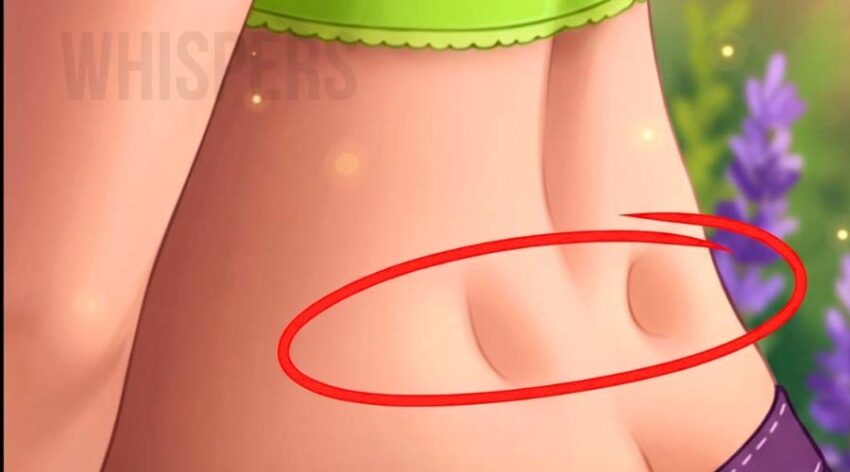
Have you ever caught a glimpse of two small, symmetrical indentations on the lower back, positioned just above the buttocks? These tiny dips are commonly known as “Venus dimples.” For centuries, they have been culturally associated with beauty, attractiveness, and vitality. Though subtle, they often capture attention because of their unique appearance.
Named after Venus, the Roman goddess of love and beauty, these dimples have long been admired in classical art and modern fitness aesthetics. But beyond their visual appeal, Venus dimples are deeply rooted in human anatomy and genetic inheritance. What exactly are they? Why are some people born with them while others are not? And do they actually indicate anything significant about a person’s health or fitness? Let’s dive into the science and history behind this fascinating physical trait.

What Are Venus Dimples? The Anatomical Facts
Medically referred to as fossae lumbales laterales (lateral lumbar indentations), Venus dimples are small depressions located on the lower back, exactly where the pelvis connects to the spine. To be specific, they form near a pair of bony landmarks known as the posterior superior iliac spine (PSIS).
These dimples are created by a short ligament connecting the skin directly to this point on the pelvic bone. When this ligament is naturally short, it pulls the skin slightly inward, creating the visible dips we recognize.
These indentations are completely natural, harmless, and a normal variation of human anatomy. While Venus dimples are most commonly discussed in relation to women’s bodies, men can have these exact same indentations. When they appear on men, they are often colloquially referred to as “Apollo holes,” named after Apollo, the Roman god of light and athletic strength.
The Role of Genetics: Why Do Some People Have Them?
The primary reason Venus dimples appear is genetic inheritance. If your parents or grandparents have them, there is a significantly higher chance that you will inherit the same anatomical structure. Much like freckles or facial dimples, you are either born with the genetic predisposition for them or you are not.
However, genetics are only part of the equation; body composition also dictates how visible they are. Because the dimples sit above a layer of fat and muscle, people with lower body fat percentages and stronger lower-back muscles tend to have more noticeable dimples.
This dual requirement—genetics plus body composition—explains why some incredibly fit individuals may never develop Venus dimples, while others naturally have prominent ones regardless of their fitness level. Without that specific underlying ligament structure, the skin simply will not pull inward.

Can Exercise Make Venus Dimples More Visible?
A widespread misconception in the fitness community is that specific core workouts can “build” Venus dimples from scratch. In reality, no exercise can magically create them. They are strictly determined by your skeletal structure and connective tissues.
However, if you do have the genetic blueprint for Venus dimples, strengthening the muscles of your posterior chain can make existing dimples appear much more defined. By reducing excess lower back fat and building the surrounding muscles, the indentations become deeper and more naturally framed.
Exercises that effectively target this region include:
- Deadlifts: Excellent for overall posterior chain development and lower back strength.
- Squats: Engages the glutes and heavily stabilizes the lower lumbar region.
- Back Extensions: Directly targets the erector spinae muscles surrounding the dimples.
- Lunges: Builds lower body stability and overall glute strength.
- Planks: Tightens the entire midsection, which helps draw attention to the lower back contour.
Ultimately, while fitness can beautifully enhance what you already have, your genetics remain the absolute deciding factor.
Are Venus Dimples Linked to Better Health?
Over the years, Venus dimples have gained an unwarranted reputation as a biological indicator of good circulation and physical vitality. Some wellness discussions even suggest that they are connected to improved blood flow throughout the pelvic region.
Additionally, a popular yet completely unproven internet rumor claims that individuals with Venus dimples experience enhanced sexual pleasure due to increased pelvic circulation.
Scientifically, there is no solid evidence supporting these claims. Medical professionals consider Venus dimples to be nothing more than a superficial anatomical feature. They are not a marker of superior health, better circulation, or enhanced physical performance. They have become indirectly associated with health simply because they are more visible on active, leaner individuals, leading to a false correlation between the dimples and overall wellness.

Venus Dimples in Art and Culture
Throughout history, physical traits that are considered rare or uniquely contoured have been celebrated as symbols of beauty. Venus dimples are a prime example.
In classical sculptures and Renaissance paintings, artists frequently emphasized the natural curves of the human body, meticulously detailing subtle elements like lower-back dimples. Their association with Venus helped reinforce the cultural idea that they represented absolute femininity, sensuality, and elegance.
Today, social media and fitness culture continue to highlight Venus dimples as an attractive physical feature. Many people proudly embrace them as a distinctive characteristic that adds individuality to their appearance. However, beauty standards evolve constantly, and features once overlooked can suddenly become viral trends. Venus dimples simply show how human anatomy is admired differently across changing cultures and generations.
Final Thoughts: Embracing Your Unique Anatomy
While Venus dimples are often praised aesthetically, not having them is completely normal. They are not an indicator of beauty, self-worth, or health status. Human bodies naturally vary in shape, bone structure, and connective tissue. The presence or absence of these lower-back indentations is just a beautiful expression of human genetic diversity.
It is important to avoid comparing yourself to unrealistic and heavily curated beauty standards online. Physical attractiveness comes in countless forms. What truly makes Venus dimples fascinating is what they represent: the unique, unchangeable blueprint of the human body. Whether you have these tiny indentations or a perfectly smooth lower back, confidence, holistic health, and self-care will always be far more important than possessing any single anatomical trait.
Disclaimer: Information is for reference only