
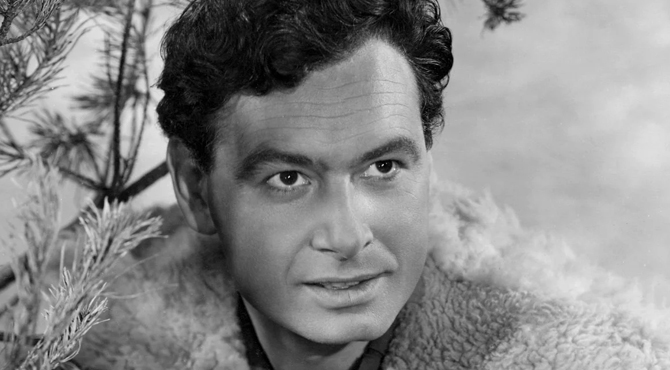
There was a particular kind of television hero who seemed perfectly suited to the years following the Second World War: brave, resourceful, athletic and determined to stand up against injustice.
For an entire generation of British television viewers, Conrad Phillips was one of those heroes.
Phillips, who died on January 13, 2016, at the age of 90, is remembered above all for playing the title character in The Adventures of William Tell, the popular television adventure series that ran in 1958 and 1959.
Yet reducing his long life and varied career to a single television role does not do justice to the man. Behind the familiar image of the crossbow-wielding Swiss hero was an actor whose life had already taken him through wartime service, theatre, British cinema, television adventure, farming and an extraordinary second act away from the spotlight.
His story was, in many respects, as adventurous as the characters he played.
From Conrad Havord to Conrad Phillips
Conrad Phillips was born Conrad Philip Havord in London on April 13, 1925. His father, Horace Havord, was a journalist and writer of detective stories. The name “Conrad Phillips” had originally been his father’s pen name, but Horace suggested that his son adopt it when he entered the acting profession.
It proved to be a name that would eventually become familiar to millions of television viewers.
Phillips experienced an unsettled childhood and was raised largely by his mother. Before he became a recognizable television star, he had already learned something about independence and resilience.
Then came the Second World War.
At just 17, Phillips joined the Royal Navy after lying about his age. His wartime service took him into the Atlantic, the North Sea and the Mediterranean. He survived the mining of a landing craft off Greece, but was eventually invalided out of the Navy after contracting tuberculosis in 1945.
Long before he picked up William Tell’s famous crossbow, Phillips had already experienced the realities of war.
Finding His Way to the Stage
After the war, Phillips turned his attention toward acting and trained at the Royal Academy of Dramatic Art, better known as RADA.
His stage career began in the immediate postwar years. He appeared in Vice Versa at the Theatre Royal, Stratford East, and was part of the premiere production of Seán O’Casey’s Oak Leaves and Lavender.
The young actor subsequently worked in repertory theatre and on the West End stage.
His first starring film role came in The Gentlemen Go By in 1948. His early years established something that would remain important throughout his career: Phillips was not simply a television personality who happened to act. He was a traditionally trained stage actor who moved comfortably between theatre, film and television.
During an era when television was establishing itself as a mass medium, performers such as Phillips often built their reputations through a mixture of stage discipline and screen work.
Television would eventually make him famous, but theatre remained an important foundation of his craft.
A Familiar Face on the Big Screen
Phillips appeared in more than 30 films during his career.
His film work included The Battle of the River Plate, Sons and Lovers and Heavens Above!, along with a number of British crime, drama and adventure pictures.
He was frequently cast as policemen, soldiers and other authoritative figures. It was a natural fit for an actor whose voice, appearance and bearing could convey confidence and determination.
But British cinema was only one part of his story.
Television was about to give him the role that would define his public image.
Becoming William Tell
Phillips had already appeared in several adventure productions before becoming William Tell.
He worked in television productions associated with the world of swashbuckling adventure, including The Scarlet Pimpernel, The Count of Monte Cristo, The Adventures of Robin Hood and The Buccaneers.
Then came The Adventures of William Tell.
The series presented the legendary Swiss hero as a classic television adventurer, battling oppression and injustice with courage, skill and a crossbow. Phillips was an ideal choice for the role.
The series ran for 39 episodes between 1958 and 1959 and made him one of British television’s early action heroes.
For viewers of the time, the appeal was immediate.
There were mountains, villains, disguises, escapes, swordplay, romance and danger. At the centre of it all was Phillips as Tell, an imposing yet sympathetic hero who represented resistance against tyranny.
The programme arrived at a particularly significant moment. Only a little more than a decade had passed since the end of the Second World War, and stories about resistance, courage and the struggle against oppression carried a special resonance.
But the series also offered something simpler and timeless: adventure.
For countless viewers, Conrad Phillips became the face of William Tell.
The Price of Playing an Action Hero
Phillips’s commitment to the role came at a considerable physical cost.
He performed many of his own stunts, and during the filming of The Adventures of William Tell he suffered a serious accident. A fall injured his ankle and knee.
The injury was so severe that he had to film the final episode while in a wheelchair.
Stunt doubles, camera angles and filmmaking techniques concealed the extent of his injuries from viewers.
The accident was only one of the physical difficulties he experienced during his career.
Phillips later suffered serious problems with his back, knees and hip. Eventually, he underwent two knee replacements and a hip replacement.
For an actor whose public identity was built around physical adventure, the consequences were particularly difficult.
More Than William Tell
One of the most interesting aspects of Phillips’s career is how much work he did outside his most famous role.
He continued to appear on television in a wide variety of productions.
He had a recurring role as Robert Malcolm in The Newcomers and later played Christopher Meadows in Emmerdale Farm. He also appeared in programmes including Cribb, The Adventures of Sherlock Holmes, Howards’ Way and Never the Twain.
His work was not restricted to adventure drama.
Phillips could play serious dramatic roles, authority figures and a wide variety of supporting characters. Yet the shadow of William Tell inevitably followed him.
Becoming closely associated with such a famous character could be both a blessing and a limitation. The role opened doors, but it also encouraged audiences to see him primarily as a swashbuckling hero.
For an actor who had spent much of his life pursuing serious theatre work, that could be frustrating.
Phillips had performed Shakespeare and worked on serious theatrical productions, but these achievements were inevitably less visible to the general public than the image of the man with the crossbow.
A Memorable Visit to Fawlty Towers
One of Phillips’s later television appearances has remained particularly memorable for comedy fans.
In 1975, he appeared in Fawlty Towers in the episode “The Wedding Party,” playing Mr Lloyd, one of the guests at the hotel.
The role was very different from William Tell.
Instead of battling tyrants and fighting for freedom, Phillips found himself caught up in one of Basil Fawlty’s increasingly ridiculous misunderstandings.
His appearance was relatively brief, but it provided a delightful reminder of the range of British performers working in television during that era.
The heroic William Tell had become part of the comic world of one of Britain’s most celebrated sitcoms.
The Stage Never Really Left Him
Although television made Phillips famous, theatre remained an important part of his professional identity.
He continued performing on stage and later worked with the English National Opera.
His theatrical work included productions connected with Mozart and Stravinsky, demonstrating once again that his interests extended well beyond the adventure roles that made him a household name.
This was an important part of his legacy.
Phillips could be the television hero fighting injustice one week and a serious stage performer the next.
His career was never simply about celebrity.
It was about acting.
The Scottish Farm
Perhaps the most surprising chapter of Phillips’s life came in the 1970s.
In 1972, he and his second wife, Jennie, bought a hill farm in south-west Scotland called Skeoch.
Phillips spent several years running the farm while continuing to accept acting work.
For someone who had spent decades in theatres, studios and television locations, farming represented a remarkable change of pace.
But it was not an easy existence.
The remote location proved difficult for a family with young children, and Phillips eventually moved with his family to Wiltshire.
Later, after filming the television adventure series Crossbow in France, he and Jennie bought a barn in Normandy and spent years converting it into a home.
Phillips’s life away from television fame was therefore almost as interesting as his years in front of the cameras.
He continued to reinvent himself.
Returning to William Tell
There was a wonderful symmetry to one of the final chapters of Phillips’s acting career.
In the late 1980s, he returned to the world of William Tell—not as the hero this time, but as Tell’s mentor, Stefan, in Crossbow, a television adaptation of the legend.
It was an affectionate return to the character that had defined his career decades earlier.
The young action hero had become the older mentor.
It was almost as though television itself had caught up with the passage of time.
His Final Screen Appearance
Phillips’s final screen appearance came in a 1991 episode of Never the Twain, the sitcom starring Donald Sinden and Windsor Davies.
By then, the physical consequences of his acting career had taken their toll.
Phillips eventually retired from acting, bringing to an end a professional career that had lasted roughly four and a half decades.
His years on screen had included adventure serials, feature films, serious dramas, comedies, soap operas and guest appearances.
But the image that remained strongest was still that of the courageous man with the crossbow.
Aiming True
Phillips eventually looked back on his extraordinary life in his 2013 autobiography, Aiming True.
The title was an obvious nod to the role that had made him famous, but the book was also an opportunity to tell the wider story of his life.
Phillips had endured an unsettled childhood, wartime service, serious illness, injuries, the pressures of being typecast and the physical deterioration that eventually forced him away from acting.
Yet he approached his past with humour and perspective.
He had lived through extraordinary circumstances, but he did not appear interested in presenting his life simply as a series of hardships.
Instead, he looked back on his experiences with the wisdom of someone who had seen the world change around him.
A Quiet Final Chapter
Conrad Phillips died at his home in Chippenham, Wiltshire, on January 13, 2016, at the age of 90, following a short illness.
His death brought to a close the life of a man who had lived through some of the most dramatic decades of the 20th century.
He had been a wartime sailor.
A stage actor.
A film performer.
A television action hero.
A sitcom guest star.
A farmer.
An author.
And, above all, a survivor.
Remembering Conrad Phillips
Today, the name Conrad Phillips may not have the immediate recognition enjoyed by some of his contemporaries. Television has changed enormously since The Adventures of William Tell first appeared.
But the disappearance of a programme from regular television schedules does not mean the disappearance of its cultural importance.
For those who remember the series, Phillips remains William Tell.
He was the man who carried the crossbow, confronted injustice and brought a sense of adventure into British homes at a time when television was still relatively young.
And there is something fitting about the fact that the actor himself had lived such an adventurous life.
He had gone to sea during wartime after lying about his age. He survived dangerous service and serious illness. He trained at one of Britain’s most respected drama schools. He built a career across stage, film and television. He endured injuries while performing action roles. He ran a Scottish farm. He restored a French barn. He wrote about his life.
Perhaps that is why the William Tell image endured so strongly.
It was not entirely an artificial creation.
There was something of the adventurer in Conrad Phillips himself.
His career also reminds us of something easily forgotten about classic television: many of its stars were working actors rather than modern-style celebrities. They moved from theatre to television, from serious drama to comedy, from film to guest appearances, and then quietly moved on to the next chapter.
Phillips was one of those performers.
He did not need to dominate headlines for decades to leave a lasting impression.
For one generation, he was William Tell.
For another, he was the actor who appeared in Fawlty Towers, Emmerdale Farm, The Newcomers and numerous other productions.
For theatre audiences, he was a classically trained performer.
And for those who knew his later story, he was a man who continued to find new adventures long after the cameras stopped rolling.
His Enduring Legacy
The passing of Conrad Phillips marked the end of a remarkable life, but it did not erase the image he left behind.
When viewers remember the classic television adventures of the 1950s, they remember a period when heroes could be larger than life, when a crossbow could become a symbol of resistance, and when a television actor could become part of the childhood memories of an entire generation.
Phillips gave William Tell dignity, courage and physical presence.
But perhaps his greatest legacy lies beyond the famous character.
It lies in the sheer variety of his life.
He was never only William Tell.
He was Conrad Phillips—a London-born actor who went to war as a teenager, found his way onto the stage, built a long career in British film and television, endured the physical price of action roles, embraced an unconventional life away from the spotlight and ultimately left behind a story far more expansive than the character for which he is best remembered.
He died at 90, but the archer still stands in the memory of classic television.
The crossbow is raised.
The arrow is aimed.
And Conrad Phillips, in the role that made him famous, remains forever ready to fire.
That is how many viewers will remember him.
And perhaps, for an actor who spent so much of his life aiming true, that is a fitting legacy.