
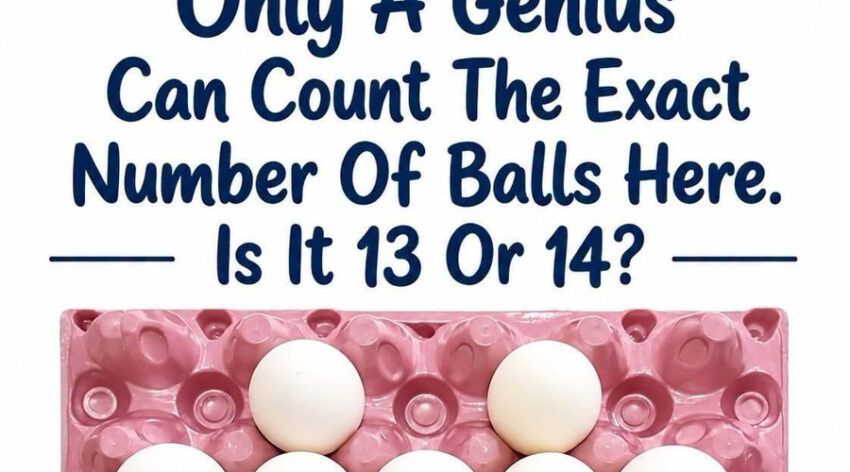
The answer is 16—not 13, and not 14. Counting from top to bottom, the five rows contain 2, 5, 2, 5, and 2 balls. Add those numbers together, and neither suggested answer survives. The empty spaces interrupt the arrangement, making a quick scan less reliable than it feels. A steadier approach is to move left to right across each row, counting every ball once before moving down. If your totals disagree, start over rather than forcing your count to match an option.
That is what makes this challenge satisfying: the misleading choice matters as much as the picture. Once two numbers are offered, it is tempting to assume one must be right. Choosing either does not mean you are bad at counting; it means the framing caught your attention. The takeaway is simple: check the evidence before accepting the options. Sometimes the correct answer was never on the menu.
The most useful way to approach this picture is to set the two proposed answers aside for a moment. Start at the top edge of the arrangement and identify the first complete row. Count that row before moving your eyes downward. The first row contains two balls. The next contains five. Keeping those groups separate makes it easier to see that the pattern alternates rather than forming one continuous block.
The middle row contains two balls, followed by another row of five and a final row of two. Written as a sum, the arrangement is 2 + 5 + 2 + 5 + 2. You can check the same result by combining the two longer rows first: five plus five gives ten. The three shorter rows contribute two each, adding another six. Ten plus six gives sixteen.
That second method provides a useful check because it does not rely on repeating exactly the same eye movement. If you simply scan the whole image again, it is easy to repeat an earlier omission. Grouping the equal rows asks a different question: how many groups are there, and what does each group contain? Here, both methods lead to the same total.
The empty spaces are part of the puzzle’s visual effect. They separate some balls while allowing others to appear clustered together. Your attention can jump from one cluster to another and leave a small group uncounted. Slowing down is enough to remove much of that confusion; there is no need to accept thirteen or fourteen just because those are the numbers presented.
The final answer remains sixteen. The challenge rewards careful observation and an independent check of the choices. Before choosing an answer in a visual puzzle, make sure the proposed options actually include the result you can demonstrate from the image.
A careful count should also stop at the boundary of each row. If you lose your place, return to that row rather than guessing a total from memory. The arrangement is small enough to check completely, and the repeated groups make the arithmetic transparent. Sixteen is supported by every row, while the two offered alternatives are not.