
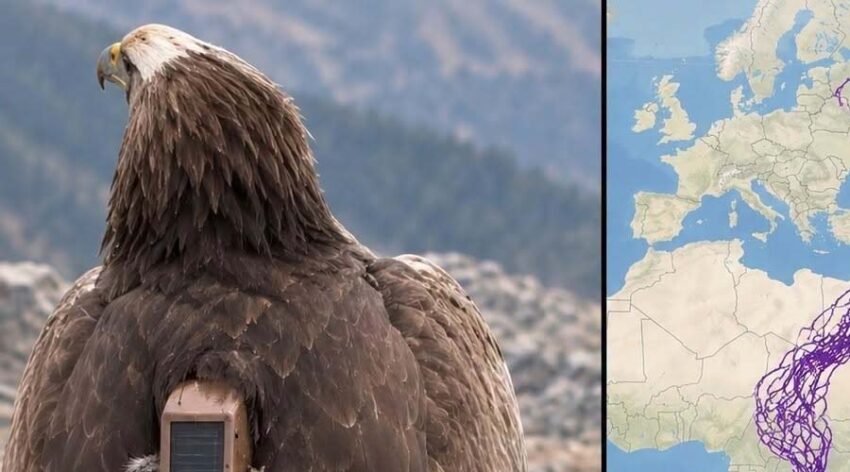
A remarkable collection of eagle migration routes once left people fascinated by what appeared to be an impossible journey. The complicated lines crossed countries, deserts, mountains, and coastlines, revealing a world of movement that humans rarely get to witness. But behind the viral story was an even more compelling scientific truth: migrating eagles are remarkable navigators whose journeys are shaped by wind, geography, survival instincts, and an extraordinary ability to respond to changing environments.
Imagine standing on a remote hillside just as the morning sun begins to rise.
The air is cool, the landscape is quiet, and somewhere high above the ground, a magnificent eagle spreads its wings. With barely a movement, it catches a rising current of air and begins to climb.
Within minutes, the bird becomes little more than a dark silhouette against the sky.
To someone watching from below, there is no way to know where it is going.
Perhaps it will travel only a few miles before finding food. Perhaps it will cross a mountain range, follow the edge of a desert, or continue toward a distant coastline. If the season is changing, it may be beginning a journey that will eventually carry it across national borders and enormous stretches of unfamiliar territory.
For centuries, much of this movement remained hidden from human observation.
People watched birds appear in spring and disappear in autumn, but the details of their journeys were often mysterious. Where did they spend the intervening months? What guided them through unfamiliar landscapes? How did they overcome natural obstacles without maps, roads, or human-made navigation systems?
Modern tracking technology has begun answering these questions.
And in doing so, it has revealed that migration is far more complicated than a simple journey between two points.
One widely shared eagle migration map became particularly famous because of the extraordinary network of routes displayed across a vast region.
The image was often described as the twenty-year journey of a single eagle.
In reality, fact-checking traced the map to movements of multiple tracked eagles over a much shorter period. Yet the truth remains fascinating. Each line represents an animal making its way through a world of changing conditions, encountering challenges that cannot be fully understood from a static map.
The scientific story behind such journeys is not about one bird mysteriously breaking every known rule of migration.
It is about how much remains to be learned from the astonishing movements of wild animals.
The Mystery Behind a Map That Captured the World’s Attention
When the eagle migration map circulated online, it immediately attracted attention.
The routes formed a dense network of lines extending across large geographical areas. Instead of resembling a neat highway connecting northern and southern destinations, the tracks curved, diverged, overlapped, and appeared to move in unexpected directions.
For many viewers, the image raised an intriguing question.
Why would a bird travel such an enormous distance without following a straightforward route?
Some lines appeared to bend around geographical obstacles. Others extended through areas that looked empty on an ordinary political map.
To someone unfamiliar with migration science, the movements might have seemed almost random.
But there is a fundamental difference between a route appearing unpredictable to humans and a route being biologically meaningless.
A political map shows countries, borders, cities, and roads.
A migrating eagle experiences an entirely different landscape.
Its world is shaped by rising air, shifting winds, mountain slopes, available prey, weather systems, and suitable places to rest.
The shortest route on a map may not be the easiest route through the sky.
A journey that looks unnecessarily long may allow a bird to avoid exhausting conditions. A curved path may take advantage of favorable winds. A pause in an apparently unremarkable location may correspond to an important feeding area.
This distinction is essential.
Scientists do not interpret animal movement simply by looking at lines on a map. They compare movement records with environmental information, individual behavior, and the physical challenges encountered along the route.
And even then, some questions remain unanswered.
The famous eagle map illustrates both the power and the limitations of tracking technology.
It can tell researchers where a bird traveled.
Understanding precisely why the bird made every turn is a much more demanding task.
How Scientists Follow Birds Across Thousands of Miles
The ability to track a wild eagle would have seemed almost magical to naturalists living only a century ago.
Early migration research depended heavily on observation, recovered bird rings, reports from distant locations, and careful comparisons of seasonal populations.
These methods produced valuable discoveries, but they left enormous gaps.
A bird might be marked in one country and later recorded thousands of miles away. Researchers could identify two locations, but the actual journey between them remained largely unknown.
Satellite telemetry helped transform this field.
Today, scientists can attach carefully designed tracking devices to suitable birds under approved research protocols. Depending on the equipment, these devices can record locations, movement patterns, altitude, and other information.
Some transmitters communicate through satellite networks. Others use mobile communication systems when coverage is available.
The resulting data can reveal where birds travel, how quickly they move, where they stop, and whether they return to particular regions.
Instead of studying only the beginning and end of a migration, researchers can examine sections of the journey in remarkable detail.
Nevertheless, attaching a tracker is only the beginning.
Researchers must consider the bird’s welfare, the weight and fit of the equipment, the transmitter’s lifespan, and the reliability of the collected information.
Tracking records may contain gaps because of limited battery power, communication failures, difficult terrain, or periods without a usable signal.
A sudden change in recorded location does not automatically indicate unusual animal behavior. Data quality must be examined before scientists draw conclusions.
But when reliable movement records are combined with meteorological observations and ecological research, they create an extraordinary window into the lives of migratory birds.
A collection of geographical coordinates becomes something far more meaningful.
It becomes evidence of how an animal interacts with the natural world.
A Journey That Does Not Always Follow the Shortest Route
One of the most surprising lessons from bird migration research is that efficiency does not always mean traveling in a straight line.
Imagine two routes to the same destination.
The first is shorter but requires a bird to fly against strong winds, cross a wide stretch of water, and spend long periods flapping its wings.
The second is longer but passes through areas where rising air provides lift and suitable feeding or resting opportunities may be available.
For a large soaring bird, the longer route may sometimes be more economical.
Eagles and other soaring raptors are especially influenced by the atmosphere.
Rather than relying entirely on continuous wingbeats, many of these birds use naturally occurring air currents to remain aloft.
Warm air rising from the ground can form columns known as thermals.
When an eagle finds one, it may circle upward, gaining altitude while conserving energy. Once sufficiently high, it can glide forward until another useful current becomes available.
In mountainous regions, wind striking a slope can also create rising air.
This phenomenon, known as orographic lift, provides another opportunity for soaring birds to gain or maintain altitude.
These invisible features of the atmosphere help explain why eagle migration routes can differ from the paths people might choose when looking at a map.
A scientific study of migrating golden eagles demonstrated that the birds adjusted their use of thermal and slope-generated lift in response to changing wind conditions.
The study involved ten tracked golden eagles, not a single bird monitored for twenty years, and it provided evidence of highly responsive flight behavior.
PMC
+1
The important lesson is that birds do not travel through a passive environment.
The atmosphere is constantly moving.
And a skilled soaring bird must respond to that movement.
A route that appears indirect from the ground may make sense when viewed through the conditions experienced in flight.
Mapping a Lifetime of Flight
The Invisible Highways Above the Earth
Human beings tend to think of geography in terms of visible objects.
We recognize rivers, mountain ranges, highways, deserts, and oceans.
But for migrating birds, some of the most important features of the landscape cannot be seen.
Air itself becomes a kind of highway.
A thermal rising above sun-warmed terrain can provide temporary support. A mountain ridge can create a predictable area of uplift. A favorable tailwind may increase the distance a bird can cover while using less energy.
These atmospheric conditions influence not only the direction of travel but also the timing.
An eagle may benefit from waiting until conditions improve rather than immediately continuing its journey.
On another day, favorable weather may allow it to travel much farther.
Migration therefore involves a combination of movement and restraint.
Knowing when to continue can be as important as being physically capable of flying.
Scientific research into raptor movement repeatedly demonstrates the importance of wind and geography.
One study examining grey-faced buzzards migrating through East Asia found that islands and favorable winds helped shape their oceanic migration routes.
The birds crossed stretches of open water that could reach hundreds of kilometers, showing how geographical stepping stones and atmospheric support can work together.
PMC
Although buzzards and eagles are different birds, research of this kind helps scientists understand broader principles affecting soaring migrants.
It also explains why a seemingly strange bend in a flight path might be perfectly understandable once the relevant environmental information is included.
What appears to be a detour may be part of an energy-saving strategy.
What appears to be hesitation may reflect the conditions needed for a safer crossing.
And what seems to be a completely unexpected destination may provide resources that are invisible on a conventional map.
Why Oceans Can Become Enormous Obstacles
Consider a large eagle approaching the edge of a coastline.
Beyond the shore lies an expanse of water.
To a human observer, flying across it may appear straightforward. Birds have wings, after all.
But the physics of flight makes the situation more complicated.
Many large raptors depend heavily on rising air over land.
Warm ground surfaces produce atmospheric conditions that often support thermal soaring. Over broad stretches of water, particularly cooler seas, such thermal support may be weaker or less dependable.
Consequently, certain soaring birds tend to avoid unnecessarily long water crossings.
Some migration routes become concentrated around narrow straits or land bridges where birds can cross with reduced exposure to unfavorable conditions.
This can create spectacular gatherings of migrating raptors.
A geographical feature that might look like a minor detail to humans can become critically important to thousands of birds moving between seasonal habitats.
Researchers have documented the influence of winds on eagle migration near the Strait of Gibraltar, highlighting how different raptor species respond differently to challenging conditions.
iris.polito.it
Yet the ocean is not an absolute barrier.
Some birds are capable of remarkable long-distance crossings.
Research on migrating ospreys found that these birds could exploit thermal uplift even over sections of open sea, although the conditions differed from those over land.
PMC
The lesson is not that all birds follow the same method.
Quite the opposite.
Different species possess different physical abilities and migration strategies.
Even within a species, individual circumstances can influence movement.
The sky is not a uniform surface, and every journey presents a changing collection of opportunities and risks.
How Weather Can Rewrite a Migration Route
If migration were controlled by a perfectly fixed internal schedule, researchers might expect birds to follow nearly identical paths regardless of conditions.
But real environments are too variable for such a simple picture.
One season may bring favorable winds.
Another may bring repeated storms, unusual temperatures, or dry conditions that change the availability of food.
Even within a single day, the atmosphere may behave differently from what a bird experienced hours earlier.
A soaring eagle traveling across a mountain region may encounter strong upward winds on one slope and less favorable conditions on another.
A broad weather system may encourage movement in a different direction.
Poor conditions may force an extended stop.
When researchers examine migration data, these changing circumstances matter enormously.
It is tempting to describe every unusual turn as evidence that a bird made a brilliant decision.
However, science requires more careful interpretation.
Some movement changes may reflect active behavioral adjustments, while others may result partly from wind drift or other physical influences.
Scientists investigate these possibilities by comparing recorded locations with weather data, flight characteristics, and habitat conditions.
The complexity is precisely what makes this research fascinating.
Migration is not merely a question of knowing where to go.
It is also a continuous interaction between an animal and its surroundings.
The bird brings its abilities and behavioral tendencies.
The environment supplies changing constraints.
And the final route emerges from the interaction between the two.
The Importance of Food Along the Way
Long-distance travel requires energy.
For a migrating eagle, finding suitable food can affect its condition and its ability to continue moving.
Different eagle species have different diets and hunting strategies. Some take live prey, while others may make extensive use of carrion or other available food resources.
These differences influence how birds interact with the landscapes they cross.
A productive hunting area may provide an opportunity to replenish energy reserves.
A region that appears empty on a map may contain prey or other resources during a particular season.
Conversely, an area that provided suitable conditions in one year may become less productive following drought, habitat changes, or other environmental disturbances.
Scientists studying movement patterns therefore often consider the ecological characteristics of areas where tracked birds spend time.
A pause in travel may be associated with feeding.
But researchers must be cautious about assuming that every stop has one obvious explanation.
A bird might also be resting, avoiding unfavorable weather, or engaging in behavior that cannot be determined from location data alone.
This uncertainty does not diminish the value of tracking research.
Instead, it reminds us that a GPS location is a clue rather than a complete account of an animal’s experience.
Understanding migration requires connecting those clues with the broader ecology of the species.
Why Mountains and Deserts Shape Migration
Mountains and deserts often appear as dramatic features on maps of bird migration.
They can also create very different challenges.
Mountain ranges may offer useful rising air along certain slopes, but they can expose birds to difficult winds, severe weather, and high elevations.
Deserts may offer wide open spaces and strong thermal conditions while presenting challenges related to food availability, heat, and places to rest.
A migrating bird moving through such environments must contend with multiple pressures.
The shortest geographical distance may involve crossing an area where conditions are demanding.
An alternative route may be longer but pass through more favorable terrain.
For example, research involving migratory raptors crossing the Himalayan region has shown how geography and prevailing winds can help explain routes that might otherwise seem surprising.
Scientific Reports
The mountain landscape becomes more than an obstacle.
It becomes part of the decision-making environment.
Wind direction, elevation, and the arrangement of suitable habitat all contribute to the journeys scientists observe.
This is one reason migration maps are so valuable.
They allow researchers to examine where movement corridors intersect with difficult natural terrain.
They can also reveal areas that may deserve greater attention because of their importance to traveling birds.
A remote mountain passage or a relatively narrow stretch of land may play an outsized role in the survival of a migrating population.
The Difference Between Instinct and Learning
One of the most interesting questions in migration science concerns how birds know where to go.
Migration involves biological mechanisms that have developed over many generations.
Inherited tendencies can influence the timing and direction of seasonal movement.
But behavior is not necessarily limited to a rigid set of instructions.
For some birds, experience can also play a role.
An individual may encounter different conditions as it matures. Its future movements may reflect not only inherited behavior but also information gained through earlier journeys.
Scientists study such questions by comparing birds of different ages and examining repeated journeys by the same individuals when suitable tracking data are available.
Research involving Eastern Imperial Eagles in Central Asia has documented differences in movement patterns between an adult and younger tracked birds, including more efficient travel by the adult in that study.
U.S. Geological Survey
This does not prove that every difference was caused by learning.
Experience, physical development, environmental conditions, and individual variation may all contribute.
Nevertheless, the findings help reveal the complexity of migration.
A young bird encountering unfamiliar terrain may face a very different challenge from an experienced adult returning to regions it has visited before.
Migration can involve both inherited biological tendencies and behavior shaped by circumstances.
It is neither a completely automatic process nor necessarily a series of fully conscious choices.
The reality is more interesting than either extreme.
Can Birds Really Make Decisions While Flying?
When people see complicated migration routes, they often describe the birds as intelligent.
There is good reason to admire their abilities.
A bird traveling across thousands of miles must coordinate movement, orientation, energy expenditure, and responses to changing conditions.
But scientific language matters.
Researchers distinguish among instinctive behavior, sensory responses, learning, flexible behavior, and different forms of cognition.
Not every successful adjustment proves deliberate planning in the human sense.
A bird may change its flight pattern because of immediate atmospheric conditions without mentally calculating a complete route.
On the other hand, repeated successful movement through complicated environments may involve memory, experience, and sophisticated behavioral abilities.
Scientists continue investigating how different species integrate information.
The most important point is that animals are not merely passive objects being carried across the planet.
Their behavior interacts dynamically with environmental conditions.
They respond to opportunities and constraints, and their movements can be remarkably effective.
Calling this process simply instinct may overlook its complexity.
Calling every maneuver conscious strategy may go beyond the evidence.
The challenge for researchers is to understand the mechanisms as precisely as possible.
That challenge has produced some of the most exciting developments in modern movement ecology.
When a Map Tells Only Half the Story
Imagine looking at a migration map covered with hundreds of lines.
It may be tempting to find the most unusual-looking section and build a dramatic explanation around it.
Perhaps a bird seemed to reverse direction.
Perhaps its route passed near the same location several times.
Perhaps it avoided a major geographical feature.
But a map usually cannot reveal every relevant detail.
Its appearance depends on the number of birds included, how often their positions were recorded, the dates covered, and the way the data were displayed.
Combining tracks from many individuals can create a complex picture that resembles the travels of one exceptionally restless animal.
That was an important issue with the viral map described as a single eagle’s twenty-year journey.
The circulating story was misleading because it confused the movements of multiple eagles with the lifetime travel of one bird.
The real tracking work was still scientifically meaningful, but its interpretation changed dramatically when the correct context was restored.
This offers a broader lesson about wildlife stories shared online.
Extraordinary images do not always require extraordinary explanations.
Sometimes the truth is already fascinating enough.
A group of eagles moving through enormous geographical regions is a remarkable subject without adding an unsupported twenty-year timeline.
And the scientific insights are more valuable when the original observations are described accurately.
Lessons From a Master Navigator
Why Migration Research Matters More Than Ever
Understanding bird movement is not simply a matter of satisfying human curiosity.
The information can have major conservation implications.
Migrating birds may depend on a network of habitats spread across several countries.
Their breeding areas may be protected, but that protection alone may not be sufficient if important feeding grounds or movement corridors are threatened elsewhere.
A bird that travels enormous distances encounters many different landscapes and forms of human activity.
Some of these environments are changing rapidly.
Habitat loss can reduce access to suitable resting or feeding areas.
Changes in land use can alter prey availability.
Power infrastructure and other developments can introduce collision or electrocution hazards for some raptor species.
Climate change may influence seasonal weather patterns, habitat conditions, and the availability of resources.
The consequences vary considerably between species and regions, but the overall challenge is clear.
A migratory animal depends on more than one location.
Its survival may be connected to environmental conditions across a very large geographical area.
Tracking data help scientists identify where birds spend time, which corridors they use, and where they may encounter particular risks.
Such information can inform conservation planning, environmental assessments, and international cooperation.
In some cases, protecting a relatively small but strategically important region may benefit birds traveling across an entire continent.
This is one of the most powerful contributions of modern wildlife tracking.
It turns invisible journeys into information that people can use to make better decisions about conservation.
The Unexpected Connection Between Migration and Climate Change
Climate change introduces another layer of complexity to the study of migration.
Seasonal conditions are important to many migratory species.
Temperature, rainfall, wind, and food availability can all influence when and where suitable conditions occur.
When these environmental patterns change, the challenges encountered by birds may change as well.
Some species may be capable of adjusting aspects of their behavior.
Others may be constrained by breeding requirements, habitat needs, or established seasonal patterns.
Behavioral flexibility can sometimes help animals respond to new conditions, but it should not be mistaken for immunity to environmental change.
An eagle may adjust a flight route in response to wind, yet still depend on suitable breeding habitat and sufficient food.
Even highly mobile species cannot simply overcome every ecological disruption by traveling farther.
This is why migration research is so valuable.
Long-term observations, reliable tracking records, and environmental data can help researchers investigate whether movement patterns are changing over time.
Scientists can explore shifts in seasonal timing, differences in habitat use, or altered responses to weather.
But understanding these changes requires careful comparisons.
A single unusual journey does not automatically demonstrate a climate-related trend.
Researchers need sufficient evidence to distinguish normal variation from persistent environmental effects.
The more accurately scientists understand migration today, the better equipped they become to recognize meaningful changes in the future.
A Bird’s Journey Can Connect Entire Ecosystems
One of the most remarkable aspects of migration is the way it connects distant places.
A single bird may depend on landscapes that appear completely unrelated to one another.
A northern breeding region, a mountain passage, an agricultural landscape, a desert-edge feeding area, and a distant wintering ground may all form part of its annual life cycle.
To humans, these places may belong to different countries, cultures, and political systems.
To the migrating animal, they are connected through the physical requirements of survival.
This perspective changes how we think about conservation.
Protecting nature cannot always be accomplished by drawing a boundary around one beautiful landscape.
For migratory species, the connections between locations may be just as important as the locations themselves.
A region that seems unremarkable may provide seasonal resources at a critical moment.
A narrow passage may allow birds to avoid a dangerous crossing.
A protected habitat in one country may support animals that spend much of the year elsewhere.
Migration shows that ecosystems are linked through movement.
It also reminds us that animals experience the planet differently from humans.
Political boundaries may matter enormously to people, but an eagle is responding to geography, weather, habitat, and biological needs.
Its journey can cross borders without recognizing them.
The responsibility for protecting migratory wildlife, however, often requires cooperation between the people living on both sides.
What Technology Still Cannot Tell Us
Despite the remarkable progress of GPS tracking, there are limits to what scientists can learn from location data alone.
A device may show that an eagle traveled a particular distance.
It may reveal changes in speed and direction.
It may even help researchers identify likely soaring behavior when suitable measurements are available.
But the data do not provide direct access to the bird’s thoughts.
They cannot automatically explain every pause, detour, or change in direction.
To investigate those questions, researchers may combine tracking with behavioral observations, environmental measurements, ecological surveys, and statistical models.
Sometimes the evidence supports a strong conclusion.
At other times, several explanations remain possible.
This uncertainty is not a weakness of science.
It is part of the process through which scientific understanding improves.
The original eagle migration story became popular because the routes looked mysterious.
Yet a carefully researched explanation can be just as extraordinary as the mystery itself.
Wind patterns, energy conservation, feeding opportunities, habitat conditions, and individual differences can interact to create routes that are difficult to predict from a simple map.
The movements become more understandable when the relevant ecological information is added.
Even then, nature retains unanswered questions.
Every new set of reliable observations can reveal something researchers had not fully appreciated before.
The Value of Looking Beyond First Impressions
There is a broader lesson hidden within the complicated lines of a migration map.
Human beings often search for simple patterns.
We expect direct routes, familiar routines, and clear explanations.
When something seems to violate those expectations, we may assume it is chaotic or irrational.
But complexity is not the same as disorder.
A route that appears confusing on a two-dimensional map may reflect perfectly understandable responses to conditions that the map does not display.
A pause that looks unimportant may be associated with food or weather.
A long detour may help avoid a demanding natural obstacle.
What we see depends on the information available to us.
This principle reaches far beyond migration research.
Natural systems often involve relationships that are difficult to recognize without careful observation.
A change in one part of an ecosystem can influence another.
Weather can affect animal movement.
Animal movement can connect habitats.
Habitat conditions can shape survival and reproduction.
Understanding these relationships requires patience and a willingness to question first impressions.
The eagle migration map became famous because it offered an unexpected view of a familiar creature.
But its deeper significance comes from the scientific effort to interpret that view accurately.
The Quiet Strength of Adaptation
There is something profoundly moving about imagining a wild eagle traveling across an immense landscape.
It does not possess the protective infrastructure that humans rely upon.
There are no airports arranged for its convenience, no weather forecasts displayed before its eyes, and no guaranteed places to stop.
Its journey depends on physical adaptations, sensory abilities, behavioral patterns, and environmental conditions shaped by natural processes.
Sometimes those conditions are favorable.
Sometimes they are demanding.
Successful migration requires an animal to function within this changing world.
The ability to respond flexibly can be valuable, although each species has its own limitations.
For humans, the image of an eagle adjusting its route offers a powerful metaphor.
Progress does not always resemble a straight line.
Sometimes reaching a destination requires changing direction, responding to circumstances, or using resources that were not obvious at the beginning.
But the biological reality deserves appreciation independently of the metaphor.
An eagle’s movements are not designed to teach human beings life lessons.
They are part of the animal’s natural history.
And that natural history is remarkable enough to inspire wonder.
Why We Should Protect the Paths We Cannot See
Most people will never witness the full migration of an eagle.
They may see one soaring over a field or disappearing beyond a mountain ridge.
They may visit a nature reserve and glimpse a bird passing overhead.
What they cannot see is the immense geographical network that may connect that moment to distant places.
Tracking technology reveals those hidden connections.
It shows that protecting migratory wildlife requires thinking on a larger scale.
A healthy breeding site is important.
So are the habitats encountered during travel and the conditions at seasonal destinations.
Where research identifies serious threats, conservation efforts can become more targeted.
This may involve protecting important habitats, reducing risks associated with human infrastructure, or improving cooperation across borders.
Not every problem has a simple solution.
But reliable scientific information gives conservation planners a stronger foundation for action.
The more we understand about animal movement, the less likely we are to overlook areas that matter.
And the more carefully we verify extraordinary wildlife claims, the more clearly genuine scientific discoveries can receive the attention they deserve.
The Bigger Picture: Nature Is More Connected Than We Imagine
The story of the eagle migration map began with a striking visual mystery.
A network of complicated lines appeared to show an extraordinary journey across continents.
The popular explanation exaggerated what the original data represented.
Yet correcting that claim does not make the underlying science less impressive.
In many ways, it makes the story more meaningful.
Instead of imagining one bird traveling unpredictably for twenty years, we can appreciate the movements of multiple wild eagles and the ecological questions raised by their journeys.
We can recognize how wind, topography, food, weather, and experience may influence migration.
We can understand why the easiest route through the atmosphere may not be the shortest line on a map.
And we can see how modern tracking helps scientists connect individual movements to broader conservation challenges.
Perhaps the most important discovery is not that eagles behave in ways humans find mysterious.
It is that their behavior belongs to a remarkably complicated natural system that we are only beginning to understand in detail.
A soaring bird may appear small against the open sky.
Its connection to the world is anything but small.
The conditions beneath its wings may have developed hundreds of miles away. The habitats it depends upon may be separated by deserts, mountains, seas, and national borders. Its successful journey may rely on a combination of biological abilities and environmental opportunities that people on the ground never notice.
Every movement reveals another piece of this connection.
And every carefully interpreted tracking record offers an opportunity to understand it better.
Final Thoughts: The Most Extraordinary Truth Was Already in the Sky
The appeal of the famous eagle migration story is easy to understand.
People are drawn to extraordinary journeys, unexpected discoveries, and the idea that nature contains secrets hidden in plain sight.
A bird crossing immense distances without a human-made map seems almost impossible when considered from our everyday perspective.
Yet such journeys are real.
Across the planet, migratory birds navigate environments that can change dramatically from one day to the next.
They encounter shifting winds, difficult terrain, seasonal variations, and natural barriers.
Their movements reflect the astonishing relationship between living creatures and the world around them.
The lesson from eagle tracking research is not that science has discovered an animal capable of ignoring every rule.
It is that the rules governing natural movement are more complex than they first appear.
And sometimes, the most valuable discovery begins when researchers recognize that a familiar explanation is incomplete.
A line on a map is more than a record of distance.
It represents an animal moving through a living, changing environment.
Behind each curve may be a different combination of weather, geography, and biological behavior.
Behind every completed migration lies a remarkable natural process.
In the end, the greatest wonder is not that an eagle could travel so far. It is that the sky, the land, and the living world are connected in ways we are still learning to see.
Scientific references
The expanded article draws on published research about raptor migration, atmospheric conditions, satellite tracking, and conservation:
U.S. Geological Survey — Movements and Landscape Use of Eastern Imperial Eagles in Central Asia.
Flight Responses by a Migratory Soaring Raptor to Changing Meteorological Conditions.
Raptor Migration in an Oceanic Flyway: Wind and Geography Shape Migratory Routes.
Scientific Reports — GPS Telemetry and High-Elevation Raptor Migration.
Fact Crescendo — Verification of the Viral Eagle Migration Map.
Virals