
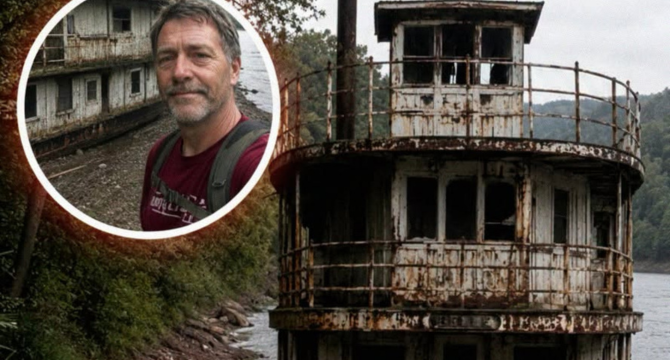
I am 48 years old, and for a long time, my life felt like something that had been dropped too many times and glued back together wrong.
My name is Michael. Three years ago, the state took my youngest daughter. Before that, I buried my oldest.
Before that, I buried my wife.
If you met me last month, you probably would have remembered the boots first. Split leather, always muddy. Then maybe the smell of dish soap from my night job or motor oil from the garage where I did cash repairs.
I worked construction during the day, washed dishes three nights a week, and on weekends, I went into the woods to collect mushrooms I could sell to neighbors and a guy at the Saturday market who never paid what they were worth.
That was my life. Work. Debt. Paperwork. Visits with my daughter Rosie under fluorescent lights. Promises I kept making because I did not know what else to give her.
My wife, Sarah, died 12 years ago.
She was seven months pregnant when a truck ran a red light and hit her car broadside. I was home packing lunches when the police knocked. I remember thinking it had to be for the neighbors. I remember one officer holding his hat in both hands.
I remember him saying, “Mr. Turner, there’s been an accident,” and me saying, “No, there hasn’t,” like I could veto reality if I said it firmly enough.
Sarah died that afternoon. So did our son.
Emily was ten then. Rosie was five. That first year after Sarah died, I learned how to braid hair badly, how to sign school forms in a waiting room, how to cry in the shower without making noise, and how to stand in a grocery store adding numbers in my head while pretending not to notice when my kids put things back on the shelf for me.
We got through it. Not well. But we got through it.
Then Emily got sick.
It started with bruises and tiredness. Then fevers. Then blood tests. I still remember the doctor folding his hands before he spoke. That was when I knew. Nobody folds their hands to tell you good news.
Leukemia.
Emily was 12 when they diagnosed her. She was 14 when she died.
People say things like, “She fought so hard.” She did. But what I remember most is how careful she became with money, like she could feel what it was doing to us. Once, during chemo, she touched my jacket pocket and said, half joking, “Did you pay for parking again? Dad, that’s such a scam.”
I laughed because she wanted me to laugh.
A few months later, she whispered, “I’m sorry I cost so much.”
I stood up so fast my chair scraped the tile.
“Don’t say that again.”
She flinched. Not because I scared her. Because she realized it was true enough to hurt me.
I sat back down and took her hand. “You hear me? I’d sell the sky if I could. You are not the problem.”
But love does not beat biology, and debt does not buy miracles. Emily died in March while the heat rattled in the hospital vents, and I was holding a cup of coffee I never got to drink.
After that, everything that had been held together by stubbornness came apart.
I missed work. Then I worked too much. Bills piled up. Rent slipped. Rosie missed school for a week because the power got shut off, and she got bronchitis in a cold apartment. Somebody reported us.
Then social services came.
The woman who handled our case was named Andrea. She was not cruel, which somehow made it worse.
She stood in my kitchen with her clipboard and said, “Mr. Turner, this is not a permanent removal if you can stabilize housing and income.”
I said, “She has a bed.”
Andrea looked at the living room, where the ceiling had water stains, and one corner of the plaster was peeling away.
“She needs more than a bed.”
Rosie stood in the hallway listening. When they took her, she wrapped herself around me so hard I almost lost my balance.
“Daddy, no,” she cried. “I’ll be good. I’ll be good.”
“It’s not that. Rosie, look at me.”
She was shaking too hard.
I held her face in both hands. “I am getting you back. You hear me? This is not forever.”
She turned 13 last month. By then, “not forever” sounded like one more adult phrase that meant nothing.
I rented a single room behind a mechanic’s shop and worked constantly. On weekends, I went into the woods because mushrooms were one of the few things the forest would still give me for free.
The Saturday I found the boat, I had just come back from a supervised visit with Rosie.
I’d brought her a used sketchbook and good pencils I could barely afford. She hugged them and smiled, and for a second, I saw my little kid again. Then she asked, “When am I coming home for real?”
I told her, “Soon.”
She looked down at the pencils. “You always say that.”
I had no answer that wouldn’t break us both.
So the next morning I went farther into the woods than usual, half because I was chasing chanterelles and half because I could not stand being near my own thoughts. It had rained overnight. The ground was slick and black. Water dripped from the pines. I crossed the ridge I usually turned back at and kept going until I heard river water.
I had never been to that stretch before.
The river was wide and slow, with reeds thick along the edge. On the mudbank, half sucked into the shore, was a small rusted boat. It looked like it had been there longer than I’d been alive. The hull was eaten up with corrosion. One of the windows was gone. Somebody had covered the inside with spray-painted names and dates.
I climbed aboard because I was curious and because there are moments when a man with nothing starts acting like danger might at least be a distraction.
The boat groaned under my weight. Inside smelled like wet metal and old leaves. I checked under a bench, kicked aside some trash, and found nothing but more evidence that bored teenagers had discovered it before me.
I was about to leave when I noticed a square seam low in the rear wall, almost hidden under rust. A little metal hatch.
I pressed on it. Nothing.
I braced my boot, shoved with my shoulder, and the hatch suddenly gave with a crack that made me curse out loud.
Behind it was a narrow compartment. Inside that compartment sat a metal box wrapped in rotting oilcloth.
I just stared at it.
My first thought was drugs. My second was a gun. My third, embarrassingly, was that I had finally gone crazy and the woods were starting to hand me prophecies.
The box was heavy. I carried it to the nearest dry patch of floor, pulled out my pocketknife, and worked at the corroded latch until it snapped.
Inside were bundles wrapped in wax paper.
Cash.
Under the cash was a leather pouch full of gold coins and a tin case with papers sealed in old plastic. I remember my hands going cold. I remember checking over my shoulder, even though I was alone. I remember saying, “No. No way.”
The papers were old letters, a faded map, and one handwritten note: If somebody honest finds this, use it better than we did.
There were names at the bottom and enough detail in the letters to suggest the money had something to do with river smuggling in the 1960s. Two brothers. One dead. One may be in prison. Cash hidden after a deal went bad.
I should tell you my first instinct was to march that box to the sheriff.
It wasn’t.
My first instinct was Rosie.
I got the box home and spread everything out on the table in my rented room. I counted the cash twice. I won’t name the number because people get weird around money, but it was enough to change a life if handled right.
Maybe more than one.
I also knew enough to understand that “found a fortune in an abandoned boat” sounded exactly like the kind of sentence that gets a poor man arrested.
The only person I trusted with it was Walter, who owned the pawn shop on Main. Walter is one of those men who insults you in the tone other people use to offer hugs.
I brought him one of the gold coins.
He looked at it through a loupe, weighed it, then looked at me.
“If you robbed a museum,” he said, “say so now. I close at six.”
“I found it.”
“That is not a better answer.”
“In a boat.”
He set the coin down. “You hit your head?”
I told him everything.
Walter locked the front door, turned the sign to CLOSED, and listened without interrupting. When I finished, he rubbed his jaw and said, “Well. Either God got drunk and threw you a bone, or trouble finally learned your address.”
“Helpful.”
“It’s accurate.”
He gave me the name of a lawyer in the next county. Denise Harper.
“She’s smart,” he said. “She’s also expensive and has the personality of a kitchen knife.”
He was right on both counts.
Denise listened to my story with the expression of someone trying not to laugh at a lie. Then she read the letters, checked the dates, photographed everything, and leaned back in her chair.
“This is either a legitimate abandoned-asset claim with criminal history attached,” she said, “or the most creative way anyone has ever wasted my afternoon.”
“Which do you think?”
“I think if you had the imagination for this, you wouldn’t be wearing boots held together with glue.”
That was how we started.
The next three weeks were the most hopeful and most terrifying of my life.
Denise filed reports, contacted state authorities, researched property claims, and explained the process in language designed to make me feel stupid for having feelings. Walter helped me store the contents in a safe where nobody local could get curious.
Then the first problem hit.
The land around the riverbank belonged to a timber company. Their attorney argued that anything found there might be theirs. Denise filed back so fast I thought the paper might catch fire. Then a man claiming to be the grandson of one of the brothers named in the letters showed up with a story, a fake family Bible record, and more confidence than evidence.
“People hear money and grow relatives,” Walter muttered when I told him.
For a week, I barely slept. Every time my phone rang, I thought it would be Denise telling me it was gone.
During all this, Andrea scheduled another case review for Rosie. I brought proof of employment, proof of savings, and proof that I was in the process of securing better housing. She flipped through everything and said, “This is improvement, but there are concerns.”
“What concerns?”
She looked up. “Your recent financial movement is unusual.”
I felt my stomach drop. Denise had warned me to disclose carefully, but not too early.
“It’s legal,” I said.
“That remains to be seen.”
“I’m doing everything the right way.”
Andrea sighed. “I’m not accusing you. I’m telling you the court will want certainty.”
Then she added the words that nearly took my legs out from under me.
“There is also a request from the foster family to be considered for long-term guardianship if reunification is delayed.”
I just stared at her.
Rosie’s foster mother, Janine, had always been decent to me. She sent me updates. She made sure Rosie got to visits. I had been grateful to her. Suddenly, gratitude and panic were trying to occupy the same body.
“Rosie wants to come home,” I said.
Andrea’s voice softened. “Wanting and timing are not the same thing in family court.”
That night, I sat in my room staring at the box’s inventory list and thinking I had found a miracle too late.
I called Denise at nine-thirty. She answered like she was already angry.
“What?”
“They’re talking about long-term guardianship.”
That got her quiet.
Then she said, “Bring me every document from the case. Tonight if you can.”
I drove them over.
She met me in sweats and an old college T-shirt, hair pulled back, glasses on, looking less like a weapon and more like a person who had not slept enough in ten years.
She read Andrea’s notes and swore under her breath.
“Okay,” she said. “We stop waiting for perfect. We show stability now.”
“With what money? I can’t touch it.”
“You can if the court authorizes a managed advance against uncontested value.” She looked at me. “It’s ugly and I hate doing it this way, but I hate family court more.”
For the first time, she smiled a little.
That week became war.
Denise secured a temporary court-approved release of limited funds while the larger claim was still under review. Walter helped me find a small two-bedroom rental owned by his cousin. I paid six months up front. The cousin replaced the broken stove mostly because Walter bullied him into it.
Then the second problem hit.
Somebody broke into my room behind the mechanic’s shop.
They tore up the mattress, dumped drawers, and smashed the cheap lamp by the bed. They did not find the box because it was in Walter’s safe, but they took my laptop, my work cash, and the folder holding copies of Rosie’s school drawings.
I stood in that wrecked room and felt something dark and ancient rise in me.
Walter came over, surveyed the damage, and said, “Word got out.”
“From who?”
He shrugged. “Town’s a sieve.”
I leaned against the wall. “I can’t do this.”
“Yes, you can.”
“No, I’m saying I’m tired of surviving things.”
Walter looked at me for a long second. “That part I believe.”
The break-in actually helped Denise. The police report supported her argument that I needed immediate safer housing and that delaying access to the funds created risk. It was a rotten little irony, but I took it.
The hearing for Rosie came ten days later.
I wore the only suit I had, which still fit if I did not breathe too deeply. Janine was there with Rosie. Janine looked embarrassed to even be present. I later learned the guardianship request had been pushed more by the agency than by her. Still, I hated seeing her at the other table.
The judge reviewed everything. Housing. income. counseling. the managed fund order. the active claim. the debt repayment plan.
Then Andrea raised the issue of “financial uncertainty tied to pending asset adjudication.”
I thought I might actually black out.
Before I could speak, Denise stood.
“Your Honor, my client has done exactly what this court asks struggling parents to do. He has maintained employment, secured housing, complied with every requirement, and acted lawfully in disclosing an extraordinary find through proper channels instead of concealing it. Delaying reunification because he was honest would be perverse.”
She could be cold, but in that moment, she sounded like fire.
Then Janine spoke, which I had not expected.
“Rosie loves her father,” she said quietly. “She talks about going home all the time. I care about her very much, but I’m not here to replace him.”
The room went still.
The judge turned to Rosie. “Where do you want to live?”
Rosie looked at me. Her face did that thing it does when she is trying not to cry.
“With my dad,” she said. “I already lost enough people.”
I put my head down because I could not let her watch me fall apart.
The judge ordered reunification with a transition period of two weeks.
Not instantly. Not cleanly. But yes.
Those two weeks were longer than the previous three years.
I painted Rosie’s room myself. Yellow, because when she was little she used to say yellow was the happiest color. Walter built shelves and complained the whole time.
“I’m too old for this,” he muttered, hauling in lumber.
“You said that three boards ago.”
“I was right then too.”
Rosie came over for trial visits, each one longer than the last. The first time she saw the room, she stood in the doorway and ran her fingers over the desk by the window.
“This is mine?”
“If you want it.”
She turned to me. “You already put my sketchbooks on the shelf.”
“Seemed like a safe bet.”
She nodded like she was trying to act grown, then suddenly hugged me so hard I nearly dropped the lamp I was holding.
The day she moved in for good, she brought one duffel bag, two milk crates of books, and a plant she said she was “pretty sure” she could keep alive.
That night, I made spaghetti because it was the only meal I could cook without thinking. She sat at the table drawing while I stirred the sauce.
After a while, she said, “So tell me again about the boat.”
“You think I’m making it up.”
“I think it sounds fake. But in a cool way.”
I laughed. Actually laughed. Not the polite version. The real kind.
So I told her the whole story, and when I got to the note in the box, she was quiet for a minute.
Then she said, “Maybe Mom and Emily had a word with the universe.”
I looked at her over the steam rising off the pot.
“Maybe.”
Later, after dinner, she fell asleep on the couch with a pencil still in her hand and one sock half off.
I covered her with a blanket. Then I went outside and sat on the front steps.
The porch light was dim. Somewhere down the block, a dog barked twice and stopped. Through the front window, I could see Rosie’s plant on the sill and the top of her head above the couch cushion.
That was it. Nothing dramatic. No speech, no lesson, no grand thought tying my life into a neat knot.
Just my daughter asleep in my house, a chipped yellow mug cooling in my hand, and the sound of her laughing from an hour earlier still hanging around the rooms like it had been waiting years to come back.