Two weeks after the storm, Grant called me at the end of a shift and told me to come to his office.
I expected another warning.
Maybe he was going to tell me my hours were being cut again. Maybe he had finally decided to fire me.
I walked down the hallway and knocked.
“Come in.”
I opened the door.
Grant was sitting behind his desk.
But he wasn’t alone.
A man in a dark suit sat across from him with his hands folded on the desk.
For a moment, I didn’t recognize him.
Then he looked up.
It was Adrian Bell.
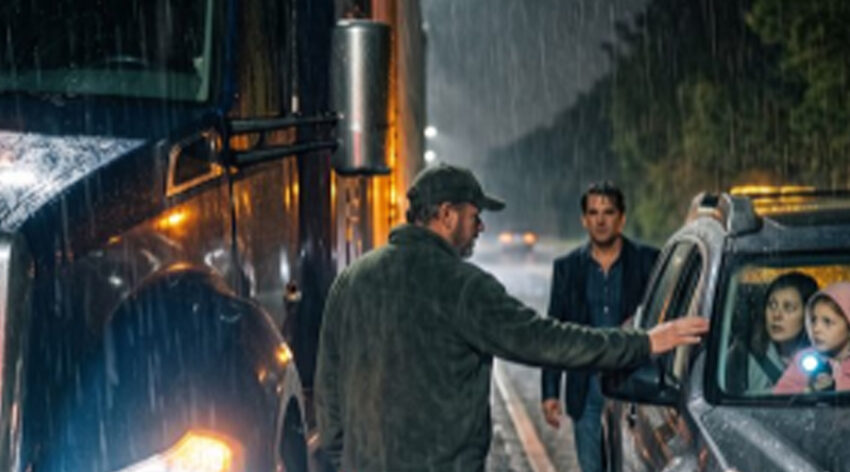
The father from the highway.
He stood immediately.
“Caleb.”
I froze.
Grant looked between us.
“You two know each other?”
Adrian smiled.
“You could say that.”
I looked at Grant.
“What is this about?”
Adrian extended his hand.
“The storm. The SUV. My family.”
I shook his hand.
“You made it home okay?”
“My wife and daughter did,” he said. “Because you stopped.”
Grant leaned back in his chair.
“Adrian is one of our largest customers.”
I looked at him.
“What?”
Adrian nodded.
“My company owns Bell Industrial Systems. We supply electronics to several warehouses across the Midwest.”
I glanced at the paperwork on Grant’s desk.
The name on the top sheet was familiar.
Bell Industrial Systems.
I had delivered their freight many times.
Adrian continued.
“The shipment you were carrying that night was ours.”
I stared at him.
“I didn’t know.”
“You weren’t supposed to,” he said. “You were just doing your job.”
Grant shifted uncomfortably.
Adrian pulled a document from his folder.
“When I got home that morning, I kept thinking about the driver who stopped for us.”
He looked at me.
“I had your name from the receipt.”
I nodded.
“I didn’t expect anything.”
“I know.”
Adrian placed the document on Grant’s desk.
“I called Northstar the next day.”
Grant’s face changed.
“You did?”
“Yes.”
Adrian turned toward me.
“I told them what happened.”
I looked at Grant.
He suddenly seemed very interested in the papers in front of him.
Adrian continued.
“I also asked whether your company had disciplined you for stopping.”
Nobody spoke.
Then Grant said, “It was an internal matter.”
Adrian looked directly at him.
“It shouldn’t have been.”
The room became silent.
I didn’t know what to say.
Adrian opened another folder.
“Our company has been considering expanding our transportation contracts. After what happened that night, I asked for a review of Northstar’s driver safety policies.”
Grant swallowed.
Adrian pushed another paper across the desk.
“This is the result.”
I looked down.
It was a letter.
Bell Industrial Systems was requesting that Northstar change its emergency-response policy for drivers.
No driver would be penalized for stopping to assist stranded motorists when doing so was necessary for safety and did not violate emergency procedures.
Adrian looked at me.
“I told them your decision wasn’t a delay.”
He paused.
“It was judgment.”
I felt something loosen inside my chest.
For two weeks, I had wondered whether doing the right thing had cost me my job.
Now I understood that someone had noticed.
Adrian stood.
“There is one more thing.”
He reached into his folder and handed me an envelope.
I opened it.
Inside was a letter of recommendation from Bell Industrial Systems.
At the bottom was a phone number.
“If Northstar doesn’t want you,” Adrian said, “call me.”
Grant’s face went pale.
I looked at Adrian.
“Thank you.”
He smiled.
“No. Thank you.”
Before leaving, he added quietly,
“My daughter still talks about you.”
I smiled.
“What does she say?”
“She calls you the truck man who stopped the storm.”
I laughed for the first time in weeks.
After Adrian left, Grant closed the office door.
For several seconds, neither of us spoke.
Then he picked up the disciplinary warning I had signed two weeks earlier.
He tore it in half.
Then again.
He dropped the pieces into the trash.
“I’ll restore your regular routes,” he said.
I looked at him.
“And the hours?”
“All of them.”
I nodded.
Then I remembered something.
“What about the warning?”
“Gone.”
I turned toward the door.
“Caleb.”
I stopped.
Grant looked uncomfortable.
“I was wrong.”
It was the first time I’d ever heard him say those words.
I nodded.
“Thank you.”
I walked out of his office.
That evening, I told Nora everything.
She listened while standing at the kitchen counter.
When I finished, she smiled.
“So the stranger from the storm showed up at your boss’s office.”
“Pretty much.”
“And he helped you?”
“Yeah.”
She shook her head.
“Funny how life works.”
A few days later, a package arrived at our house.
Inside was a handwritten note from Poppy.
The handwriting was crooked and filled half the page.
It said:
Thank you for stopping.
Underneath it was a drawing of a big truck, a little SUV, and three stick figures standing underneath an umbrella.
I put the drawing on our refrigerator.
Months passed.
I kept driving for Northstar.
My hours returned.
The warning never came back.
And every time I passed that stretch of highway, I remembered that night.
I used to think stopping had cost me something.
A delivery.
A warning.
Two weeks of uncertainty.
Maybe even my job.
But I eventually realized something.
Not every important decision comes with a reward.
Sometimes you stop because someone needs help.
Sometimes you do the right thing without knowing whether anyone will ever notice.
And sometimes, months later—or two weeks later—a door opens and you discover that somebody did notice.
I never saw Adrian and his family again in person.
But every Christmas, a small card arrives at our house.
The first one had a picture drawn by Poppy.
The second had three words written in bright blue crayon:
Thank you, truck man.
I kept every one.
Because that storm taught me something I will never forget:
A delivery can be late. A schedule can be changed. A job can be replaced.
But when someone is standing alone in the rain and needs help, you don’t always get a second chance to do the right thing.