
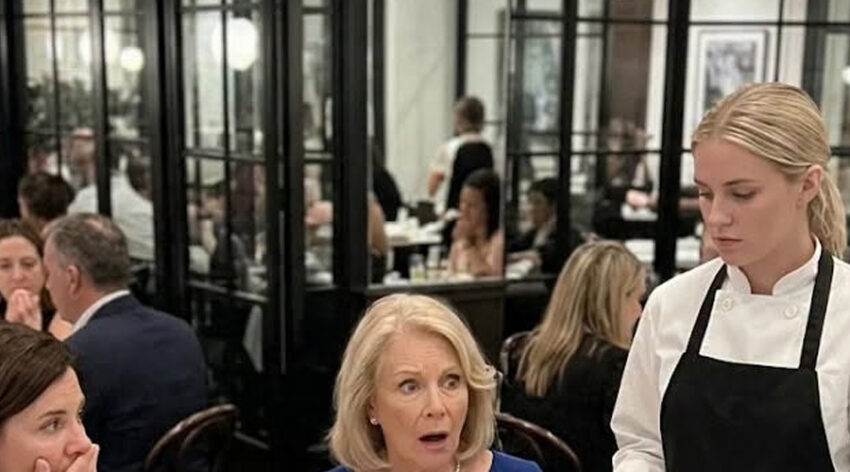
Beatrice read the first page with her glasses pushed up on her forehead, and I watched her lips move. Thirty-eight women sat very still around the long table, their wineglasses halfway to their mouths.
“What is this?” she said. “Camilla, this says ‘Wire Transfer Authorization.’ Why does it have my name on it?”
“Read the amount,” I said.
She looked down. Her mouth made a small, dry shape.She’s never been cruel to my face. She’s something worse. She’s gracious. She’ll introduce me as “my son’s wife, the little chef.” She’ll say, “Camilla does the cooking, but Lucas handles the important things.” She tells people the restaurant was a wedding gift. I’ve corrected her. She smiles, pats my hand, and says it again the next week.
You know the rest of that Friday. The 1:30 rush. The thirty-eight women in silk and diamonds, the RESERVED sign, the line, My daughter-in-law owns this restaurant, so consider yourselves family! My manager, Gavin, coming to me with a face like a man watching a dam crack.
Find somewhere to seat them. Serve whatever they order. Record everything.
I’d like to tell you it was a plan. It was closer to a held breath.
For three months, I’d been reading bank statements at the kitchen table after midnight. It started with a small thing. In June, our accountant, Mr. Okafor, a kind, rumpled man of sixty who’d handled my books since the first year, called me about a reconciliation. “Camilla, there’s a line item I can’t match. Eleven thousand dollars, to a company called Sable Ridge Consulting.”
“I don’t have a consultant.”
“I didn’t think so.”
I looked into it. It took three weeks to find the pattern. Lumina’s operating account had a second signatory, because the bank had insisted, in 2019, on a “spousal backup” in case I was incapacitated. It was Lucas. I’d signed the form at a desk with a banker named Carol and a plate of cookies, and I’d forgotten it.
Starting last November, someone had been writing checks and authorizing wires from that account. Eleven of them. Hotels in Cabo and Scottsdale. A jeweler on Prospect Street in La Jolla. A condo deposit in Del Mar. A payment to a woman named Tiffany Brandt, with a memo line that read Consulting — Q1.
The total was $187,400.
I told no one. I want that on the record. I didn’t tell my sister, or my best friend, or my lawyer, for six weeks. I did what a chef does when something tastes wrong. I tasted it again. I went through every statement, every cancelled check, every email. I took photographs. I made copies, on the machine in the restaurant office after close, and put them in a locked drawer under the wine inventory.
I learned something that I’m still ashamed of. I wasn’t surprised.
I’d known for a year. I’d known the way you know a pan is too hot before you touch it. He’d started coming home at midnight. He’d started wearing cologne. He’d taken to answering his phone in the garage. I’d said nothing. I’d told myself I was too busy, and the truth was that I was afraid if I looked, I’d have to do something.
Then in September, I went to see an attorney. Her name was Marguerite Okafor, no relation to the accountant. She was sixty-two, small and gray and brisk, with a sign on her desk that said READ THE INSTRUMENT.
“Mrs. Hartwell,” she said, after forty minutes, “I’d like to ask you a question. Who owns the restaurant?”
“I do.”
“On paper?”
“On paper. The LLC is mine alone.”
“Then he can’t touch it.” She tapped the file. “But he’s been spending its money. And that’s a different animal.”
Let me tell you what Marguerite told me, because it’s the spine of the whole thing.
Lumina Hospitality LLC was a single-member limited liability company. I was the only member. Lucas had no ownership. But he was a signatory on one account, and in the state of California, a person who writes checks on a business account without the owner’s authority commits what the law calls misappropriation. It can be embezzlement. It can be fraud. It is, in plain English, theft, even from a spouse.
“There’s a complication,” said Marguerite. “California is a community property state. The money in that account, if it’s earned during the marriage, may technically be community property.”
“So it’s his?”
“Half of it is.” She held up a finger. “But the business is your separate property, because you started it before the community accrued any interest, with a loan in your name. The income may be community. The entity isn’t.” She smiled, thinly. “It’s a very good argument. It’s also why I’d rather he confess than litigate.”
“Why would he confess?”
“Because,” said Marguerite, “there’s a second signature on some of those checks. And I don’t think it’s his.”
I stared at her.
“What do you mean?”
“Look at check number 4412.” She slid a photocopy across the desk. “The memo says ‘Equipment.’ The payee is Sable Ridge. The amount is $14,000. The signature is Camilla Hartwell.”
“That’s not mine.”
“I know.” She tapped it with a pencil. “Yours has a flat crossbar on the H. This one has a curl.”
I looked at it for a long time. My hand began to shake. Not much. A small tremor, like a spoon in a cup.
“Someone forged my name,” I said.
“Yes.”
“Lucas?”
“Possibly.” She leaned back. “Or someone with access to his computer. Or his mother.”
I looked up. “Beatrice?”
“I’m not accusing anyone.” Marguerite took off her glasses. “But you told me she has a key to the house.”
I thought about that for a month. I thought about the Saturday morning, in July, when I’d come home from the restaurant at 2 a.m. and found Beatrice’s white Lexus in my driveway. She’d been “dropping off a casserole.” Lucas had been asleep. She’d been in the kitchen with a cup of tea, standing very close to the desk where we kept the checkbook.
I thought about how she’d said, “Camilla, dear, you look exhausted. Why don’t you let Lucas handle the paperwork?”
I thought about the calligraphy class she’d taken in 2020 at a community center in La Jolla. She’d shown me her certificate. She’d said, “I’ve always had beautiful handwriting.”
I hadn’t wanted to believe it. A woman of sixty-eight, in pearls, practicing her daughter-in-law’s signature on the back of a church bulletin. It sounded insane.
But I’d been a chef for twenty-four years. I knew what it was to taste something and not want it to be what it was.
I decided to give her a chance. I decided to see what she’d do if she thought nobody was looking.
That’s what Friday was. You know what I said to Gavin. Seat them. Serve everything. Record it. I’ve never told anyone why. I didn’t want revenge. I wanted to see her face when she thought the restaurant was hers to spend.
She’d done it before. At least eleven times in the last two years, she’d walked in with a group, ordered the most expensive items, and left without paying. I’d tallied it. It came to $34,100. Lucas had told me, every time, “She’s my mother, Camilla. She brings you business.”
But she’d never brought thirty-eight.
By three o’clock, the private room had become a party. The women had finished the tuna tartare and the scallops. They’d moved on to the Wagyu. Bottles came up from the cellar, a 2015 Napa cabernet, a Burgundy, a pair of Champagnes. A woman in a lavender suit stood up and proposed a toast, “To Beatrice, the most generous woman in San Diego!”
Beatrice, at the head of the table, in her pearls, accepted it like a coronation.
And then you know what she said about Lucas. A beautiful younger woman has caught his attention. The silence. Lucas deserves to enjoy himself.
I stood with a bottle in my hand, my fingers going cold.
With money from this restaurant, naturally! Everything stays in the family.
I want to tell you what I felt, because it surprised me. It wasn’t pain. I’d used that up. It was a very clean click, like a lock turning. I’d been collecting evidence for three months, with the faint, ugly hope that I’d find it was all a misunderstanding.
She’d just said it out loud. In front of thirty-eight witnesses.
I set the bottle down. I smiled at her. I said, “Is there anything else I can bring you, Beatrice?”
“Another dessert tray, dear. And a few more of the Champagne.”
“Of course.”
I walked out of the private room and into the kitchen. My hands were steady. I found Gavin at the pass, with a towel over his shoulder.
“Gavin. Get me the bill. Itemized. Every bottle, every plate. And I need a sommelier’s list of the vintages.”
“The whole thing?”
“Everything. And put a hold on the card terminal. I’d like to handle payment myself.”
He stared at me. He’s a lean, thirty-four-year-old man from Fresno who’d worked for me six years and never once seen me rattled. He opened his mouth. He closed it.
“Camilla,” he said quietly. “Are you okay?”
“I’m going to be.”
I went to my office. It’s a closet with a desk and a window onto the alley. I opened the locked drawer. The folder was where I’d left it, a plain manila one, two inches thick, tabbed in four colors.
I laid it on the desk. I looked at it for a minute.
Behind me, the door opened. Mr. Okafor, the accountant, stood in the doorway with his hat in his hands. I’d asked him to come. He’d driven in from Escondido in his old Buick. He hadn’t said why.
“Camilla.”
“Thank you for coming.”
“I read the bill in the hall.” He swallowed. “I’m sorry. It’s a lot of money.”
“It is.”
“Will she pay?”
“I don’t know.”
He came in and closed the door. He sat on the one other chair, a folding one, and put his hat on his knee. He’s a gentle, stooped man with white hair and round glasses, and he’d been a family friend since my first job. He took a breath.
“Camilla,” he said. “May I tell you something I should have told you in June?”
“Please.”
“The Sable Ridge account,” he said. “I know whose it is.”
I held very still.
“I noticed it in March,” said Mr. Okafor. “A strange vendor. I looked it up. It’s registered to a post office box in Pacific Beach. The registered agent is an attorney. But the beneficial owner, I called a friend at the Secretary of State, is a woman named Tiffany Brandt.”
“Lucas’s girlfriend.”
“Yes.” He rubbed his eyes. “I thought you knew. I thought, if I mention it, she’ll think I’m interfering. I didn’t want to lose a client. So I didn’t say.”
“Mr. Okafor.”
“I’m so sorry.”
“It’s okay.”
“It isn’t.” His voice shook. “I’ve been your accountant for eight years. I should’ve called you in March. Instead I sent a polite note about a reconciliation.” He looked at his hands. “I’m an old coward.”
I put my hand on his shoulder. He’s sixty. He felt very thin.
“You’re not,” I said. “You called in June. That’s when it counted.”
“There’s something else.”
“What?”
“The checks.” He lifted his chin. “The ones with the forged signature. I saw the originals at the bank yesterday. I asked a teller. She let me look.”
“And?”
“They weren’t forged by Lucas.” He took off his glasses. His eyes were wet. “I know his handwriting. It’s too neat. These were done by someone who writes a very careful, very educated hand.”
I closed my eyes.
“Beatrice.”
“I can’t prove it,” he said. “But I’d bet my license.”
I sat for a minute in that tiny office with the noise of the kitchen coming through the wall, a clatter of pans, a shout from the grill. I thought of a woman in a pearl choker holding a pen.
“All right,” I said.
“All right?”
“I’d like you to come with me. I want you in the room.”
“Camilla, I’m not a lawyer.”
“You’re an accountant. You can read the numbers.” I picked up the folder. It was heavier than I remembered. “And I want a witness who isn’t family.”
He stood. He put on his hat. He’s not a tall man, but he stood very straight.
“I’d be honored,” he said.
We walked out through the kitchen, past the line, past Gavin, who’d printed the bill and held it out in a shaking hand. I took it. I read the number at the bottom.
$23,289.
I’d like to tell you I felt nothing. I felt a little sick. It was a great deal of money. It was the price of four weeks of payroll. But I thought of eleven wires, and a signature with a curl, and a woman laughing at the head of my table.
I went in.
You know what I said. Beatrice, I hope you and your friends enjoyed everything. She waved a hand. Of course, dear. You can clear the tables now. I placed the bill in front of her. Twenty-three thousand, two hundred and eighty-nine dollars. She laughed her nervous laugh. We’re family!
I put the folder beside the bill. Open it.
She opened it. She read the first page, a wire transfer, dated November 14, for $22,500, to Sable Ridge Consulting LLC. She read the second. A hotel folio from the Los Cabos Resort, dated February, for two guests.
Her smile vanished. I’d like to describe it. It didn’t fall. It drained, from the corners inward, like water from a basin, until what was left was a pale, stiff, powdered mask with two very bright eyes.
“What is this?” she said.
“Page three.”
She turned it. It was a bank record. A scanned check, number 4412, for $14,000. Signed Camilla Hartwell. With a curl on the H.
“That’s not my signature,” I said.
Nobody in the room breathed.
Beatrice looked up. Behind her, at the long table, thirty-eight women had stopped drinking. Somewhere, a fork clinked on a plate and rang.
“I don’t understand,” said Beatrice. Her voice had thinned. “Why would you show me this?”
“Because you’re the one who wrote it.”
A sound went around the table, a low, collective intake, like a wind through leaves. A woman in a lavender suit put down her glass.
“Camilla,” said Beatrice, with a shaky laugh, “that’s absurd.”
“Is it?”
“I’ve never seen this document in my life.”
“Mr. Okafor?”
He stepped forward. He’d been standing behind me, with his hat in his hands. He cleared his throat, and when he spoke, his voice was dry and exact, like a man reading a verdict.
“Mrs. Hartwell. I’m the accountant for Lumina. I examined the original of this check yesterday at the bank. The handwriting on the signature line is consistent with, I’d say, a trained calligraphic hand. The kind taught in a, say, community-center course.”
Beatrice’s face went the color of candle wax.
“I have a certificate,” he went on, “from the instructor of a class held at the La Jolla Recreation Center in the spring of 2020. Her name is Delphine Pruitt. She keeps records.” He took a folded paper from his pocket. “Your name is on the roster.”
“That proves nothing.”
“It proves you know how,” said Mr. Okafor, gently. “That’s all I’m saying.”
I looked at my mother-in-law. She sat very still at the head of the table, with the folder in front of her, and her pearls gleaming, and a glass of my best Champagne at her elbow. She looked, for the first time since I’d known her, old.
“Beatrice,” I said. “I’d like to ask you something. In front of your friends.”
She said nothing.
“Did you sign my name?”
She opened her mouth. For a moment I thought she’d deny it. She had that look, the one she gets when she’s about to say the gracious thing. But a long silence went by. The only sound was the hum of the refrigerator in the pantry.
“Lucas needed it,” she said.
A gasp, soft and horrified, moved around the room.
“He said it was temporary.” Her voice cracked. “He said he’d put it back. He had a, he was in trouble, Camilla. A gambling thing. In Las Vegas. He owed a man forty thousand dollars. He was crying.” She pressed her fingertips to her lips. “He’s my son.”
“So you forged a check.”
“I signed once. I thought, it’s family money. It’s his, too.”
“It was eleven checks.”
“I only signed four.”
“And the other seven?”
She flinched. She said nothing.
I’d like to tell you what I felt then. It wasn’t triumph. I looked at a woman of sixty-eight in a pearl choker, confessing in a private dining room, in front of thirty-eight of her friends, and what I felt was pity, hot and sour, like a taste in the back of the throat.
“Beatrice,” I said. “The seven others. Who signed them?”
“I don’t know.”
“Yes, you do.”
She put her hand over her eyes. A tear slid out from under her palm and ran down her powdered cheek.
“Tiffany,” she whispered.
“Tiffany Brandt.”
“She, Lucas gave her a blank checkbook. He said she could, for emergencies. He said she was good with, she’s twenty-six, Camilla. She’s so, she was so sweet. She sent me flowers.”
“She forged my name.”
“I thought it was a, I thought it was a loan.”
Behind me, the door of the private room opened. I hadn’t heard it. I turned my head.
A young woman stood in the doorway. She was slender, blond, in a white sundress and a cream blazer, with large dark eyes and a tiny gold necklace. She was twenty-six. She had a paper bag in one hand and a face that had gone completely white.
I’d never seen her in my life. And I knew exactly who she was.
“I’m so sorry,” said Tiffany Brandt.
Nobody moved. The lavender woman put a hand over her mouth.
“I wasn’t supposed to come.” She had a small, clear, trembling voice. “Beatrice told me she’d be here. She said there was a party. She said Lucas would be, and I thought, I’d like to see the place.” She took a step into the room. “I didn’t know it was you.”
“It’s me.”
“You’re so, you’re not what I thought.”
“What did you think?”
“That you’d be cold.” She laughed, shakily. “Lucas said you were like a refrigerator. He said you never talked to him. He said the restaurant was your whole life.”
“It is.”
“I know.” Tears had begun to run down her face. “I read about you. In the Union-Tribune. You’re so, you built all this. I thought, why would he, why would anyone.”
“Tiffany.”
“I didn’t know it was your money.” Her voice rose. “He told me the restaurant was his. He said he’d built it. He said you worked for him.”
I looked at her. A girl of twenty-six, in a white sundress, with her hands knotted together. She looked like a student.
“How much did you take?” I said.
She told me. She didn’t hesitate. I’ve thought about that often. Lucas had told her he was a “restaurateur.” They’d met in March of last year at a hotel bar in La Jolla, where she worked as a hostess. He’d bought her a drink. He’d said he was separated. He’d said his wife was “a chef who lived at work.”
By summer, she’d quit her job. Lucas had said she didn’t need to work. He’d given her a debit card on the Lumina account. He’d said it was “a business expense.” In October, he’d given her the checkbook.
“I wrote four,” she said. “I thought it was a, he said it was for supplies. For my consulting company.” She wiped her eyes. “He said I was starting a catering business.”
“Did you?”
“I didn’t know how.” She laughed, wet. “I bought a, I bought a ring. For myself. And a car.”
“Where’s the car?”
“In the lot.” She pointed, helplessly, toward the street. “A white Mini. It’s, I can give it back.”
Mr. Okafor, at my elbow, made a small, pained sound.
“How much was the ring?” I asked.
“Eleven thousand.”
“And the rest?”
“I don’t know.” She was sobbing now. “I don’t have it. I don’t have anything. I live in a studio in Pacific Beach. I owe four months’ rent.”
I put down the folder. I crossed the room. I stood in front of her, a thin, shaking girl in a white dress, and looked at her face.
“Tiffany,” I said. “Sit down.”
I took her to the corner of the private room, to a small velvet banquette by the window. I sat her down. I took a napkin from a passing server and put it in her hand. She pressed it to her face.
Behind us, the thirty-eight women had begun to murmur. I heard a chair scrape. A woman in a red jacket whispered, “I think we should go.” Another said, “I had no idea.” Beatrice sat at the head of the table with her hands in her lap, perfectly still, staring at the wall.
I sat down next to Tiffany. I didn’t touch her.
“Did Lucas ever tell you he was married?”
“He said he was divorcing.”
“Did you see papers?”
“He said his lawyer was drafting them.” She gulped. “He said, in December, it’d be done.”
“It’s November.”
“I know.” She laughed, helplessly. “He told me last week. He said the date had slipped.”
I almost smiled. It wasn’t funny. It was the oldest line in the world.
“Do you love him?” I said.
She looked up. Her eyes were very wide and dark and wet.
“I thought I did.”
“And now?”
She thought about it for a long time. Behind us, the noise in the room had died. It was a strangely tender silence, like the quiet after a bell.
“I think I wanted somebody to take care of me,” she said. “And he said he would. And I didn’t ask how.”
I want to tell you what I did next, because I’ve gone over it a thousand times.
I looked at this girl, who’d forged my name four times and spent my money on a ring and a Mini Cooper, and I thought about myself at twenty-six. I’d been washing dishes. I’d had a fiancé, a nice man named Daniel, who’d said, “You’ll never make it as a chef, Cam. It’s not a woman’s job.” I’d stayed with him for two years.
I’d have taken any hand that was held out.
“Tiffany,” I said. “I’m going to tell you three things. And then I’d like you to leave.”
She nodded.
“One. You’ll give back the ring and the car. Tomorrow. To Mr. Okafor, who’ll hold them for my attorney.”
“Okay.”
“Two. You’ll write a statement. Everything you know. Every date, every amount, every word Lucas said. In your own handwriting. You’ll sign it, and you’ll sign your real name.”
“I will.”
“Three.” I took a breath. “You’ll go to a woman I know named Rosalind Park. She’s a credit counselor in Hillcrest. She has a sign on her desk that says DEBT IS A SHAPE, NOT A SENTENCE. I’ll pay for the first three sessions.”
She stared at me.
“Why?”
“Because somebody should have asked you how,” I said.
She went. She stood up, and she looked at the room, at Beatrice, at the thirty-eight women. She turned to me. She seemed about to say something and could not. She walked out through the door of the private room, into the corridor, and past the hostess stand, and into the late bright light of Fifth Avenue.
I watched her go. A small white figure with a paper bag.
Then I turned to Beatrice.
She hadn’t moved. She sat at the head of the table with her hands folded, like a woman in a church pew. Around her, the women had begun to gather their purses. A few had already slipped out. A tall, gray-haired woman in a navy suit stood at the door with her arms folded, watching.
“Beatrice,” I said.
She lifted her eyes. They were red-rimmed, enormous, and very tired.
“I know what you’re going to say.”
“Do you?”
“You’re going to call the police.”
“No.”
She blinked.
“I’m going to give you a choice.”
I laid it out for her in the quiet, with the remaining guests listening, because I wanted witnesses. I’m not proud of that. I’m only telling you why. I’d spent three years being laughed at in front of a crowd. I thought it would be fair if she heard the truth in front of one.
“One,” I said. “You pay the bill.”
“Camilla.”
“Twenty-three thousand, two hundred and eighty-nine dollars. I’ll take it in installments. Five hundred a month. It’ll take you about four years.”
“I don’t have that.”
“You have a condo in La Jolla. You have a pension. And you have eleven thousand dollars in a savings account at Wells Fargo, which Mr. Okafor found.”
Her mouth opened.
“I’m not asking you to sell anything,” I said. “I’m asking you to pay for what you ordered.”
“And two?”
“Two. The forged checks. Four of them. Fifty-eight thousand dollars. I’m going to ask the bank to treat them as unauthorized. I’m going to cooperate with the district attorney. I’ll tell them exactly what I told you.” I held her eyes. “I won’t ask them to prosecute you.”
A gasp from the door.
“But I’m going to tell them the truth,” I said. “That’s not optional.”
She said nothing. She sat very straight. Her hands, in her lap, were shaking.
“And three,” I said, more gently. “You’ll call Lucas. Tonight. And you’ll tell him what you’ve told me.”
It was Gavin who found Lucas. I hadn’t asked him to. He’d gone upstairs to the office, and when he came down he had his phone in his hand and a very odd expression.
“Camilla. Your husband’s at the front door.”
I looked at him. “Lucas?”
“He’s been there for twenty minutes. He’s in the foyer. He saw the cars.” Gavin swallowed. “I don’t think he wants to come in.”
“Is he alone?”
“There’s a girl in a white dress with him. She’s crying.”
I closed my eyes.
I’d like to tell you I was surprised. Tiffany had walked out of the restaurant and straight into the arms of my husband, who’d been waiting in the lot. It’s what a person does. It was the one thing I’d forgotten to anticipate.
“Send them in,” I said.
“Both?”
“Both.”
I turned to Beatrice. “Stay where you are.”
She stared at me. “Camilla, please. Not in front of.”
“It’s family,” I said. “You said so yourself.”
Lucas came in slowly. He stood in the doorway of the private room in a charcoal suit and an open-collared white shirt, with his hair a little too long and his tan a little too deep. He’s thirty-nine now, still handsome, still a man whose face can make a stranger trust him. He looked at the table. At his mother. At the thirty-odd women arranged around it like a jury.
He looked at me.
I’d planned something dignified. What I felt was an enormous, quiet tiredness. I saw a man I’d loved for fifteen years, and I could not find, anywhere in my body, a single thing to say to him.
“Camilla,” he said.
“Lucas.”
“What’s happening?”
“I think you know.”
“I got a text from Tiffany. She said, ‘Come to the restaurant. It’s over.’” His voice cracked. “I thought she meant, I thought she’d, I came to get her.”
“She told me everything.”
“I’m sure there’s a, Camilla, I can explain.”
“Can you?”
He opened his mouth. He closed it. Tiffany, beside him, had put her hand over her face. Behind him, in the corridor, I could see Mr. Okafor, very small and straight in his gray suit.
“Lucas,” I said. “Do you remember what you said when I told you I was opening Lumina?”
He frowned. “I don’t.”
“You said, ‘It’ll never work.’”
“I was joking.”
“I know.” I smiled, thinly. “It’s the funniest thing you’ve ever said.”
I laid it out for him. It took about four minutes. I did it in order, in the voice I use to give a kitchen its orders for the night, plain and level and unhurried. The wires. The hotels. The jeweler. The condo deposit in Del Mar. The checks, each with its number and date. I read the total.
“One hundred and eighty-seven thousand, four hundred dollars,” I said.
His face had gone gray. “I was going to pay it back.”
“With what?”
“With the, I had a deal. In Scottsdale. A development.”
“You’ve never had a deal in your life.”
He flinched.
“I looked at your accounts,” I said. “Last month. Mr. Okafor helped. You have eleven hundred dollars in checking and a credit card with a limit of five thousand. You owe sixty-two thousand to a man in Las Vegas. And you’ve been spending my money on a girl in a white dress.”
Tiffany made a small sound.
“Camilla,” said Lucas. His voice had gone soft and wheedling, the voice he used on buyers. “Honey. We’ve been married fifteen years.”
“Yes.”
“You’re not going to, over money.”
I looked at him. I’d heard that sentence a thousand times. Why does everything have to be about money?
“It’s not about the money,” I said. “It’s about who you told.”
“Who I told?”
“You told your mother I was a refrigerator.” I kept my voice even. “You told your girlfriend you built my restaurant. You told thirty-eight women, through your mother, that I was lucky to be allowed to cook.” I paused. “You told everyone I was nobody. And then you spent my money to prove it.”
He didn’t answer. He stood in the doorway with his hands at his sides.
“I worked sixteen-hour days,” I said. “For eleven years. I burned my forearms. I missed my father’s funeral because a health inspector came on a Tuesday. I did it, Lucas, because I wanted a place that was mine. And you stood in my kitchen on Friday nights and told people you’d given it to me.”
“It was a joke.”
“It wasn’t a joke.” My voice cracked, just once. “It was a theft. You stole the one thing I’d built, and you did it with a smile.”
His mouth worked. Behind him, in the corridor, the lavender woman had come to the door. So had the woman in the red jacket. A little cluster of faces, in the soft light, listening.
“I’m sorry,” said Lucas, hoarsely.
“For what?”
“All of it.”
“That’s not an answer.”
“I’m sorry I said you were a refrigerator.”
I almost laughed.
“Say the rest,” I said.
He couldn’t, at first. He stood there in his good charcoal suit with his tan and his too-long hair and his mother’s long neck, and I watched him try to find a sentence that would work. I’ve watched a thousand cooks try to explain a burned dish. They always begin with the stove.
“I thought it was ours,” said Lucas.
“It wasn’t.”
“I thought, we’re married. What’s yours is mine.”
“You never put in a dime.”
“I put in me.” His voice rose, thin and cracked. “I put in fifteen years. I was the one who, I carried you. When you were too tired to, who held you at night?”
“I held myself.”
He stopped.
“I’m sorry,” I said. “That’s unkind. But it’s true.”
He put his hand over his eyes. Tiffany, beside him, had begun, quietly, to cry again. I felt, in the room, the strange gentleness of a thing that has finally been said.
“Lucas,” I said. “I’d like to tell you what’s going to happen.”
He lowered his hand.
“I’m filing for divorce on Monday.”
He didn’t flinch. I think he’d known.
“I’ll keep the restaurant. It’s mine. I’ll ask for nothing else. Not the house, not the cars, not the account in your name. I want it clean.”
“Camilla.”
“I want to be free of you more than I want your money.”
It was a long silence. Nobody breathed. In the kitchen, a pan clattered, and somebody swore softly in Spanish.
Beatrice, at the head of the table, spoke.
“Camilla.”
I turned.
She’d risen. She stood with one hand on the back of her chair, in her pearls, tall and straight, like a woman about to give a toast. Her face was calm. It had gone past tears to something older.
“I’d like to say something,” she said. “To you. In front of them.”
“Go ahead.”
She looked around the room, at the women, at the door. She took a breath.
“I told them you were a servant.”
Nobody spoke.
“For fifteen years. I said you were lucky. I said Lucas had given you everything.” Her voice was thin and clear. “I said it because I was afraid.”
“Of what?”
“That you were better than us.”
A small, startled sound ran around the room.
“I grew up in a house in Santee,” said Beatrice. “My father drove a truck. My mother cleaned offices. I married a dentist, and I spent forty years pretending I’d been born in a house with a library.” She laughed, thin. “And then my son married a woman who’d actually built something. With her hands. And I thought, she’s going to find me out.”
“Beatrice.”
“I’m so sorry.” Her eyes had filled. “I signed your name. I didn’t think it would matter. I thought, she has so much.”
I looked at her, a thin, elegant, trembling woman in pearls.
“I didn’t,” I said. “I had exactly what I’d made.”
It took a year, and I’ll give you the pieces.
I filed on the Monday. Marguerite handled it. It took eight months. Lucas didn’t contest. He signed a stipulated judgment for $187,400, payable at $900 a month, and gave up any claim to Lumina, in writing, in front of a mediator. He took a job as a leasing agent for a property company in Temecula. He told me, on the phone, that it was the first job in his life where he’d had to be on time.
The district attorney’s office declined to prosecute Beatrice. They said the amount was small, the victim had declined to press charges, and she’d returned the proceeds. They sent a polite letter.
Beatrice paid the bill. I want you to know that. She paid $23,289, in installments of five hundred, by check, on the first of every month, for forty-seven months. Each check had a small notation in the memo line. Payment 1. Sorry. Payment 12: Thank you. Payment 31: I’ve started a small garden. I never answered. I read every one.
She sold her condo in La Jolla in the second year and moved to a one-bedroom in Escondido. She took a job at the front desk of a library. She told me once, at a family gathering, with a paper plate in her hand, that she’d never been so tired and so happy.
Tiffany saw Rosalind Park every Tuesday for three months. She returned the ring and the car. She wrote her statement, four pages in a round, careful hand. She signed her real name, Tiffany Marie Brandt, at the bottom, and I read the signature twice. It was nothing like mine.
She got a job at a bakery in Pacific Beach. In the spring, she wrote me a card. It said:
Camilla. I made a lemon tart today and it came out right. I thought of you. T.
I put it on the bulletin board in the kitchen. Gavin read it. He said nothing. Then, a week later, he left a small paper bag on my desk with a lemon tart in it, wrapped in wax paper. There was a note. From the girl who gets it right.
I ate it standing up. It was perfect.
Lumina turned eleven in May. It’s still the best restaurant on Fifth Avenue, and, if I say so myself, one of the best in the state. We’ve been in the Michelin Guide for three years. I hired two women last year, a sous-chef and a pastry chef, and I put their names on the menu in the same size type as mine.
On the anniversary, I came in early, before dawn, as I always do. I turned on the lights. I walked through the dining room, past the empty tables, past the long window onto the street. At table nine, in the corner, a small white card sat on the cloth.
I don’t know who left it. It was in a looping hand, in blue ink, on cream stationery.
Camilla. I should like to reserve a table for one, on the first Friday of every month, at 1:30. I will pay in advance. I will order the least expensive item on the menu. I will tip twenty percent. I will leave on time. Respectfully, B. H.
I read it three times. I sat down at table nine, in the gray light, with my elbows on the cloth.
I thought about a woman in pearls, at the head of a long table, saying, consider yourselves family. I thought about a girl in a white sundress with a paper bag. I thought about a plate of tuna tartare, and a bill for $23,289, and a folder.
I took a pen from my apron. On the back of the card, under her looping hand, I wrote one line.
Table nine is yours. The soup is excellent.
Then I stood up, and tied my apron, and went into the kitchen to start the stock.
“Forty-one thousand dollars,” she whispered.
“Keep going. There are eleven of them.”
My name is Camilla Reyes-Hartwell. I’m thirty-nine. I own Lumina, a sixty-seat restaurant on Fifth Avenue in San Diego with a tasting menu, a wine cellar of four hundred bottles, and a kitchen I built one burn at a time. I started at fifteen, washing dishes at a diner in Chula Vista for $6.75 an hour. I worked my way through six kitchens, and I was an executive chef at thirty-one. I saved for eight years. In 2019, I signed a lease for the space with my own money and a small business loan in my own name.
Lucas didn’t put in a dollar. I’ve said so a hundred times, and I’m tired of saying it. What I want you to understand is that I never needed him to. I needed him to be a husband.
I married him in 2014. He was a charming, restless man of thirty-three who sold commercial real estate and could talk to anybody. He had a way of laughing that made a room feel lucky. I believed that was enough for a while.
Beatrice Hartwell is sixty-eight. She’s tall, silver-haired, and elegant, with a long neck, a pearl choker, and the posture of a woman who was told as a girl that she was a queen. Her husband, a dentist, died in 2011. She lives in a condo in La Jolla on his life insurance and her own opinions.