
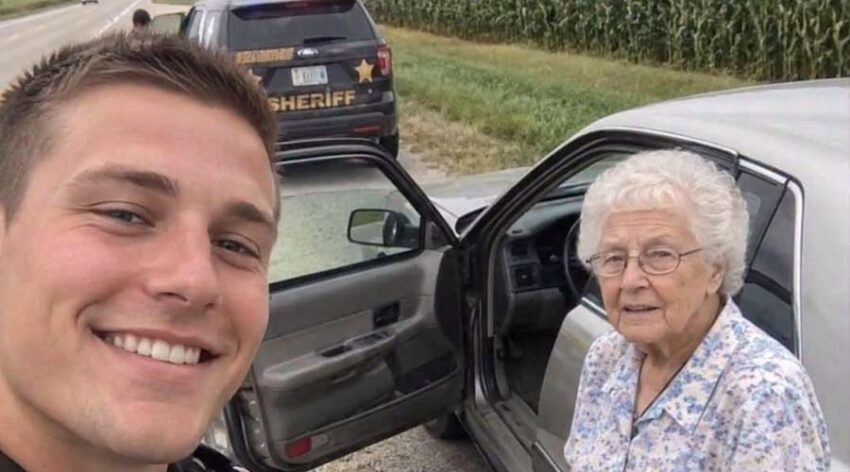
The deputy held my mother’s yellow temporary license up to the light, with his thumb beside a dark mark near her address.
“Did they tell you what this meant at the license office?” he asked.
“No,” Shirley said. “They gave me the paper and said my new card would come in the mail.”
I had the lemon bar pan balanced against my hip. Its lid shifted when I leaned forward to see the mark, and I caught the edge before it could slide off.
“Is there a problem?” I asked.
“I can’t make out the notation.” The deputy lowered the paper. “I’d like to check it before I send you on your way.”
Shirley looked toward the Buick. “That’s fine. Is there somewhere I should wait?”
“Right here for now, ma’am. I’ll need a few details first.”
His name tag said Allen. He looked about the age of the younger salesmen in my office, though he spoke with a careful slowness that made me want to answer for my mother.
Instead I looked at my watch. It was 1:11, and the church ice cream social opened at 2:30. Shirley had promised to bring the lemon bars before the serving table got crowded.
“We have a church social,” I said. “Would it be possible to check it quickly?”
“Quickly,” Allen repeated. He tapped his pen against his notebook before writing. “I’ll do what I can.”
Shirley held out her hand for the pan, but I kept it. Powdered sugar clung to the rim under the clear lid, and the pan was still warm from her kitchen.
“I can hold this,” I said.
“I know you can. You’re tipping it.”
I leveled the pan. Allen asked Shirley for her date of birth, then wrote it down. He checked the address against what she told him, but his pen stopped beside the mark on the yellow paper.
“Did you renew in person?” he asked.
“Yes. At the licensing office in Benton, last Tuesday.”
“Last Tuesday.” He wrote that down too. “And this is the paper they gave you there?”
“It is. You’re welcome to look at it as long as you need.”
I shifted the pan to my other hand. “The road is right there,” I said. “Could we wait by the car?”
Allen glanced toward the traffic on County Road 6. “Yes. Stay on the shoulder, please. I’ll come over when I’ve made the inquiry.”
Shirley walked around to the passenger side, and I followed her. The Buick’s open door gave us a narrow patch of shade, though the cloth seat still held the afternoon heat.
“I should have put the pan in the trunk,” I said.
“And had it slide from one side to the other?” She reached over and pushed the lid down at one corner. “Keep it level, Jeffrey.”
“Would it be possible for me to carry it out of the sun?”
“You can carry it over here. I’ll carry it into church myself.”
“You’ve already carried it from your kitchen to the car.”
“And I expect to make it from the parking lot to the table.” She gave the lid another pat. “Thank you for offering.”
I moved closer to the open door, holding the pan where the shade covered most of it. Shirley leaned against the Buick and looked back at Allen, who stood beside his patrol vehicle with her license in one hand.
“He didn’t say how long,” I said.
“No. He didn’t have an answer yet.”
“The ladies setting up will wonder where your bars are.”
“They’ll have ice cream. Nobody has to wait for my bars to start.”
She had paid three dollars for each of our social tickets and tucked them into her handbag that morning. I had told her she could save my ticket until I was sure I could get away from work. She had bought it anyway.
“I could call the church,” I said.
“There’s no need yet. We have more than an hour.”
She rested her hand on the edge of the door. “Did you remember the serving knife?”
I looked down at the lid. A knife lay beneath it, wrapped in a paper napkin, right where she had placed it.
“You put it in.”
“I did. I wanted to hear you say you saw it.”
Allen approached before I could answer. He had the yellow paper and his notebook together in one hand.
“Mrs. Hagen, may I see your registration?” he asked.
“Yes. Give me a minute, please.”
I set the pan on the passenger seat while she opened her handbag. The lid rattled against the metal rim, and I steadied it before it could move again.
“I’ll get it from the glove box,” I said.
“No, it’s in here.”
She pulled out her wallet, the social tickets, and a folded receipt. The receipt had four dollars written across the top beside the word milk. She put it back and reached into a narrow pocket along the lining.
Allen waited by the front fender. He tapped his pen against the notebook, then held it still.
“Do you keep a copy somewhere else?” I asked.
“I keep the registration in my bag.” She separated two envelopes with her thumb. “The insurance card is with it.”
“You don’t have to find the insurance card for me,” Allen said. “I only need the registration.”
“Registration,” Shirley said. “I’ve nearly got it.”
I watched her take out a small packet held by a rubber band. She slipped the band off, sorted through the papers, and handed Allen a folded sheet.
“Here you are. The registration.”
“Thank you, ma’am.”
I had been reaching for the glove box latch when she found it. There were other papers in her packet, their corners softened from being handled, and she tucked them back before I could see what they were.
Allen unfolded the registration beside the yellow license. “Same address,” he said, and copied a line into his notebook.
“Has she done something wrong?” I asked.
“I haven’t said that. I need to check the notation and verify the license.”
Shirley put the rubber band around her remaining papers. “I renewed because my old card was about to expire,” she said. “I didn’t want to wait until the last day.”
“Last day,” Allen repeated. “No, ma’am, that’s sensible.”
He handed the registration back. She put it into the handbag pocket by itself, then closed the clasp.
“Can I keep this with me?” she asked, touching the yellow paper.
“I need it for the check, if that’s all right.”
“All right. Thank you for asking.”
The pan sat on the passenger seat, with one corner of the lid raised again. I pressed it down and lifted the pan before Shirley could reach for it. She moved toward the open doorway, and I stepped aside.
“I can put it back on the floor,” I said.
“Not yet. There might be grit from my shoes.”
I held it while she sat on the edge of the seat. She smoothed her dress over one knee, then drew her feet back onto the gravel. The clock on the Buick dashboard read 1:20.
“We’re still early,” she said.
“For now.”
“You sound like you did when you missed the turn for the high school.”
“I didn’t miss it.”
“You took the long way, then.”
I gave her a look, and she smiled. We had taken that road for years when I played football. Most Fridays she had been at work, and I had gone home with somebody else’s parents or waited for her to pick me up afterward.
“The home game against Mill Creek,” I said. “You were working that night too.”
She looked up at me. “Yes, I was.”
“We won by two points. I kept looking toward the gate because you said you might make it.”
“I remember that game.”
“You weren’t there.”
“No. I wasn’t.” She touched the edge of the pan, keeping it steady against my arm. “I remember more of those Fridays than you think.”
I waited for her to say how. A car passed us on the road, and Shirley turned her face away from the dust it left.
“What do you remember?” I asked.
She reached into her handbag and took out the two church tickets. She checked that they were still together, then slipped them back into the pocket.
“More than whether you won,” she said.
I had spent years telling myself that the games hadn’t mattered much to her. When I asked what else she knew, she looked past me toward Allen.
He had opened his notebook again. “Mrs. Hagen, I’m going to check with dispatch now.”
“All right,” she said. “We’ll be here.”
I set the pan back on the seat and put one hand over its lid. Shirley rose and stood beside me, close enough that our sleeves touched.
“Would it be possible to tell us when you hear back?” I called.
“Yes, sir. I’ll come right over.”
Allen carried the yellow paper toward his patrol vehicle.
Shirley touched the corner of her eye and asked if I had a tissue. I had a clean handkerchief at home, but that did her no good beside County Road 6.
“There might be one in the glove box,” she said. “If it has not turned to dust.”
I opened the passenger door and pulled the latch. The box dropped against my knee, showing a stack of napkins, a tire gauge, and an envelope with a corner folded under.
“Do you want a napkin?” I asked.
“That will do. Pick one from the middle.”
The first two had a gray line across them where the latch had caught. I pulled a clean one free and handed it to her. Underneath was a thin yellowed sheet, folded twice.
I opened it enough to see the name of my high school and a column of dates. The ink had faded, but the word FOOTBALL was still clear across the top.
“Where did you get this?” I asked.
Shirley took the napkin and touched it to her eye. “From your school. They gave them out at the start of the season.”
I turned the paper over. On the back, in her handwriting, were milk, eggs, and coffee. Farther down she had written butter, then crossed it out.
“You used it for a grocery list.”
“Yes. I did not have another piece of paper handy.”
I held it by the fold. One corner had gone soft from rubbing against the other papers in the box. There was a faint circle around one of the Friday dates on the front.
“Did you know it was still in here?” I asked.
“I did. Please do not throw it away.”
“I was only looking at it.”
“I know. You have a way of clearing out a car when you get started.”
I set the schedule on the passenger seat. She had kept it even after the groceries were bought, and I could not see why.
Allen came back with the registration in one hand and the temporary license in the other. He stood where Shirley could see both papers.
“The addresses match,” he said. “I compared the street and the number.”
“That is my address,” Shirley said. “Thank you for checking it.”
He placed the registration against his notebook. “The mark beside it on the temporary license still has not been clarified through the records system.”
“Has not been clarified?” I asked.
He tapped his pen against the notebook before writing. “The inquiry went through. I have not received an answer about that mark.”
Shirley held out her hand for the registration. Allen passed it to her, and she returned it to her handbag, fitting it behind a small zippered pocket.
“Do you need that again?” she asked him.
“I may. Could you keep it handy for now?”
“Yes. I know where it is.”
She closed the clasp but kept the bag on her arm. I looked toward the patrol vehicle, where the screen was visible through the open window.
“Is there someone you can call?” I asked.
“I sent the inquiry through our system,” Allen said. “I will follow up if I need to.”
“Would it be possible to see what it says?”
“See what it says.” He glanced toward his vehicle. “Yes, come over to the window.”
I started to follow him, then looked back at Shirley. The pan was still where I had left it, and the lid had slipped a fraction to one side.
“I will stay right here,” she said. “Go ahead.”
At the patrol vehicle, Allen moved his notebook off the passenger side so I could lean close enough to read the screen. The letters were small, and he pointed to a line near the bottom.
“That is the request I sent,” he said.
The line showed her name and a status. Pending.
“Does a simple renewal normally take this long?” I asked.
“Sometimes a response comes back quickly. Sometimes it takes longer.”
“How much longer?”
“I cannot give you a time.”
He tapped the screen with his pen, then pulled his hand away without touching it again. There was no answer under the request, only a space where one could appear.
“Could the mark be holding it up?” I asked.
“It could be part of what they are checking. I do not want to guess before they answer.”
I read the line again. The word was still there, small and unchanged.
“Does this mean her license is all right?” I asked.
“It means the inquiry is pending. I still need the response.”
He turned the screen slightly toward himself and checked the date on his notebook. Shirley was watching us from the Buick, her handbag tucked close to her side.
“We have to get to church,” I said. “The social opens at two thirty.”
“Two thirty.” Allen wrote the time beneath his notes. “I understand you have somewhere to be. I will let you know as soon as I have an answer.”
“Could you ask them to hurry?”
“I can check on the inquiry. I cannot promise that will make the response come sooner.”
He set the pen across his notebook. I had expected to see an error message or a blank field he could fill in. There was neither.
Back at the Buick, Shirley had picked up the schedule. She held it open with both hands, keeping the thin fold from splitting.
“Did you find out anything?” she asked.
“The request is in. It says pending.”
“And the mark?”
“He is still waiting on that too.”
She folded the schedule along the old lines and handed it to me. “Put it somewhere safe, please. It has lasted this long.”
I laid it across the seat again, away from the open door. She looked down at the pan, then at the strip of sun reaching across its lid.
“Those bars are getting warm,” she said.
“I could move them into the car.”
“Yes, if you can find a flat place. I do not want lemon filling on the upholstery.”
The cloth seat held the afternoon heat when I pressed my palm against it. I crouched and looked into the passenger footwell. The floor mat lay level, and the space was out of the direct sun.
“Here?” I asked.
Shirley bent to look. “The footwell will be fine. Make sure the pan is not sitting on that buckle.”
I moved the loose seat belt buckle to the side, then lifted the pan with both hands. The metal was warm at the rim, and powdered sugar clung there where the lid did not quite cover it.
“Watch that corner,” she said.
“I have it.”
“You said that when you carried my birthday cake.”
“The cake made it to the table.”
“Most of it did. Your uncle got a very large slice from the lid.”
I lowered the pan onto the mat. Shirley checked it from the doorway while I pressed lightly on each side.
“It is flat,” she said. “Thank you.”
The lid rattled once as I settled it. I left it closed and pulled my hands back so I would not tip the pan trying to improve its position.
“I will bring it in when we get there,” I said.
“No, I will carry it. You can open the door for me.”
“That sounds like a fair division of labor.”
“It does to me.” She rested one hand on the door frame. “Did the screen say what the delay was?”
“No. But it has to be a computer error. They would have answered by now if the system were working.”
“Has to be?”
I looked toward Allen. He had returned to his seat and was writing something in his notebook before checking the screen again.
“The addresses match,” I said. “The renewal is right there on the paper. What else could it be?”
“I do not know, Jeffrey.”
“Neither does he, apparently.”
“No. A screen saying pending is not the same as an answer.”
I reached for the passenger door, then stopped before closing it. The pan was safe on the floor, but the schedule lay across the seat, where someone could sit on it or it could slide out.
“Did you circle this date?” I asked, opening the paper again.
Shirley came closer and looked at the faded mark. “I may have. I do not remember making that circle.”
There were other dates printed below it, some close together. I tried to place the season, but the grocery list showed through the thin paper and made the numbers hard to read.
“You could have written the list on anything,” I said.
“I could have. That was what I had.”
She took the napkin from her hand and tucked it into her handbag. Across the road, a truck passed, and I waited until we could hear each other again.
“You really want to keep it?” I asked.
“Yes, I do. Thank you for asking.”
The glove box still hung open. I picked up the schedule, folded it on its old creases, and put it back.
Shirley reached past me and pressed the glove box shut.
“The map is in the back,” she said. “Under the blanket.”
I opened the rear door and found a folded county road map beneath a thin blue blanket. The Buick’s cloth seat held the afternoon heat, and the paper had softened along its creases.
“Are you planning another way to church?” I asked.
“I thought we might need one. Bring it over here.”
She sat sideways on the back seat with her feet on the gravel. I stood beside her and opened the map across the cushion. One corner caught under my hand, and the paper folded in on itself.
“Which way is north?” I asked.
“Turn it once to the left.”
I did, but before I found County Road 6, she had put her finger on a narrow line near the center.
“There’s the courthouse road,” she said. “We could take that down to Main, then turn by the bank.”
“You found it before I even got the map open.”
“Yes. You had it upside down, honey.”
I looked at the print again. She was right. I had been trying to read the river as a road.
The corner near the courthouse was creased more heavily than the rest. A little square had been marked in pencil, though I could not tell whether it was the building or the block around it.
“Did you draw that?” I asked.
“I may have. It’s been there a long time.”
She traced the road from the courthouse toward the church with one finger. I watched her pass over two intersections without stopping to read their names.
“Would that save us much?” I asked.
“Maybe a few minutes. Not enough to make up for standing here.”
The social opened at 2:30. The women at the serving table would be setting out the desserts before then, making room for cakes and pies and Shirley’s lemon bars. She had told them she would bring a full pan.
I pointed to another road. “This one looks shorter.”
“It does on paper. There’s a stop sign at each end, and you have to cross Main twice.”
“All right. Courthouse road.”
“If Allen lets us go in time to use it.”
She lifted the map closer to her glasses and checked the turn again. Her nail stopped beside a bend I had missed.
“How did you find that so fast?” I asked.
She glanced up at Allen’s patrol vehicle. “I’ve looked at this county a few times.”
Allen came around the back of the Buick with the yellow paper in his hand. He kept it clear of the gravel as Shirley stood, and I took the map before it slipped from her lap.
“There’s a number beside that mark,” he said. “I’m going to ask dispatch what it refers to.”
“Is that all you need?” I asked.
“The number first. Then I still need the records response.”
Shirley stepped over to the trunk, and I followed with the map folded loosely in my hands. Allen held the paper where he could read it and called Kim on his radio.
“Kim, I have a notation next to the address on a temporary renewal,” he said. “Can you check the number for me?”
“Allen, go ahead with the number.”
He read the digits slowly. Shirley leaned against the trunk, keeping one hand on the metal edge. I looked toward the open passenger door, where the pan sat in the footwell.
“Did you get all of that?” Allen asked.
“The last digit again, please.”
He repeated it. There was a pause, and he checked the paper while we waited.
“Could it be a seven?” I asked. “That print is small.”
Allen turned the page toward us. “It looks like a one to me.”
Shirley bent closer. “It’s a one. There’s no line across the top.”
“One,” Allen said. He tapped his pen against his notebook and wrote it down.
I wanted Kim to answer before he closed the notebook. A truck passed on the road, and I waited for its noise to fade. Allen kept the radio near his shoulder.
“Kim, I want to make sure I gave you the right sequence,” he said.
“Allen, you did. I’m checking the notation now.”
Shirley moved her hand from the trunk to the edge of the map I was holding. “Don’t fold that part backward,” she said. “It’ll tear.”
I eased the paper open. The courthouse corner had nearly separated at one crease, and I held the two sides together while Allen waited for Kim.
“Kim, is that number for the renewal office?” he asked.
“Allen, yes. It’s a routine licensing office notation. The mark beside the address is part of their processing.”
“So the mark is all right?” I asked.
“The notation is ordinary,” she said. “The full license status still has to come back through records.”
Allen looked at Shirley. “That gives me an answer on the mark. I can’t finish until the other response comes in.”
“All right,” Shirley said. “Thank you for checking it.”
She did not ask him how much longer. I did, but the radio sounded again before he could answer.
“Allen, the records request is still pending,” Kim said.
He acknowledged her and lowered the radio. Shirley looked at the map in my hands, then toward the church road beyond the patrol car.
“Would it be possible for us to use the car while you wait?” I asked. “We could get the bars there and come right back.”
“I need you to stay here until the check is complete,” Allen said.
Shirley reached for the map. “I don’t want those bars riding around without me, either.”
“You think I’d eat them?”
“I know you’d test one. You always ask whether the corner pieces are spoken for.”
“The corner pieces have more crust.”
“They do,” she said. “That’s why they’re mine.”
I gave her the map. Allen went back to the patrol vehicle, and I followed him to the open window. His notebook lay on the seat beside him, open to a page with the address and a line of numbers.
At 1:39, he checked the yellow paper against what he had written. He tapped his pen once against the notebook before adding Kim’s answer.
“What does that say?” I asked.
“Routine office notation.” He turned the notebook a little so I could see. “I’m keeping the number with the rest of the inquiry.”
I read the words, then looked at the screen inside the car. The inquiry was still there.
“Kim knows what the mark means,” I said. “What is the separate response for?”
“The license status. The notation doesn’t tell me whether the renewal is valid.”
“Didn’t the office issue the paper?”
“Yes. But I have to complete the records check.”
He laid the pen across the notebook and checked the screen again. I kept my hand on the window frame, waiting for him to say it had changed.
“Would it be possible to call the licensing office directly?” I asked.
“The request goes through records. Kim is checking it through the proper channel.”
“Can you see how many requests are ahead of ours?”
“No. I can see that ours is pending.”
He picked up his pen and drew a line beneath the notation. I glanced at my watch. Eleven minutes had passed since I had asked him about the renewal at this same window.
“The social starts at 2:30,” I said.
“Two thirty,” he repeated. “I’m sorry I can’t give you a time.”
A strip of receipt paper lay on the seat beside his notebook. I picked it up, aligned its curled edge with the notebook, and put it back down.
“That mark is ordinary, but I still need the status,” he said. “As soon as I get it, I’ll let you know.”
Behind me, Shirley had moved to the Buick’s open front door. She was trying to fold the map against the steering wheel without letting it touch the floor.
“I should help her,” I said.
Allen nodded, but his eyes went back to the screen. I crossed the gravel, taking care not to catch my shoe on the edge of the shoulder.
At 1:42, Shirley handed me one end of the map. She had managed the first two folds, but the courthouse corner kept opening.
“Hold this side even,” she said. “Not too tight.”
I took the paper between my fingers. The old creases guided most of it, though one section wanted to turn the wrong way.
“Is it the left fold first?” I asked.
“Yes. Then the bottom comes up.”
The pan had shifted in the footwell. One end rested against the raised edge of the floor mat, and the lid sat higher on that side.
“Jeffrey, set the pan flat again, please.”
I crouched beside the door. “I thought the mat was level.”
“It was until I moved my feet.”
I lifted the pan with both hands and slid the mat back. Powdered sugar clung to the rim of the metal pan beneath the lid.
“Can you see under that end?” I asked.
“Move it toward me an inch.”
I did, and she leaned down to look. She put her hand on the lid while I shifted the pan clear of the mat. It settled flat against the floor.
“That’s better,” she said. “Thank you.”
I touched the lid to make sure it had not slid off. “We’ll still have something to put on the table.”
“Of course we will. They may have to use a spoon on the first row.”
“Then I’ll take a spoon.”
“You can wait until everybody else has had one.”
She held out the map again. I took the end she offered, and she tucked a narrow strip inward along its crease.
“Did you mark the church on here too?” I asked.
“No. I know where the church is.”
“I thought you knew where the courthouse was.”
“I do. A mark can help somebody else find it.”
She pressed the folded sections together. The pencil square remained visible near the worn corner, separate from the printed streets around it.
“Who needed the mark?” I asked.
She glanced toward Allen, who had stepped out of the patrol vehicle with his notebook. “Let me get this folded first.”
I held the last flap while she brought the two sides together. The map closed with the courthouse square exposed at the fold.
Shirley tucked the map beside her purse. Allen was coming back across the shoulder, his notebook open in one hand.
“Would it be possible for her to wait in the Buick?” I asked. “She could sit down while you finish.”
Allen looked through the open door, then at Shirley. “I have a few questions first. I need to hear her clearly, and the radio is easier to use out here.”
“She can hear you from the seat.”
“I can, Jeffrey,” Shirley said. “But let him ask.”
Allen tapped his pen against the notebook. “I won’t keep you standing longer than I have to.”
The cloth seat was right behind her. I put my hand on the door frame and moved it again.
“Are these questions about the mark?” I asked.
“No. That part has been explained. I’m checking the information on the renewal.”
He turned a page in his notebook. The corners had curled where he held them, and he pressed one down with his thumb.
“Is your current address the same one printed on the yellow paper?” he asked Shirley.
“Yes, it is.”
“And there hasn’t been a recent move?”
“No. I’ve been there a good many years.” She tipped her head toward me. “Jeffrey can tell you how long. He still brings his mail there by mistake.”
“Once,” I said.
“Twice. One was a catalog.”
Allen gave a brief smile and wrote down her answer. I could have corrected her about the catalog, but she was watching him work, not me.
“Can she sit now?” I asked.
“I have another question for the records check. Then I’ll see where we are.” He closed the notebook around his pen. “I need to speak with dispatch first.”
He walked back toward the patrol vehicle. Shirley rested her hand on the open driver door and waited until he was out of earshot.
“Jeffrey, would you come over here a minute?”
I stepped beside her. The door gave us a little cover from the road, though we could still see Allen at his window.
“You don’t have to argue every question for me,” she said.
“I asked if you could sit.”
“I heard you, and I appreciate it. But he’s checking the paper. Let’s keep our voices level while he does.”
I looked down at the gravel caught along the edge of the door. “I wasn’t raising mine.”
“No, but you were getting ready to.”
She reached past me and took the football schedule from the glove box. One corner had caught under the latch when I put it back. She freed it and held the sheet by its fold.
“I didn’t mean to leave this sticking out,” I said.
“You didn’t. The corner has been like that for years.”
The old list faced me when she turned it over. Milk was near the top, followed by eggs and a word she had crossed out so heavily I couldn’t read it.
“What was that supposed to be?” I asked.
“Mustard. I bought it before I made the rest of the list.”
“You kept a grocery list all this time?”
“I used the blank back because it was handy. Then I left it in the glove box.”
She turned it again, so the printed games showed. The paper had gone soft along the fold.
“And I liked having a reminder of your school days,” she said.
I took the schedule when she offered it. A few dates had small pencil marks beside them, but the grocery list had been written over part of the print on the other side.
“You could have kept a picture,” I said.
“I had pictures. This was already in the car.” She held out her hand. “May I have it back?”
I gave it to her. She slid it into the glove box without trying to smooth the corner.
I wanted to ask about the marks, but Allen was standing by the patrol vehicle with the radio in his hand. He put it down and looked at us through the window.
“Do you need her again?” I called.
“In a minute. I’m waiting for Kim to get back to me.”
Shirley closed the glove box. “You can ask about the schedule later.”
I went over to Allen while she stayed beside the Buick. He had laid the yellow paper on his notebook, with his pen across the top so the breeze wouldn’t lift it.
“Would it be possible to use the registration for the address?” I asked. “You’ve already compared them.”
“I have. I still need to document her answer.”
“She gave it to you.”
“She answered whether it was current. I need her to tell me the address.”
I looked back at Shirley. She was checking the Buick door, pushing it until the latch caught, then leaving it open a few inches.
“She knows her address,” I said.
“I expect she does.”
“Then why not ask her and let her sit down?”
“I will ask her. I was waiting until I could hear the radio response before I took another answer.”
He lifted the pen and turned the yellow paper toward himself. I could see the office mark beside her address, the one Kim had already explained.
“My mother is careful with information,” I said. “She worked for the county, answering phones.”
Allen paused with his pen above the notebook.
“She worked for the county,” he repeated.
“At the sheriff’s office. For years. If she gives you an address, you can rely on it.”
“The same check applies to everyone, sir.”
I heard the sentence before I noticed Shirley had come up behind me. She had shut the Buick door after all, and the keys were in her hand.
“I can tell him my own address,” she said.
“I know you can.”
“You’ve always had trouble remembering my ZIP code, though.”
“I know the first three numbers.”
“That leaves two.”
Allen lowered his head over the notebook, but I saw the corner of his mouth move. He tapped the pen once against the paper and wrote down the date.
I wished I had kept my mouth closed. I had meant to help, and the sentence I had used was still there between the three of us.
“Did you need the ZIP code now?” Shirley asked him.
“I’ll need the full address in a moment. Kim may want to hear it too.”
The radio made a short sound, and Allen picked up the microphone. He answered, then listened with his head turned toward the speaker.
“Kim, I have the document here,” he said. “I’m ready when you are.”
A voice came through, too low for me to make out the first few words. Allen adjusted the volume and glanced at his notes.
“Same address on the registration,” he said. “She confirmed it’s current.”
He listened again, then set his pen against the notebook.
“She would like you to say the address yourself,” he told Shirley.
“Of course.” Shirley moved closer to the open window. “Do you want the ZIP code too?”
Allen lifted the microphone. “Full address, including the ZIP.”
She gave it clearly, from the house number through the last two digits I had claimed I could remember. Allen wrote while she spoke, stopping her once to check the street name.
“That’s right,” she said when he read it back. “Thank you.”
He repeated the address over the radio. I stayed where I was, near the back edge of the window, with no question left to ask about it.
Kim answered him, then stopped. The speaker was quiet long enough that Allen looked down at the microphone as if he might have missed a button.
“Allen,” she said, “who gave you that address?”
“The driver. Mrs. Hagen.”
“Mrs. Hagen.” Kim left a small space after the name. “I thought I recognized that voice.”
Shirley leaned toward the window. “Kim?”
Allen looked from her to the speaker. “You know each other?”
Shirley opened her mouth, but Kim came back over the radio before she could answer.
“Allen, would you let her come close enough to say hello?”
Allen stepped aside, and Mom moved up to the open window. He held the microphone toward her, then waited until she had a hand on the door to steady herself.
“Shirley,” Kim said, “is that really you?”
“Yes, Kim. It’s good to hear you.”
“You sound exactly the same.”
“Well, I hope you don’t mean I still sound tired.”
Kim laughed. “No. I meant you sound like Shirley.”
Allen looked from Mom to the radio. “Shirley Hagen,” he said, and tapped his pen against his notebook.
“That’s right,” Mom said. “Kim, I hope we aren’t keeping you from something.”
“Shirley, I can do this while I’m on duty. I’ve sent the renewal inquiry through the licensing records channel. We still have to wait for their answer.”
I leaned closer to the window. “Would it be possible to find out how much longer they expect it to take?”
“Jeffrey,” Kim said, “I can ask, but they haven’t given me a time yet.”
Mom turned toward me. “She’ll tell us when she hears.”
I stepped back, leaving room for her at the window. Allen kept the microphone where she could reach it, though he still had the yellow paper in his other hand.
“Kim, do you need anything else from me?” Mom asked.
“I might. Keep the document nearby, Allen. I want to check the numbers before I send another message.”
Allen laid his notebook open on the edge of the window. A corner of the yellow paper stuck out beneath it, and he moved it clear of the glass.
Mom glanced toward the Buick. “Jeffrey, would you make sure that pan is still flat?”
“I set it in the footwell.”
“I know where you set it. I asked if it was flat.”
I went around the patrol vehicle and looked through the Buick’s open doorway. The pan had stayed where I put it, with one end of the lid close to the seat rail. I slid it an inch toward the middle.
When I came back, Mom was standing on the verge, waiting while Allen spoke to Kim. She rubbed the back of her neck, and I remembered the bottle of water in the Buick.
“Would you like some?” I asked.
“Yes, please. There’s one in my handbag if you can reach it.”
The bag was on the passenger seat. I found the bottle in a side pocket, beside a packet of tissues and a pen with no cap. The water was warmer than I would have liked.
“Sorry,” I said, handing it to her. “It’s not cold.”
“It’s wet. That’s the important part.”
She twisted the cap and took a drink. Then she held the bottle out to me.
“You have some too.”
“I’m all right.”
“Take it, Jeffrey. You’ve been talking more than I have.”
I drank and handed it back. She put the cap on without tightening it all the way, ready for another swallow.
From the patrol window, Allen said, “Renewal date?”
Mom started toward him, but I reached the window first. “She renewed it at the licensing office. It should be right there on the paper.”
“Jeffrey,” Kim said over the radio, “Shirley, tell me the renewal date yourself.”
Mom came up beside me. Allen shifted the notebook so she could see the yellow document beneath it.
“June twelfth,” she said.
“June twelfth,” Allen repeated. He tapped his pen once, then wrote it down.
“I went in the morning,” Mom added. “The woman there told me the card would come by mail.”
“Shirley, that fits with what you have,” Kim said. “I still need the records response to confirm the status.”
I had opened my mouth to offer the registration again. Mom was looking at the yellow paper, so I closed it and moved a step away.
Allen checked his notes. “The registration address matches the address on the temporary paper. I wrote that down earlier.”
“Allen, thank you,” Kim said. “Let me see what else they need from us.”
Mom took another drink. She had a small spot of powdered sugar on the front of her blouse, just below the buttons. I pointed it out, and she brushed at it with the side of her hand.
“That will be from the pan,” she said.
“From carrying it through your kitchen, you mean.”
“Yes. I was there. I remember.”
The corner of her mouth lifted. I took the bottle when she offered it again and set it on the Buick’s passenger seat, where she could reach it.
By two o’clock, Allen had his notebook open against the patrol window. Kim asked him for the renewal date and the document number together.
He did not answer at once. He turned back a page, checked his entry, and tapped his pen before reading the date.
“June twelfth,” he said. “The document number is here too. I want to make sure I copied it correctly.”
He lifted the yellow paper into the light and compared it with the notebook. I stood close enough to see the columns he had made, one for the question and one for the answer.
“Did you get all of it?” I asked.
“Yes,” he said. “I’m checking the last two digits.”
Mom watched him without reaching for the paper. The folded county map was visible on the Buick’s front seat, its courthouse corner showing beside the water bottle.
“Allen,” Kim said, “read the number from the document to me, please.”
He did, slowly enough for her to write it down. Then he read the number from his notebook and compared the two.
“They match,” he said.
“Good. I’ll put them with the date in the request.”
I looked at my watch. The social would open at two thirty, and we still had to get the pan onto the serving table. Mom had bought our tickets in advance and put them in her purse with the registration.
“Would it be possible for me to take the pan on ahead?” I asked.
Mom looked toward the Buick. “How would you get there?”
I looked at the empty road in both directions. “I hadn’t worked that part out.”
“You could carry it,” she said. “It would be a long walk.”
Allen tucked his pen into the spiral of his notebook. “I’ll let you know as soon as we have an answer.”
“I appreciate that,” Mom said. “And the bars will get there when they get there.”
I wanted to tell her that people would be waiting for them. Instead I went back to the Buick and checked the lid without lifting the pan. One corner sat a little higher than the others, but the cover stayed on when I touched it.
Mom followed me as far as the open doorway. She rested her hand against the roof and looked into the footwell.
“Still level?” she asked.
“Yes.”
“Then leave it alone for a minute.”
I moved my hand away. The map had slipped against the water bottle, so I picked it up and placed it on the rear seat. The creases opened slightly as I set it down.
From the patrol vehicle, Kim called, “Shirley, are you still there?”
“Yes, I am.” Mom turned toward the open window. “I was checking on my lemon bars.”
“Lemon bars?”
“For the church social. Jeffrey has inspected them several times.”
“I have not inspected them,” I said. “I’ve been trying to keep them from sliding.”
“Shirley,” Kim said, “save me one if I get there in time.”
“I’ll try. You know how that table looks once people start through.”
“I do. Put one under a napkin for me.”
Mom shook her head. “I’m not hiding food at a church social, Kim.”
“Then I’ll take my chances.”
Allen stepped away from the radio while Kim worked. He looked toward the Buick’s passenger side, where the open door cast a narrow patch of shade on the gravel.
“Would you rather wait over there?” he asked.
“We can stand here a little longer,” Mom said. “Thank you for asking.”
He nodded and returned to his notes. I stayed beside Mom, close enough to hear the radio without leaning into the patrol vehicle.
Kim came back a minute later. “Shirley, I nearly forgot. I found an old photograph when I was looking through a drawer last week.”
“Did you?” Mom asked. “I thought you had put all your photographs in albums.”
“I meant to. This one never made it that far.”
“What photograph?” I asked.
Kim did not answer me at once. There was a sound of paper moving near her microphone, followed by her voice again.
“I’ve kept it for years, Shirley. I’ll bring it when I see you next.”
“You don’t have to go hunting for it,” Mom said.
“It’s already out of the drawer.”
Mom leaned a little closer to the radio. “Am I going to wish you’d left it there?”
“I don’t think so.”
“That is not a yes or a no.”
Kim laughed. “No, Shirley. You won’t have to hide it under a napkin.”
Mom gave me a brief look, but she did not explain the photograph. I had seen the albums she kept at home, with school pictures and weddings fitted into clear sleeves. I could not think which picture Kim might have kept.
“Can you tell us when you’ll be at the social?” I asked.
“Jeffrey, I’ll come after my shift if there’s still time. First I need to finish this check.”
Allen put his pen against the notebook again. “Do you need the number once more?”
“I do. I want to compare it with what I wrote before I send it.”
Mom moved back toward the Buick doorway, and I followed her. She picked up the water bottle from the seat and took another drink while Allen read from the yellow paper.
“Is that the same as your notes?” Kim asked him.
“It is.”
I could hear him turn a page. Mom held the bottle by its middle, the loose cap resting in her palm, while we waited for Kim to answer.
“Allen,” Kim said, “I have the document number. Keep the radio clear while I check.”
Allen lowered the radio handset and looked toward the Buick. The passenger door was still open, and the seat was shaded now.
“Mrs. Hagen, would you rather sit down while we wait?” he asked. “I can come over there if I need to ask you anything else.”
“Yes, thank you,” Mom said. “I brought the chair with me, so I might as well use it.”
He stepped aside, and I held the door while she eased herself onto the passenger seat. She smoothed her dress over one knee and set the water bottle upright beside her.
“The seat’s cooler than it was,” she said. “That’s a welcome change.”
Allen leaned down enough to see her without making her turn. “Do you have enough water?”
“I do. Jeffrey made sure of that.”
I picked up the cap she had set on the sill and handed it to her. She screwed it onto the bottle and looked down at the pan in the footwell.
“Don’t put your shoes against that lid,” she said. “I don’t want you wearing lemon to church.”
“I thought it might improve my suit.”
“It might improve the shoes. I’m not sure about the suit.”
Allen smiled, then glanced toward his vehicle. “I’ll be close by. If Kim needs anything, I’ll bring the radio over.”
“Would it be possible,” I asked, “for us to leave as soon as she answers?”
“As soon as the status is confirmed and I finish my notes,” he said. “Yes.”
That sounded close enough to a plan that I looked at my watch. There were twenty-five minutes until the social opened.
Mom noticed me looking. “They won’t shut the doors at two thirty.”
“I know. You promised to have the bars there when they opened.”
“I promised to bring them. The bars weren’t given an appointment.”
I reached into the footwell and nudged the pan a little farther from her feet. The lid shifted under my fingers, though I could not see which corner had lifted.
Allen had returned to the open driver door. “Mrs. Hagen, could I ask you one more question?”
Mom turned toward him. “Of course.”
He held his notebook against the roof of the Buick. “Would it help to have the license in front of you for your address?”
“No, thank you. I can tell you.”
He nodded and waited, his pen poised over the page. She gave him her street address and Benton, Ohio, without reaching for her handbag.
“Ohio,” he repeated. He tapped his pen against the notebook before he wrote.
I kept one hand on the passenger door. “The address is on the registration, isn’t it?”
“It is,” Allen said. “I wanted to hear it from her, too.”
Mom took a drink of water. “Did you get the house number?”
“I did. I wrote it down earlier, but I want to make sure I copy it correctly for the inquiry.”
She leaned toward him across the front seat. “Would you like me to spell the street name?”
“Yes, please.”
She spelled it, and he checked each letter against the registration. A corner of the yellow paper showed beneath it on the roof, held down by the heel of his hand.
“That matches,” he said.
“Good,” Mom said. “You have enough to do without looking for a house on the wrong street.”
He gave her a brief nod, then picked up both papers. I followed him a few steps toward the patrol vehicle.
“Is there another problem with the address?” I asked.
“No. The address matches. I just want my notes to match the records request.”
He rested the notebook on the open window ledge and turned back a page. The lines were crowded, but he had left a space beside the renewal date.
“I wrote the document number here,” he said, pointing. “The address goes below it. Then the date.”
He tapped the pen once before copying the address. When he came to the house number, he checked the registration again instead of trusting the first entry.
“Does Kim need all of that again?” I asked.
“She may not. If the records office asks, I’ll have it ready.”
He wrote the renewal date, paused, and compared it with the yellow paper. Then he drew a small line under the entry and closed the notebook over his finger.
“I don’t want to send her a wrong number and start the wait over,” he said.
I looked through the Buick’s open door. Mom had turned the water bottle in her hands so the label faced her. She was reading it as if it had news on it.
“You’ve been careful,” I said. “Can you tell me whether Kim is nearly finished?”
“Nearly finished?” Allen repeated. He took his finger out of the notebook and closed it. “I can’t see where the request is now.”
“But she’s checking it herself.”
“She is. The reply still has to come from records.”
I watched him set the yellow paper back on the window ledge. “You offered Mom the seat. I thought that meant you were about to let us go.”
“I should have explained that better.” He glanced toward her. “I can make her comfortable while we wait, but I can’t give you a time yet.”
“Not even a rough idea?”
“No, sir. If I guessed, you might count on it.”
He slid the registration beneath the yellow paper and kept both within reach. The radio stayed quiet.
“Do you need anything else from her right now?” I asked.
“Not right now. I’ll tell her if I do.”
I went back to the Buick, leaving Allen beside the patrol window with his notebook in one hand.
Mom had lowered her window a little more. A strip of the folded county map stuck out beside her handbag, with the penciled courthouse corner showing.
“Did he say how much longer?” she asked.
“He can’t tell us.”
She tucked the map farther into the bag. “All right. Did he get the address written down?”
“He checked it twice.”
“That’s better than putting the wrong one down once.”
I leaned against the door frame. “He asked if you needed the paper to remember it.”
“He did.”
“I could have told him you didn’t.”
“You could have,” she said. “I was there, though.”
I moved my hand off the door frame so she could see past me. Allen had opened his notebook again and was reading the line he had written.
“Was that unkind?” I asked.
“I don’t think he meant it that way. He could have asked me for the address first.”
She put the water bottle in her handbag, then shifted the bag against her leg. The map slipped halfway out again.
“I’ll put that in the back,” I said.
“Leave it there. We may want it when we can go.”
I glanced at my watch. It was twelve minutes after two. The second hand moved past the six while I did the arithmetic.
“Eighteen minutes,” I said.
“Until the social opens?”
Mom looked at the pan. “Could you check the lid before we make any more plans about when we’ll arrive?”
I crouched beside the open door. One corner of the lid sat above the rim, leaving a narrow gap.
“Did it come loose when you moved the pan?” she asked.
“It might have. I didn’t hear it.”
“Well, don’t take it off to look. The sugar will end up on your sleeve.”
I put my thumb on the raised corner and pressed. The metal rim caught under the lid with a small click.
“Is it secure now?” she asked.
“Yes. That corner was loose, but it’s fastened.”
“Thank you. That’s one question answered.”
I checked the opposite edge without lifting the pan. Powdered sugar clung to the metal rim beneath the lid, and a little had collected near the handle.
“I could take it out and carry it for you,” I said. “Then you wouldn’t have to reach down for it when we get there.”
“You could take it out,” she said. “I’ll carry it in.”
“I could at least open the church door.”
“I’ll allow that.”
I stood up, and she tipped her head back to look at me. Her hair had shifted where it touched the seat, and she patted it once.
“Do I look ready for a social?” she asked.
“You look ready to tell me what to do at one.”
“Then I look like myself.”
Allen came back around the Buick with his notebook open. He stopped at the passenger door instead of asking her to get out.
“Mrs. Hagen, would you mind giving me the address once more? I want to check my copy against what you say.”
Mom held out her hand. “Would you like me to look at it with you?”
He turned the notebook so she could see. The address sat below the document number in small, neat letters, with the renewal date on the next line.
“The street is right,” she said. “You have the house number right, too.”
“Thank you. I wrote it quickly the first time.”
“Do you need me to say it for your notes?”
“Yes, please. I want to be certain I haven’t missed a digit.”
She glanced at me, then settled back against the seat. The yellow paper was still at the patrol window, well out of her reach.
She gave him her full address without looking at it.
Allen tapped his pen against his notebook. “Thank you, Mrs. Hagen. I have what I need for now.”
“Good,” Mom said. “You have better handwriting than I do, too.”
He looked down at the page. “My instructor might disagree with you.”
From the patrol window, Kim asked, “Allen, can Shirley hear me?”
He leaned toward the speaker. “She can hear you. The records response is still pending.”
“I know. I sent another inquiry.” Kim paused. “Shirley, Dennis is here. He asked me to tell you hello.”
Mom sat forward. “Dennis is there? Ask him if he ever found his good cap.”
Allen glanced at me. “His cap?”
“He had one he saved for occasions,” Mom said. “He kept the old one in his car and spent half his time looking for the good one.”
Kim laughed over the speaker. “Shirley, he says the good one is on his head.”
“That settles it,” Mom said. “Tell him I hope it fits.”
Allen looked toward the county road, where a truck passed without slowing. “Dennis knows Mrs. Hagen?”
“Allen, Shirley and I worked together in dispatch,” Kim said. “Dennis worked with both of us when he was on the road.”
He tapped his pen again. “In dispatch. How long were you there together?”
“Long enough for her to tell me when I was writing too fast,” Kim said. “Shirley, remember my first week?”
“You made your sevens look like ones,” Mom said. “I made you put a line through them.”
“That was the second week. The first week I could hardly find my notebook.”
“You found it under your lunch.”
Allen smiled, then glanced at the screen in his car. “Did you work the same shift?”
“Some days,” Kim said. “Other days I came in while Shirley was finishing. She would leave me the notes I needed before she went home.”
I stood beside Mom’s open door with the bottle of water in my hand. I had called her work answering phones, and Kim was talking about notes passed between shifts.
“Can Dennis hear us?” Mom asked.
“He can now,” Kim said. “Hold on a second.”
There was a faint sound of someone moving near the radio at the county office. Allen reached inside his car and adjusted the volume.
“Shirley?” Dennis said. “I hear you’re keeping Allen company.”
“I am,” Mom said. “He has been very particular about my address.”
“Your address,” Allen repeated. “I needed to make sure my notes matched.”
“You did,” Mom said. “There’s nothing wrong with being particular.”
Dennis gave a short laugh. “She’s the one who taught me to listen for the whole address.”
Mom raised her eyebrows. “I remember you listening.”
“Not that night on County Road 6,” he said. “I got the road number wrong and started toward the courthouse.”
“The courthouse?” I said.
Dennis answered me. “I thought the call was near the square. Shirley asked me to read back what I had heard.”
Mom reached across the seat for the folded map. “You said the road went past a feed store.”
“That’s right,” Dennis said. “She asked which side of the road the store was on. Then she asked whether I had passed the old bridge.”
“I hadn’t,” Mom said.
“You hadn’t either,” he said, and she laughed.
The map opened over her lap. The courthouse square showed at the worn fold, with a pencil mark near the corner.
Dennis went on. “I had mixed up two roads. She checked the location against the map and sent me back the other way.”
Mom put a fingertip beside the square. “You were heading south. The place you needed was north of town.”
“You knew where I was before I did,” Dennis said.
I looked at the pencil mark. I had seen Mom find the courthouse road in seconds, and I had thought she was simply good with a map.
“What happened when you got there?” I asked.
“I found the address,” Dennis said. “That was what mattered. She stayed with me until I had the right place.”
Mom folded one edge of the map inward. “You would have found it.”
“Not as quickly,” Dennis said. “And not on that road.”
Allen turned a page in his notebook. “You checked landmarks before sending him on?”
“I asked what he could see and checked it against the call,” Mom said. “There were roads with similar names, and people did not always give us a number.”
Dennis said, “She was patient when I needed to turn around. That helped, too.”
“I don’t recall being especially patient about the cap,” Mom said.
“No,” Dennis said. “You made me put my name in it.”
Mom’s mouth opened. “Did I?”
“In ink,” he said. “I had to borrow the pen.”
Allen’s radio carried another voice, too faint for me to make out. Kim came back on a moment later.
“Dennis has to go,” she said. “Shirley, he wanted to say he hopes he sees you at the social.”
“Tell him there will be lemon bars if we get there,” Mom said.
“I’ll tell him. Allen, I’m still waiting for the records office.”
“Still waiting,” Allen said. He closed his notebook around the pen but kept it in his hand.
Mom folded the map along its creases and held it against her knee. “Thank you for letting him say hello.”
Allen moved back from the door as she shifted in the seat. “Would you like to stretch your legs while we wait?”
“Yes, thank you.” She handed me the map and took the water bottle. “I would like to see whether that pan has slid again.”
I checked the footwell. “It’s where we left it.”
“Then you can leave it there a little longer.”
She stood in the shade of the open door, drinking a little water. I held the map while she straightened the bottle cap.
At the patrol window, Kim said, “Shirley, I mentioned you were on the radio. I have a few messages for you when Allen has a minute.”
Allen checked the road and then his screen. “I have a minute.”
“A firefighter asked me to tell you hello,” Kim said. “He remembered you helping him find a farmhouse when the caller could only describe the lane.”
Mom leaned closer to the speaker. “Was it the lane with the stone posts?”
“Shirley, that was the one. He said you asked about the posts before he ever reached them.”
“There used to be two white mailboxes there,” Mom said. “One had no number, and the other belonged farther up.”
I held the map by its corners. “You remembered the mailboxes?”
“I had written them down,” she said. “Someone else on a shift had found the place before. We kept notes for the next person.”
Kim said, “And a woman at the hospital asked after you. She remembered you calling ahead when a crew needed directions to the right entrance.”
“Please tell her hello,” Mom said. “Is she still at the front desk?”
“She is. She asked whether you were still making lemon bars.”
Mom looked at the Buick. “Tell her I am trying.”
I could not see the pan from where I stood, but I knew the lid was shut. “We could save her one.”
“We could,” Mom said. “If we have any left.”
Kim said, “There was one more. A road worker heard your name and asked me to say hello. He remembered you calling to ask which crossing was open when a road was being repaired.”
Mom nodded. “That crossing was closed twice that summer. The signs did not always stay where they belonged.”
Allen rested his notebook against the car door. “You called the road crew yourself?”
“Sometimes,” she said. “If we did not know whether a road was open, we asked somebody who did.”
“And wrote it down,” Kim added. “Shirley, you were forever reminding us that a road could look open on a map and be closed that afternoon.”
I unfolded the courthouse corner again. A faint line ran out from the square, and a small notation sat beside a crossing. I could not make out all the writing.
“Was this your work map?” I asked.
“No,” Mom said. “This one stayed in the car. The office had its own.”
Kim called another unit, and Allen stepped away from the speaker to give her room. Mom tucked the bottle into the door pocket.
“I did not know you called the hospital,” I said.
“Sometimes we needed to know where a crew should go,” she said. “It depended on the call.”
“And road workers.”
“If they knew the road better than we did.”
Allen came back to the Buick. “Kim is handling another call. She’ll let us know when she hears from records.”
Mom glanced at the small clock on the dashboard. “The social opens in eleven minutes.”
“I could call the church,” I said. “Let them know the bars are on their way.”
“You could, if you like.” She looked at the pan. “Tell them not to hold a space just for me.”
I took my phone out, then put it back when a new voice came over Allen’s radio.
“Allen, this is Tom. Is Shirley comfortable?”
Allen lifted the microphone. “She has been sitting in the Buick, Sheriff. She has water, and she’s standing in the shade now.”
Tom asked, “Is the verification still pending?”
“Yes, sir. Kim has sent another inquiry.”
There was a brief pause. “I’ll come by while you wait.”
Mom moved closer to the window. “Tom, I am all right. You do not need to hurry on my account.”
“Are you sure you have enough water?” he asked.
“Yes. Jeffrey brought it, and there is more in the car. Thank you for asking.”
“All right,” Tom said. “I’ll see you shortly.”
Allen set the microphone back in its holder. “He said he’s coming by.”
Mom looked at the road. “He can see for himself that the Buick is still in one piece.”
“I hope he knows about the lemon bars,” I said.
“He will if Kim has told him.”
I opened my phone again and found the church number. Before I called, I looked at Mom standing beside the open door.
“Would it be possible for me to explain your work to people at church?” I asked. “I could tell them what Dennis said, and about the roads.”
Mom took the map from my hands. She pressed the folded edge flat against her palm.
“We can discuss that later, Jeffrey.”
She opened the map at the courthouse corner. I looked from the marked square to her face.
A car turned onto the shoulder behind Allen’s patrol vehicle. Shirley folded the map once and laid it beside the pan.
“That’s Tom,” she said.
He got out and came around the front of his car, pressing his thumb against his watchband. Allen stepped away from the radio to meet him.
“Are you comfortable, Shirley?” Tom asked.
“Yes. Allen offered me the passenger seat. I have water, too.”
Tom looked into the Buick. The bottle stood on the floor beside her shoes, and the pan rested level in the footwell.
“Can I bring you anything?” he asked.
“No, thank you. Have you had lunch?”
“I have. You might have missed yours.”
“I had a sandwich before we left. Jeffrey had two.”
“I was invited to have two,” I said.
Shirley gave Tom a small smile. “He was. I didn’t count on him finishing the pickles, though.”
Tom glanced toward the patrol vehicle. “Is the records response back yet, Allen?”
“Not yet. Kim is checking through the records office.”
“All right. Walk over here with me.”
They moved a few steps away, leaving Shirley and me by the open passenger door. Tom kept his voice low, but I heard him ask Allen how long we had been waiting.
Shirley reached for the water bottle. I handed it to her, and she took a sip before passing it back.
“Would it be possible to put the pan in the shade somewhere else?” I asked. “The sun’s moving around.”
“It’s all right there for now. Would you check the lid?”
One corner had lifted again. I pressed it down and held the rim while Shirley gave it a firm pat.
“That should keep it,” she said. “Unless you plan to inspect it every two minutes.”
“I might.”
“Then I’ll put you in charge of the lid.”
I looked over at Tom and Allen. Tom was listening with his hands at his sides, and Allen had his notebook open.
“Do you think he came to hurry Allen along?” I asked.
“No. Tom knows the records check has to be finished. He can ask how we’re doing while we wait.”
Tom spoke again, and this time I caught a few words about telling people what to expect during a long check. Allen tapped his pen against the notebook.
“Do you think they’ll have room for the bars?” I asked.
“Yes. They asked me to bring them.”
I checked my watch. It was 2:25, five minutes before the social opened. Someone at the church would be setting out bowls, and the bars were still at my feet.
Allen came back first. He stopped beside the passenger door and held his notebook against his chest.
“Mrs. Hagen, I should have explained sooner that you could sit here while we waited,” he said. “And I could have told you more about what I was checking.”
“All right,” Shirley said. “Thank you for saying so.”
“I don’t know how much longer the response will take. Kim has the number, and she’s using the proper channel.”
“The proper channel,” Shirley repeated. “That’s where she ought to be.”
Allen looked at her for a second, then gave a short nod. “Yes, ma’am.”
Tom came up beside him. “Is there anything you need from Shirley now?”
“No, sir. I have the address and the renewal date written down. I’m waiting for the status.”
Tom pressed his thumb against his watchband again. “Then let’s keep the radio clear.”
Shirley shifted in the seat and moved the pan a little farther from the door. “Jeffrey, would you put the map in the back? I don’t want to sit on it when we leave.”
I took it from her. The courthouse square was still showing at the fold, and I set the map on the rear seat without closing it any tighter.
“Would it be possible for me to call the church?” I asked. “I could tell them you’re on your way.”
“You could, but they won’t move the serving table out on account of one pan. We can tell them when we get there.”
At 2:29, the radio called Allen’s name. He went to the patrol vehicle, and Tom held the door while Shirley stood up. I stayed close enough to offer my arm, but she didn’t take it.
“Allen,” Kim said, “I have the records response on Shirley’s renewal.”
Allen lifted his pen. “The records response.”
“Yes. The renewal is valid. The temporary license is valid until the card arrives.”
Allen checked the yellow paper against his notes. He read the document number back to her, and Kim confirmed it.
“Shirley,” Kim said, “you’re all set on my end.”
“Thank you, Kim. I appreciate your checking.”
Allen tapped his pen once, then wrote the confirmation and the time. I watched him turn a page to make sure he had not missed a line.
Tom waited beside the open door. He did not reach for the paper or tell Allen to stop writing.
“Is there anything else?” Shirley asked.
Allen checked his notes once more. “No, ma’am. That’s the complete response.”
He handed her the yellow paper. Shirley looked at the address before putting it in her handbag with the registration.
“Thank you for staying with it,” she said.
“You’re welcome. I’m sorry it took so long.”
“It did take a while. You were careful with the number.”
Allen closed his notebook. “Careful with the number,” he said, as though he wanted to keep that part straight.
Tom walked Shirley back to the Buick. “I’ll let you get to church,” he said. “Save me a lemon bar if any are left.”
“I can’t promise that,” Shirley said. “But I’ll tell them you asked.”
I picked up the pan long enough for her to get into the passenger seat. The lid had a faint yellow smear underneath it, and I wondered what the bars looked like now.
“Keep it flat,” she said.
“I will.”
“And you can carry it to the car door when we get there.”
“Only that far?”
“Only that far.”
At 2:38, the church parking lot was nearly full. I pulled into a space near the side entrance, where the fellowship hall door stood open.
People were already coming and going with paper bowls. Through the doorway, I could hear voices and the clink of a scoop against a metal container.
“I’ll take it in,” I said, lifting the pan from the footwell.
Shirley opened her door and held out both hands. “No, I’ll take it. You can get the door.”
“The filling may have moved around.”
“Then people can eat it where it moved.”
I gave her the pan. She held it against her middle, with one palm under the bottom and the other steadying the lid.
A boy came out carrying a bowl piled higher than the rim. He stopped to let us pass, then caught a drip with his spoon before it reached his shoe.
“That’s a good save,” Shirley told him.
He grinned and went on toward the parking lot. I held the door while Shirley stepped inside, then followed her into the hall.
The serving table was crowded with pies, cakes and plates of cookies. Someone had left a narrow space beside a stack of napkins, but another woman was moving a tray toward it.
“Would it be possible to make room for this?” I asked.
The woman shifted the tray and pulled the napkins closer to the end. “We can fit it here.”
Shirley kept hold of the pan while the woman moved a bowl of spoons. From the other side of the room, Kim raised her hand and came toward us.
“I wasn’t sure you’d made it,” Kim said. “My shift ended a few minutes ago.”
“We got here at last,” Shirley said. “Are you ready for some ice cream?”
“I am. I haven’t had a chance to look at the flavors yet.”
Kim tucked a loose strand of hair behind her ear and glanced at the covered pan. “Shirley, did the bars stay level?”
“Jeffrey checked them often enough. We’ll find out when I lift the lid.”
I reached for the lid, but Shirley moved her hand over it first. She was still holding the pan just above the edge of the table.
“Mom, I wanted to tell Kim something,” I said.
Kim looked at me. Behind her, two people were waiting with empty bowls, and the woman at the table was making more room.
“Earlier, when Allen was asking his questions, I told him you spent your years at the county answering phones,” I said. “That was too narrow.”
Shirley kept her eyes on me. “Yes, it was.”
“I could explain to people here what Dennis said. And what Kim told us about the roads. Would it be possible for me to do that?”
Kim stepped aside to let the people with bowls pass. Shirley shifted the pan in her hands before she answered.
“I can tell people about my own work, Jeffrey.”
“I know. I thought I could say something first.”
“No. I’ll decide what I want to tell them. You can make room for the pan.”
I moved the stack of napkins to the end of the table. Kim reached over and lifted the lid, uncovering the bars.
The powdered sugar had dissolved into the lemon filling. Shirley set the pan on the crowded table.
Kim reached past me for a stack of paper plates. “Shirley, did you get a chance to try the peach ice cream?”
“Not yet. Save me a spoonful if there is any left.”
“There is a whole tub under the table,” Kim said. “I think we can manage.”
I moved aside so Shirley could reach the plates. She took one and held it out to me.
“Would it be possible to come by later?” I asked. “I wanted to ask you something.”
She looked at the plate in her hand. “You can ask me now.”
“I would rather have a little more time.”
“All right. Come after supper. And take a plate before somebody puts a scoop in your hand.”
At ten past six, Shirley opened her kitchen door before I could knock a second time. The empty pan was on the counter, its lid propped beside it.
“Did you eat?” she asked.
“I did. You?”
“Yes. There is still iced tea if you want some.”
I followed her into the kitchen and set my keys on the table. The folded county map lay beside the sugar bowl, where she must have put it after bringing it in from the Buick.
“Would it be possible to see where you worked?” I asked. “Maybe we could go over to the courthouse.”
“Not this evening,” she said. “The office is closed, and I do not know what they would let us see.”
“I could call and ask.”
“You could. But let me show you something here first.”
She went to the drawer beneath the telephone and pulled it open. A rubber band caught on the handle, and she worked it loose with one finger.
“Are those your pictures?” I asked.
“Some of them. There is a box farther back.”
I came around the table to help, but she had already lifted a stack of envelopes from the drawer. Beneath them was a shallow cardboard box with a loose lid.
“Careful,” she said as I reached for it. “The bottom is not very strong.”
We carried it together and set it on the table. She took off the lid, revealing a headset with a padded earpiece and a cord wound loosely around it.
“You kept that?” I asked.
“Yes. They were getting rid of the old ones. It was not much use to anybody by then, but I asked if I could have it.”
She lifted the headset out by the band. The earpiece had a small split in its cover, and she turned it so I could see.
“I thought I might mend that,” she said.
“When?”
“Apparently not yet.”
I pulled out a chair for her. She sat, smoothed her dress over one knee, and reached back into the box.
There were several photographs underneath. In one, I could see a console with rows of buttons and a telephone beside it. Shirley laid it next to the map.
“Was that yours?” I asked.
“It was the console I worked at then. We shared it between shifts.”
I touched the edge of the photograph. “What did you do when a call came in?”
“First I got the location. Or as much of it as the caller could give me.”
“An address?”
“Sometimes. Sometimes a road and a landmark were all they had. I wrote down what they said, then checked it before sending anyone.”
She opened the map to the courthouse corner, its crease worn soft from use. Her finger stayed on one road while she looked for another.
“If somebody gave you a number, did you write that down too?” I asked.
“Yes. The address, a callback number, the time, whatever was needed. If a road name sounded uncertain, I asked again.”
I looked at the photograph. The console seemed to have more buttons than I had noticed at first.
“Did you have the map right there?”
“Close enough to reach. We had other records too. You did not want to send somebody to the wrong side of the county because you had guessed at a name.”
She pointed to a road near the fold. “There were places where people used an old name even after the signs changed.”
“How did you keep them straight?”
“You learned them. And you asked someone who knew if you did not.”
She let me hold the headset. It was lighter than I expected, though the cord had tangled around itself.
“Did you wear it the whole shift?”
“Most of it. I took it off for breaks. Once I stood up with it still on and gave my chair quite a turn.”
“Did anyone see?”
“Kim did. She was kind enough not to tell everyone until lunch.”
I laughed, and Shirley held out her hand for the headset. She set it beside the photograph, with the cord gathered inside the band.
“Mom, I would like to hear what you actually did.”
“I can tell you,” she said. “You may have to ask more than once. I am not going to remember every detail in one evening.”
“I can do that.”
She tapped the photograph. “Start with where you think a caller was. Then ask me what I needed to check.”
I named a road I knew from a customer visit. Shirley asked which end of it I meant, and I had to stop and look at the map.
“The end near town,” I said.
“Which town?”
“Benton.”
“Good. Now tell me what is nearby.”
I found the road with my finger. There was a turn I had driven past many times, but I could not name what stood on the corner.
“I would have had to ask you,” I said.
“Yes. And you would have had to let me answer.”
She closed the map along its creases and slid it to the far side of the table. I started to put the photograph back, but she held out the box.
“Leave the headset on top. I may want it again.”
At the sink, I ran water into the empty pan. A few crumbs loosened from the corners while Shirley put the photographs back in the drawer.
“You did not have to wash that,” she said.
“I know. Is there a towel?”
“On the oven handle. The clean one is underneath.”
I lifted the pan from the water. Her telephone sat on the counter near the drawer, with the receiver resting squarely in its cradle.
“Is your telephone working properly?” I asked.
“Yes. It rang this morning, and I spoke to the person at the other end.”
“I only meant I had not called lately.”
“I knew what you meant. You can still dry the pan.”
I took the towel from the oven handle and rubbed a corner of the pan. A little water ran down my wrist.
“I have your number somewhere,” I said. “I am not sure where I put it.”
“Then I will give it to you again.”
She found a grocery slip in the drawer and wrote her number on the blank side. She set the slip beside my keys, leaving the pencil on top so it would not curl.
“Is that the same one you have had for years?” I asked.
“Yes. You have called it before.”
“I know.”
“Keep that copy anyway.”
I set the dry pan on the counter. She checked one corner with her fingertip, then put the lid on and tucked it into the cupboard below.
“Will you be home tomorrow evening?” I asked.
“I expect so. Why?”
“I was thinking I might call.”
“All right. If I am out, you can try again.”
I picked up the slip and read the number, though I could have recognized it without the pencil marks. Shirley took the towel from me and hung it back on the oven handle.
We went out to the porch at half past six. She sat in the chair by the door, and I stayed on the top step with my keys and the slip in my hand.
“I wanted to ask you about church,” I said.
“You did ask me there.”
“I know. I wondered if you had changed your mind.”
“About you explaining my work?”
“Yes. People were glad to see you today. Maybe next Sunday I could tell them a little more about it.”
She rested her hands on the arms of the chair. “No. I would rather describe my work myself.”
I turned the key over against the grocery slip. “Even if I asked you what to say first?”
“Even then. I can speak for myself.”
A car passed at the end of the street. Shirley waited until it had gone before she leaned forward.
“I am glad you want to learn, Jeffrey. Ask me what you want to know.”
“Would it be possible to talk with Kim too?”
“Yes. She may remember parts I do not. You can ask her.”
I looked back through the open door at the box on the table. The headset band was visible beneath the lid, keeping it from closing quite flat.
“I said something to Allen that I should have said differently,” I said.
“You told me that at church.”
“I did not tell you exactly what I wanted to do about it.”
She waited, but I kept the grocery slip in my hand. I could ask Kim and Shirley to sit down together, and I could repeat my own words without asking Shirley to make them easier for me.
“Are you going to tell me now?” she asked.
“Not yet. I need to think about how to ask.”
“All right. You know where to find me.”
She stood and opened the screen door. “Take the number with you. It will not do much good on my porch.”
Inside, she lifted the box lid and settled it over the headset. Then she carried the box back to the table rather than putting it away.
I stayed on the step. I would ask Kim to meet with us, and I would tell them how I had described Shirley’s work. I would not ask Shirley to correct my account for me.
I folded the grocery slip around my car key.
The following Sunday at three, Kim slipped an envelope from her purse and laid it on the side room table.
“I brought the photograph, Shirley. I wasn’t sure you would remember it.”
Shirley put her hand on the envelope. “I remember you had a camera that day. I didn’t know you kept the picture.”
“I kept one,” Kim said. “I brought the other for you.”
I had asked them to meet after church, and I had expected to do most of the talking. Shirley had brought the folded county map and the box with her old headset inside. She set both on a chair before opening the envelope.
The photograph showed her seated at the dispatch console, with a county map on the wall behind her. One hand rested beside a row of switches, and the other held a pencil over a pad.
“That was before they moved the console,” Kim said. “Shirley, do you remember what you had written on that pad?”
Shirley held the picture closer. “No. But I know what’s in that coffee cup.”
Kim tucked her hair behind one ear. “It wasn’t coffee?”
“Pencils. Somebody kept taking mine.”
Kim laughed and pointed at the cup. “I thought you had caught me.”
“You took the red ones,” Shirley said. “You always gave them back short.”
I leaned over the table for a better look. The map behind Shirley had dark marks along several roads, and the console took up nearly the whole desk.
“Would it be possible to see that?” I asked.
Shirley handed me the photograph. “You can hold it, Jeffrey. Kim didn’t bring it in a frame.”
I noticed a small clock above the map. Its hands showed ten minutes past nine, though I could not tell whether it was morning or night.
“Was that a long shift?” I asked.
“Long enough that I needed more pencils,” Shirley said.
Kim opened her purse again. “I have another picture in here, but that one is mostly the back of my thumb.”
Shirley reached for it. “Let me see.”
Kim passed it over, and Shirley held the two photographs side by side. In the second, the console was partly hidden, but a corner of the map showed above Kim’s thumb.
“That was the old courthouse corner,” Shirley said. “We marked it because callers gave it as a landmark so often.”
I looked at the map she had brought. “Is that why this one has a pencil mark there?”
“Yes. Open it up, and I’ll show you.”
By eight minutes past three, the map covered most of the table. Its courthouse corner had been folded so often that the paper was thin along the crease. Shirley took the headset from its box and placed it beside the map.
“Now,” she said, “suppose you called and told me you were on County Road 6.”
“I would probably tell you which direction I was going.”
“You might. You might also tell me you were near a white barn.”
Kim pulled a chair closer. “Shirley, give him the white barn with the two driveways.”
Shirley smiled. “There were more than a few white barns. I would ask what road you had passed last, or whether you could see a sign.”
“What if I couldn’t?”
“Then I would keep asking. Could you see a church? A bridge? Had you crossed railroad tracks?”
I put my finger on the courthouse square. “And you found it on here?”
“On a map or in the road listings,” she said. “Sometimes I already knew the place, but I still checked what the caller gave me.”
Kim touched a road south of the square. “Jeffrey, if Shirley wrote down the wrong road number, the crew might start in the wrong direction. The record had to say what had been checked.”
“And what had not,” Shirley added. “There was no use making a guess look certain.”
I moved my finger along County Road 6 until it met another road. “Would you write down every answer?”
“The useful ones. I wrote the time, the location we had, and which people had been sent. If the location changed, I put that down too.”
Kim pointed to the headset. “Shirley, show him how you kept your hands free.”
Shirley lifted it, settled the band over her hair, and reached for the pencil beside the photograph. She held the pencil above a blank church program as though waiting for my answer.
“Tell me where you are, Jeffrey.”
“At the white barn.”
“Which white barn?”
“The one past the church.”
“Which church?”
I named ours, and she put a dot on the map near the road leading out of Benton. Then she drew a short line toward the next intersection.
“Now tell me what you can see from there,” she said.
I studied the paper. “A road sign. I think it says County Road 6.”
“You think it does?”
I bent closer. “It says County Road 8.”
Kim covered her mouth, but I heard her laugh.
“That’s why she asked twice,” she said.
Shirley set down the pencil. “It’s easier when there’s a sign on the map in front of you. Callers didn’t always have that.”
I took the headset when she offered it. The earpiece was worn smooth, and the cord had been looped neatly around itself. I held it to one ear and could hear Kim and Shirley talking on the other side of me.
“Did you wear this the whole shift?” I asked.
“Most of it,” Shirley said. “We took breaks when we could.”
Kim gathered the photographs while Shirley refolded the map. At the doorway, I put the headset back in its box but did not close the lid.
“Mom, there was something I asked Kim here to hear.”
Shirley turned toward me. “You said you wanted to talk about my work.”
“I did. I also wanted to say what I told people about it.”
Kim stayed beside the table, the photographs in her hand. Shirley waited in the doorway, with the map against her side.
“I told people you answered phones,” I said, “and I never asked what that involved.”
Shirley looked down at the headset box. “You said that to Allen.”
“Yes. I heard myself say it, and I left it there.” I rested my hand on the open lid. “I had said it before, too.”
Kim set the photographs down again. “Jeffrey, what did you think Shirley did after she answered?”
“I thought she took down a name and passed the call along. I didn’t ask about the roads or the records. I didn’t know there was more to ask.”
Shirley shifted the map into her other hand. “There were calls I passed along. But I stayed with the information until the people going out had what they needed.”
“Did you talk to them on the radio the whole time?”
“Not always. I might have another call coming in. I wrote down what each crew needed to know, and I kept track of who was available for the next call.”
Kim nodded. “Shirley, you also checked the address when a caller gave it too quickly.”
“I did. People could be in a hurry, and numbers sounded alike over a telephone.” She looked at me. “I asked them to repeat it. Then I repeated it back.”
I picked up the church program with her pencil dot on it. “Like you did with me.”
“Like I did with you. You were a very cooperative caller, once you read the sign.”
“You had the map upside down from where I was sitting.”
“I did not,” she said.
Kim opened the door for us. “Jeffrey, I can confirm it was right side up.”
I folded the program and put it in my pocket. Shirley took the photograph Kim had brought and slid it back into its envelope.
“I should have asked you sooner,” I said.
“Yes,” Shirley said. She touched my arm. “You can ask me now.”
We stood there while people passed the end of the hall carrying coats and covered dishes. Kim had to leave, but she stopped and pointed at the envelope in Shirley’s hand.
“Shirley, that copy is yours. I still have the one with my thumb.”
“Keep it safe,” Shirley said. “Someday someone may want a photograph of your thumb.”
Kim laughed, and Shirley waited until she had gone before looking back at me.
“What did you want to ask?” she said.
I looked at the map under her arm. “Did you always have time to check a road that carefully?”
“No. Sometimes I had to give the best location I had and keep working on it. I told the crew what I was certain of and what still needed checking.”
“And if another call came in?”
“I answered it. Kim or someone else could take over part of the first call if they were free.”
Shirley placed the map on top of the headset box. I reached for both, but she kept her hand on the map.
“I can carry these out,” she said.
“I know. I thought I could take them home for you.”
“You may carry the map to the car. I’ll take the headset.”
Outside, the parking lot had begun to empty. I held the map against my shirt while Shirley opened her car door and set the envelope on the seat.
“Would you come sit on my porch?” she asked. “I have another question for you.”
“About the map?”
“No. About those Friday games you mentioned.”
She lifted the headset from its box. I waited beside the open car door as she checked the cord and loosened one loop that had caught beneath the earpiece.
“I’ve been thinking about what you said,” she told me.
I wanted to ask which game she remembered, but she was looking for the end of the cord. I held the box steady while she freed it.
Shirley put the headset carefully back in its box.
“Would it be possible to ask you about those Fridays now?” I said.
Shirley put her hand on the box lid. “Yes. Come over to the porch, and I’ll tell you what I can.”
At her house, she took a chair near the rail and set the box beside it. I sat across from her, with my knees nearly touching the little table between us.
She glanced toward the Buick. “I brought something else in from the car.”
“The schedule?”
“Yes. I thought we might want it.”
She had left it inside, and she started to rise. I offered to get it, but she held up a hand.
“In a minute,” she said. “What did you want to ask?”
I had practiced questions about the scanner on the way over. None of them sounded right once she was waiting.
“I thought you missed the games because they weren’t important to you,” I said.
Shirley rested her hands on the arms of her chair. “No. I cared about those games, even when I could not be there.”
I looked at the porch boards. One nail had worked loose near my shoe, and I pressed it with my toe.
“You didn’t say much when I got home,” I said.
“Some nights you were asleep before I got there. Other nights you gave me the score and went to your room.”
“I thought that was all you wanted.”
She picked up the headset box and moved it out of the sun. “I wanted more than the score. I also knew you were sore with me.”
A car passed at the end of her street. Shirley waited for it to turn the corner before she spoke again.
“On the nights I worked, I listened to the scanner when I could,” she said.
“Could you hear the games on it?”
“No. It wasn’t a broadcast of the game. I listened for calls from the field.”
I leaned forward. “What kind of calls?”
“If someone needed help, I paid attention until I knew people were safe. Then I went back to whatever was waiting on my desk.”
I had pictured her at a telephone, far from the field and far from any thought of me. I put my hand on the table, close to hers.
“Did you know when I played?”
“Not from the scanner. I asked you afterward, if I had the chance.”
She tapped the box with one finger. “I asked about the team, too. You boys had names, but sometimes all I got was a number.”
“You knew my number.”
“Forty-two. You told me enough times.”
I smiled, though my face felt tight. “I wanted you to be able to find me.”
“I know, Jeffrey.”
She went inside for the schedule before I could answer. I heard the kitchen drawer open, then the door came back against its stop.
She handed me the folded paper and sat on the top porch step. I joined her there, with the schedule spread across our knees.
The grocery list showed through the back. Milk was written in a larger hand than the rest, as if she had added it after the paper was already folded.
“You still needed milk,” I said.
“I usually did. You drank it by the gallon.”
I ran my finger down the printed dates. One Friday near the bottom had a small circle around it, and I asked what the circle meant.
“That was a home game,” she said. “I thought I might get there after my shift.”
I remembered standing by the fence afterward while other players found their families. “You didn’t make that one.”
“No. We had a busy evening, and I got out too late.”
“I kept looking at the gate.” I held the paper down where the breeze had lifted a corner. “I told myself you had forgotten.”
“I hadn’t forgotten.” She touched the circled date. “I’m sorry I wasn’t there.”
“I wanted you there more than I wanted to win.”
“Did you win?”
“By two points.” I looked at her. “I dropped a pass, though.”
“Then it’s probably best I wasn’t there to remind you.”
I laughed, and she smiled at me. The circle stayed between our hands.
“I don’t remember you asking about that game,” I said.
“I may not have. You were quiet that weekend, and I let you be.”
“I could have told you why.”
“You could have. I could have asked again.”
The paper had grown soft along its folds. I turned it over and read the list aloud, including the word she had crossed out twice.
“Pickles,” I said. “Were those for me?”
“No. Those were for me. You wouldn’t touch one.”
“I’d eat one now.”
“I’ll keep that in mind.” She took the schedule and folded it along the old creases. “There are plenty of Fridays I can’t put back.”
We sat on the steps until she asked whether I wanted iced tea. I followed her into the kitchen and took two glasses from the cupboard while she filled them.
At the table, I moved a grocery advertisement to make room for her glass. The slip with her telephone number was still folded around my key in my pocket.
“Kim might ask how today went,” I said.
“She might. She was glad you asked her to come.”
“I could tell her Allen was careless with you. People at church would probably say the same.”
Shirley put her glass down. “Was he careful with the license?”
“Yes. He wrote every date down.”
“And he made sure I had a place to sit.”
“After we’d been standing there a long time.”
“Yes,” she said. “I’m not saying the wait was easy.”
I picked up the advertisement. “He asked if you needed help remembering your address.”
“He did. I could have done without that question.”
“Then why shouldn’t I tell people he was careless?”
She waited while I set the paper down again. “Tell them what he did, Jeffrey. But courtesy shouldn’t depend on knowing a person’s name.”
I thought about Allen reading from his notebook, checking each number against the yellow paper. He had needed to finish the check, and she had needed a better way to spend that wait.
“I could make him sound worse than he was,” I said.
“Yes. You could also ask him how he might handle it next time.”
I took a drink of tea. “I was ready to explain you to him before I had asked you much myself.”
“You were worried about the social.”
“I was. But that wasn’t the first time I’d talked about your job without asking.”
She opened the drawer and tucked the schedule inside. “You asked today.”
“I still spent years getting it wrong.”
“You did.” She shut the drawer and brought the tea pitcher to the table. “Would you like a little more?”
I held out my glass. I decided I would not use Allen to account for those years.
Later that week, I stopped by her house at ten fifteen in the morning. Shirley was at the mailbox with a white envelope in her hand.
“It came,” she said, holding it up before I had reached the walk.
“Your new license?”
“Yes. I haven’t opened it yet.”
She worked a finger under the flap, then stopped and passed me the envelope. “Would you get that started? They’ve sealed it right to the edge.”
I tore a short opening and gave it back. She pulled out the sheet inside and unfolded it against the top of the mailbox.
The card was attached to the paper. She read the address first, then checked the expiration date.
“Is it right?” I asked.
“It is. The picture is less flattering than the address.”
“You could ask them to use the one from the church room.”
“With the headset? I’d have to explain it every time I bought cold medicine.”
She bent the sheet to loosen the card. I took the rest of her mail while she worked one corner free.
“Kim told me something about Allen,” I said.
Shirley looked up. “Is he all right?”
“He is. She said he asked experienced staff for guidance after our stop.”
“About the license check?”
“About handling a long wait, too. She said he spent some time learning about dispatch.”
Shirley held the card by its edges. “Good. Kim knows where to send him.”
“She didn’t tell me every question he asked.”
“She doesn’t need to.” Shirley freed the last corner and held up the card. “Did you see how carefully he kept those notes?”
“I did. He checked them before he gave Kim the numbers.”
“He had that part down.”
Inside, she opened the kitchen drawer and took out the yellow temporary license. She laid it flat beside the folded schedule, then pushed the drawer closed.
I handed her the rest of the mail. The grocery slip in my pocket brushed against my car key when I reached for it.
“Would it be possible to ask you about the old console again sometime?” I said.
“Yes. You have the number, and I’ll be glad to talk.”
She opened her wallet at the table and slid the new card into its slot. Then she closed it.
“Would it be possible to borrow that old schedule again?” I asked.
Shirley put her wallet in her handbag. “Yes. It’s still in the Buick. What did you want it for?”
“I wanted to see who we played after that game.”
She smiled. “You wanted to see if you won the next one.”
“That too.”
She handed me the car keys, and I went out to the Buick. The schedule was where she had left it, folded in the glove box. I brought it back and laid it on the table between us.
She pointed to the following Friday. “You played away that week.”
“We lost by three points. I remember the bus ride home.”
“I remember you came in hungry,” she said. “You ate the last of the potato salad.”
I turned the schedule over. Her shopping list was still there, with milk and coffee written near the fold. I handed it back, and she tucked it into her handbag with the keys.
“I’ll see you Sunday,” I said.
“At church?”
“I may have to be out of town. But I’ll call you that evening.”
She looked at the clock over the stove. “Nine would be good. I’ll be home.”
At nine on Sunday, I had a customer’s heating figures spread across my kitchen table. I moved them aside and took the grocery slip from beside the telephone.
Shirley answered before I had decided what to say after hello.
“Did you get home all right?” she asked.
“I did. The customer wanted a new estimate, so I brought the numbers home.”
“Did he feed you?”
“No.”
“Then I’d put him at the bottom of the stack.”
I laughed and pulled out a chair. “How was church?”
“The social committee counted the money from the ice cream social. They’re pleased with it. And I brought my pan home, in case you were wondering.”
“I was wondering if you got any lemon bars.”
“One. I put it aside before I set the pan on the table. I had promised myself one.”
I picked up a pencil and made a mark beside one of the figures on my estimate. Shirley asked what kind of building needed the work, and I told her about a grocery store with a noisy old heating unit.
“Will they replace it?” she asked.
“I hope so. The owner wants one more price first.”
“Then I hope yours is the one he likes.”
I had expected the call to last a few minutes. When the clock showed twenty past nine, I still had the estimate open in front of me.
“Are you keeping me from your work?” she asked.
“I can finish it tomorrow. Would it be possible to call you again next Sunday?”
“Yes. Nine is fine, Jeffrey.”
After we said good night, I wrote nine o’clock on the corner of the grocery slip. I left it by the phone and put the estimate back in its folder.
On another Sunday, I called at nine and heard a cupboard door close at her end.
“I was putting away a glass,” she said. “I thought you might be a minute late.”
“I nearly was. I had a call to make for work, and it ran long.”
“Did you get your answer?”
“Not yet. The man asked me to call him tomorrow.”
“That’s a good time for it,” she said. “I was wondering if you had another question about the console.”
I turned over an envelope and found a clear space on the back. “How did you keep track when more than one call came in?”
“There were different lines. You learned the sounds and watched the lights. But you still had to write down what each caller told you.”
“Did you use a separate page for each call?”
“We did by then. Earlier on, some of the forms were different.” I heard her move a chair. “That box Kim brought the photograph in is on the kitchen table. Let me get my glasses.”
I waited while she found them. She had the headset box out too, and she tapped it with a fingernail so I could hear.
“I was going to put this away,” she said. “Then I thought I might show it to a woman from church. She asked me about it after the service.”
“Does it still work?”
“I haven’t tried it. I don’t have the console to plug it into.”
I wrote down another question, then let her finish looking at the photograph.
“You can see one of the line buttons beside my hand,” she said. “The picture isn’t very clear, but I remember that button. It stuck sometimes.”
“Was somebody supposed to fix it?”
“They did fix it. Before that, I had a pencil with a good eraser on it. I could press the button down without scraping it.”
I looked at the pencil in my hand. “Did the repairman ask why the button had pencil marks on it?”
“He did. I told him he had taken too long to come.”
I heard her laugh before she went on. She described where the map had hung and how she checked a road name against what a caller said. When she paused, I looked at the question on my envelope.
“What if the caller didn’t know the road?” I asked.
“Then you asked what they could see. A crossing, a building, a sign. Whatever they could give you.”
We talked until the clock over my sink showed nearly ten. She said she had an early appointment, so I let her go, but I kept the envelope beside the grocery slip.
Several weeks later, Kim stopped me in the church parking lot and held out a manila envelope.
“Jeffrey, I made you a copy,” she said. “Your mother said you’d like one for your desk.”
Inside was the photograph of Shirley at the console. The copy showed more of the map behind her than I had noticed in the original. A strip of tape held its upper corner to the wall.
“Mom told me about a button that stuck,” I said.
Kim tucked her hair behind one ear and leaned over the picture. “Shirley used the eraser on her pencil. She kept that pencil until there wasn’t enough left to hold.”
“She didn’t tell me that part.”
“She probably had another pencil by then.” Kim pointed to the edge of the console. “I took this on my first week there. I asked if I could, and she said yes, as long as I didn’t get in her way.”
I held the photograph by its corners. Shirley was looking toward the map, with one hand near the row of buttons.
“Did she know you kept it?” I asked.
“Not until I mentioned it that Saturday. I had it in a box at home.”
A car pulled into the space beside us, and Kim stepped closer to the church door to let the driver out. I put the photograph back in its envelope.
“Would it be possible to thank Allen for me?” I asked. “For taking time to learn from the experienced staff.”
“Yes. I’ll tell him.”
“I don’t want him to think I’m holding him up as an example of what not to do. He had a check to finish. I had years when I could have asked Mom about her work, and I didn’t.”
Kim held the door as someone came out with a paper plate. “Jeffrey, I’ll tell him what you said. He’ll appreciate it.”
She started toward her car, then turned back. “Does Shirley have a frame for her copy?”
“I think so. She put it on the shelf by the kitchen table.”
“Good. I was afraid she’d stick it in a drawer.”
“She might have, if I hadn’t asked to see it twice.”
Kim smiled. “That sounds like her.”
I set the envelope on the passenger seat. The copy would fit beside the telephone on my desk, where I could see the console and the corner of the map.
By the time the fields outside Benton began to turn gold, Sunday calls had become part of my week. I still had estimates to finish, but I stopped leaving them for nine o’clock.
On one cool Sunday evening, I called Shirley a little earlier to ask whether she needed anything from the store. She said no, but she had a question for me.
“Will you call at nine as usual?” she asked.
“Yes. Did you want me to bring something over?”
“No, thank you. I found a photograph you might want to hear about. It’s not the one Kim took.”
“Who was in it?”
“You’ll have to wait until nine. I’m going to sit on the porch while there’s still enough light.”
I could hear the porch door open. She set the phone down for a moment, then came back to tell me she had carried the headset box out beside her chair.
“I thought I might show it to you next time you come,” she said. “There’s a label inside the lid I hadn’t noticed.”
“What does it say?”
“I’ll get my glasses before you call back.”
I put the phone down and finished the figures for Monday’s appointment. At a quarter to nine, I closed the folder and set it on the counter. The photograph Kim had given me stood beside the telephone.
I took the grocery slip from under its frame. The number had worn faint at one fold, but I could still read every digit. On the back, the ink from my old envelope had left a small blue mark.
At nine, I unfolded the slip and dialed. I wanted to ask about the photograph and the label, and I had no work left on the table.
My finger rested on the folded grocery slip. Her voice came through on the first ring.