
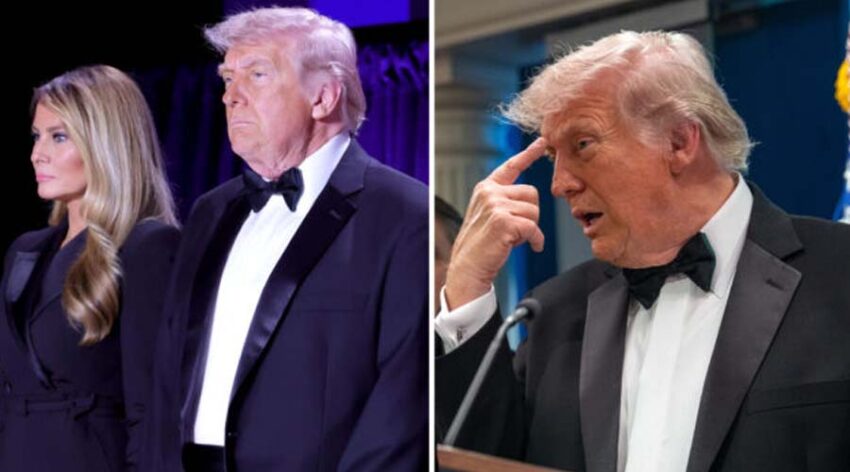
A night meant to celebrate media and politics at one of Washington’s most high-profile events quickly turned into a moment of fear when gunfire erupted—forcing Donald Trump and other officials to be rushed out under heavy security.
Chaos at a high-profile event
The incident unfolded during the 2026 White House Correspondents’ Dinner at the Washington Hilton, a venue long associated with major political gatherings. As shots were reported inside the building, security teams moved swiftly to escort Trump, Melania Trump, and other protected individuals to safety.
Authorities later confirmed that everyone under protection was unharmed.
The suspected attacker, identified as Cole Thomas Allen, was reportedly carrying multiple weapons, including a shotgun, a handgun, and knives. Law enforcement said he exchanged gunfire with officers before being subdued and taken into custody.
Early investigation points to intent
Speaking publicly after the incident, Todd Blanche stated that investigators believe the suspect may have intended to target high-level officials, including the president. That assessment is reportedly based on writings or a manifesto discovered during the investigation.
Authorities also traced Allen’s movements across the country, suggesting he traveled from Los Angeles to Washington, D.C., by train shortly before the event.
At a press briefing, Trump described the suspect in blunt terms:
“My impression is he was a lone wolf whack job. These are crazy people.”
He also emphasized the speed and effectiveness of the response:
“To see a man charge a security checkpoint armed with multiple weapons… and he was taken down by some very brave members of the Secret Service… it is always shocking when something like this happens.”
Despite the danger, Trump characterized the aftermath as unusually unified, noting that people in the room reacted together in the face of the crisis.
A location with a troubling history
For many observers, the most unsettling detail came not from the attack itself, but from where it happened.
The Washington Hilton is not just another event venue—it is historically significant for a far more infamous moment. In 1981, Ronald Reagan was shot outside the same hotel in an attempted assassination by John Hinckley Jr..
During that attack, a bullet ricocheted off Reagan’s limousine and struck him, leaving him seriously injured. The event became one of the defining security crises in modern American political history.
Public reaction and broader concerns
The parallel between the two घटनات—decades apart but tied to the same location—quickly drew attention online. Many viewers pointed out the eerie coincidence, highlighting how a place associated with past political violence once again became the scene of a security scare involving a sitting president.
At the same time, officials have been cautious not to jump to conclusions about motive, emphasizing that the investigation is ongoing.
A reminder of persistent risks
While the immediate danger was contained, the incident serves as a reminder of the risks surrounding high-profile political events. Even with extensive security measures in place, unpredictable threats remain a challenge.
The response by law enforcement has been widely described as swift and effective, preventing what could have escalated into something far more serious. Still, the combination of a high-profile target, a heavily armed suspect, and a historically significant location has left many reflecting on how fragile even the most secure environments can feel in moments like this.