
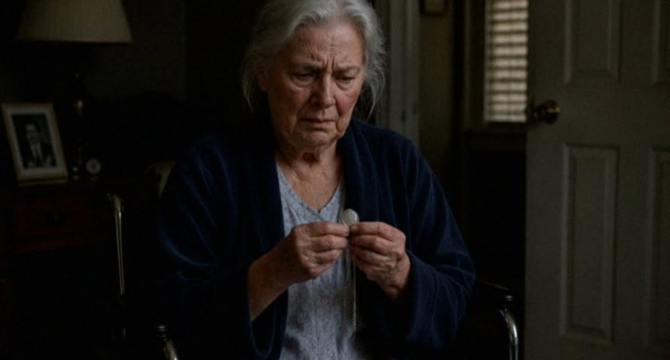
My daughter took almost everything before I was even out of the house.
By the time the movers came to take me to the nursing home, the good dishes were gone. The antique lamp my husband loved was gone.
The carved walnut side table from my mother was gone. Even the framed photographs had been pulled from the walls, though Amanda had not bothered to take all of them.
She only took the ones in silver frames.
“You’re not going to need all this where you’re going,” she said, standing in my living room with a legal pad in her hand as if she were managing an estate sale instead of dismantling the last home I ever expected to live in.
I was sitting in my wheelchair by then, unable to do much more than watch.
A stroke had taken the use of my left side two years earlier. The second one, smaller but crueler in its own way, left me too weak to live alone.
After that, everyone started using phrases like “for your own good” and “the safest option.”
What those phrases usually mean is that your life is about to get smaller, and everyone expects you to be grateful for it.
Amanda was my only child.
She was 41 years old, divorced, permanently dissatisfied, and convinced life had been unfair to her in ways it had somehow never been unfair to anyone else.
If she looked at a room, she saw what it was worth. If she looked at a person, she saw what they might leave behind.
The only thing she never touched was the silver locket I wore around my neck.
She had mocked that locket for years.
“It’s tarnished, old-fashioned, and probably worth less than the chain it’s on,” she used to say. “You hang onto the strangest junk, Mom.”
I always touched it when she said that. Not defensively. Just instinctively.
The locket was oval, scratched, and no bigger than a plum pit. I had worn it so long that taking it off felt like leaving the house without my wedding ring, which I once had.
My husband, Ken, gave it to me 30 years ago, though he had not bought it. It had belonged to his grandmother first, then his mother, then somehow to me.
I had never opened it.
I know that sounds ridiculous. Who wears a locket for decades and never opens it? Me, apparently.
Ken had clasped it around my neck one Christmas Eve and said, “This has been in our family for so long, wear it with pride and keep it safe.”
I laughed and asked what was inside.
He kissed my forehead and said, “You’ll know when you need to.”
I thought he was being poetic. Ken had a dry sense of humor and liked saying things that sounded mysterious just to watch me roll my eyes. So, I left it alone.
Then life became busy. Amanda was born. Bills piled up, and Ken worked. I worked. His mother died, and then mine.
And somewhere in all that ordinary human mess, the locket became one of those objects you stop questioning because it has crossed over from jewelry into identity.
Then Ken died suddenly of an aneurysm.
It happened on one afternoon, and then a hospital room that still visits me in dreams.
He had always handled our paperwork. Not because I was incapable, but because he liked systems and I liked trusting him.
After he died, I found files, account books, insurance policies, and neat little labels on manila folders in his study.
He had prepared for everything except leaving me.
Or so I thought.
Amanda started circling even then.
At first, she disguised it as concern.
“You should really simplify things,” she told me after the funeral. “That house is too much for one person.”
A month later, it became, “Have you thought about putting my name on anything? Just so if something happens, probate won’t be such a mess.”
Then, after the first stroke, she stopped disguising it.
She began asking direct questions.
“What accounts did Dad leave?”
“Whose name is on the deed?”
“Is there anything valuable in the attic?”
If grief makes some people softer, it made Amanda sharper. Or maybe it just removed the last reason for her to hide what she was.
By the time I was forced to leave the house, she was already speaking about it as if it belonged to her.
“I’ll sort through the rest once you’re settled,” she said that last day. “No point paying to store furniture you’ll never use again.”
I looked around the room that had held my whole marriage. “It’s still my house.”
She did not even blush. “Of course it is.”
But she said it the way people say yes to children.
The nursing home was clean and bright. The staff was kind enough. My room had one narrow bed for overnight aides, one dresser, and one window facing a parking lot.
It had just enough space for a person to understand, in a very practical way, how little of herself the world still required.
I brought clothes, photographs, my Bible, and the silver locket.
That was all.
Amanda visited twice in the first month.
The first time, she brought flowers that smelled too sweet and spent 20 minutes complaining about paperwork.
The second time, she asked whether I had remembered where Ken kept the “important documents.”
“What documents?” I asked.
“The ones that matter.”
I looked at her for a long moment and said, “If your father wanted you to have something, I suppose he would have arranged it.”
Her mouth tightened. “You always did that.”
“Did what?”
“Act like I’m some kind of thief.”
I turned my wheelchair slightly toward the window. “Amanda, if the shoe fits, at least have the grace not to complain about the color.”
She left after that.
I did not see her again for nearly three months.
Then I got the letter.
It arrived in a plain white envelope with the return address of “Erick, Attorney at Law.”
I knew the name. Erick had handled some of Ken’s business years ago and had helped with the will after his death.
I assumed it was routine paperwork related to the house, or perhaps another question about Amanda trying to push something through.
Instead, the letter contained a single question:
“Have you ever opened the silver locket?”
I frowned so hard my forehead hurt.
That was all on the first page. No explanation or legal language. Just that question sitting there like a finger on my chest.
Then I turned the page.
“If the answer is no, please do so immediately. Your late husband instructed me to contact you only if Amanda attempted to claim the remaining protected assets without your direct authorization. She has now done so.”
My heart skipped so hard I actually pressed my palm to it.
I kept reading.
Ken had apparently met with Erick months before his death.
If Amanda ever came asking for everything, or tried to move the title of the house, liquidate the final protected assets, or pressure the estate beyond the terms already laid out, Erick was to send me that letter and ask that one question.
“Have you ever opened the silver locket?”
By then, my hands were already shaking.
The locket was somewhere in the nursing home with me.
I just had to find it.
That would have been easier if panic and age had not both made my memory slippery.
I wheeled myself to the dresser first. Nothing. Then the top drawer of the bedside table. Hairbrush, hand cream, old receipts, but no locket.
I checked the box where I kept my late husband’s watch. Nothing.
I opened the little pouch in my knitting basket where I sometimes tucked away rings when my fingers swelled. Still nothing.
For one terrifying moment, I thought Amanda had taken it after all.
Then I remembered.
Two weeks earlier, one of the nurses had helped me change nightgowns after I spilled tea on myself.
I had unclasped the locket so it would not snag, then wrapped it in a handkerchief and tucked it into the zippered pocket of my winter robe hanging in the wardrobe.
I wheeled across the room so fast I banged my knee on the bedframe and barely felt it.
The robe was still there.
I reached into the pocket and found the square of cloth.
By then, I was shaking badly enough that I almost dropped it.
The locket lay in my palm, dull silver under the fluorescent light, small and unimpressive and suddenly heavier than anything I had ever held.
I stared at it for a long moment.
Then I took a butter knife from my tea tray, wedged the fine edge gently into the seam, and pressed. It did not open.
I tried again, harder this time. There was a tiny click, and the locket opened.
Inside was no photograph or anything sentimental.
Instead, folded into the hollow center with maddening precision, was a tiny slip of waxed paper containing a key.
Just a key. Small, brass, and stamped with a safety deposit box number.
I sat there in complete silence.
Then I called Erick immediately.
He answered on the second ring and listened carefully as I explained what I’d found.
“Ken hid a bank key inside my necklace for 30 years and never told me.”
He actually chuckled. “That sounds like Ken.”
“It sounds deranged.”
“It sounds cautious.”
Then he explained.
Years ago, long before my strokes, Ken had become quietly concerned about Amanda’s character.
Not in the dramatic way parents announce estrangement over one argument. In the sad, slow way, people understand that someone they love has a hunger nothing ever fills.
Amanda had debts I only partly knew about. A failed business venture and credit card problems.
Some kind of settlement after her divorce.
Ken had helped her more than once, always privately, always hoping it was temporary.
It never was.
So he made arrangements.
The bank box, Erick said, contained the original title deed to the house and documents attached to a trust Ken had established using an inheritance from his mother’s side of the family.
The house itself had been legally shielded in a way that meant Amanda could not seize it, transfer it, or force any change while I was alive.
“Why didn’t he tell me plainly?” I asked.
“Because he knew you loved your daughter.”
I closed my eyes.
Erick continued gently, “And because he suspected that if you knew the full extent of what he’d protected from her, you might eventually tell her out of guilt.”
He was right. I hated that he was right.
“What did Amanda do?” I asked.
There was a pause.
“She came to me three months ago asking about the house title, the remaining accounts, and whether there were any assets not yet transferred under the will.”
I gripped the phone tighter. “And?”
“And when I told her the matter depended on a personal item still in your possession, she called it, and I quote, ‘it must be that worthless junk necklace my mother keeps around her neck like a peasant heirloom.’”
My face burned.
Not from surprise. Nothing Amanda said could surprise me anymore.
From shame, maybe. Or grief.
Or the simple humiliation of having raised someone who would spit on the very thing that saved me.
Erick went on. “She dismissed it immediately. Which, I think, was precisely what Ken expected.”
The next week, Erick arranged transport and met me at the bank himself.
I had not been outside the nursing home except for medical appointments since moving in.
Riding through town in the wheelchair van felt surreal, as if I were briefly being returned to the world instead of being moved through it.
The bank manager took us into a private room downstairs.
When the box was brought out, and the key fit cleanly into the lock, I felt an absurd flash of anger toward Ken for all the years he had walked around knowing this secret while I wore it around my neck like a fool.
Then the lid lifted.
Inside were documents, exactly as Erick said. The original title deed, trust papers, certificates, and a sealed letter.
And beneath all that, a velvet pouch containing several rings and pieces of antique jewelry I had never seen before.
“His mother’s things,” Erick said quietly, glancing over one inventory sheet. “Ken sold some assets years ago to help Amanda, but he preserved the family line items here.”
I touched the edge of the sealed letter. My name was on it in Ken’s handwriting.
I opened that first.
“My darling Rahel,”
“If you are reading this, then one of two things has happened: either I have become a melodramatic fool for no reason, or Amanda has finally proved me right.”
I smiled despite everything. That was his voice exactly.
He wrote that he had not hidden the truth from me because he doubted me. He hid it because he knew me.
He knew I would forgive too easily, hope too long, and sacrifice my own safety for our daughter even after she had stopped deserving it.
He also wrote this:
“Amanda does not understand the difference between value and price. That is why she will never think to look closely at the one thing you kept for love instead of money.”
I had to stop reading for a moment after that.
Because that was the whole sad shape of it, wasn’t it?
Amanda would strip a room down to nails for what it could bring her, but she would never examine the one object she had already declared worthless.
Her contempt had protected me better than locks ever could.
The letter ended with instructions.
“Sign the trust activation papers. Reconfirm the life estate on the house in my name.”
And one final line that hurt and healed me all at once:
“Do not let guilt hand her what greed could not reach.”
Back at the nursing home, I signed everything.
The house would remain mine for the rest of my life. If I ever improved enough to leave care, it would be there waiting. If I did not, it could not be sold from under me.
After my death, the house would not go to Amanda automatically.
It would pass into a charitable trust funding long-term care support for disabled seniors who had no reliable family advocates.
That, too, was Ken.
He had loved me enough not just to protect me, but to make sure whatever Amanda could not devour might still do some good.
Amanda appeared two days later, furious enough that even the receptionist looked rattled when she escorted her into my room.
She did not sit down.
“What did you sign?” she demanded.
I folded my hands in my lap. “Good afternoon, Amanda.”
She laughed sharply. “Don’t do that. Erick won’t tell me anything except that the house is now fully locked down and I have no access or claim to it while you’re alive.”
“That must have been disappointing.”
Her eyes flashed. “I’m your daughter.”
“Yes,” I said. “You are.”
It is a terrible thing to look at your own child and feel the full weight of who she chose to become.
Not because you stop loving them. That would almost be easier.
No, what hurts is that love remains, even while respect dies in front of you.
She stepped closer. “What was in that locket?”
I looked down at the silver oval resting against my sweater.
“The one you said was worthless?”
Her face changed then. The realization that she had failed not because she was outmaneuvered by brilliance, but because she could not imagine that anything she despised might matter.
“You planned this,” she said.
I almost laughed.
“Your father planned it,” I told her. “Because he knew you.”
She went pale with anger. “He always judged me.”
“No,” I said quietly. “He always understood you.”
For a moment, I thought she might cry.
Instead, she said, “So that’s it? You’re cutting me off?”
I held her gaze.
“No, Amanda. You cut yourself out. Years ago. Your father simply made sure you couldn’t drag me down with you.”
She opened her mouth, closed it, then looked around my little room as if seeing it for the first time. The narrow bed and the folded blanket. The tray of untouched tea and me in the wheelchair, she had half treated like furniture for months.
“You’d really leave everything to strangers?” she asked.
That question lodged in me.
Because it revealed, more nakedly than anything else, the shape of her mind.
In Amanda’s world, anyone who could not be used was a stranger.
Anyone vulnerable was already halfway erased.
I touched the locket again.
“No,” I said. “Not strangers, just people in need.”
She left without saying goodbye.
I have not seen her since.
People always want a neat ending after stories like this. They want repentance or punishment, tears in a doorway, some final speech that breaks everyone open and makes them honest.
Life is rarely that tidy.
Amanda sends cards on holidays now. Very proper ones. No handwritten messages. Just her name in ink that looks rushed.
Perhaps that is her version of connection. Perhaps it is guilt. Perhaps she is simply keeping one eye on the calendar.
I no longer spend much time guessing.
What I think about instead is the locket.
All those years, I wore it because it felt like part of my marriage. I thought it held memory. Sentiment. Love in the vague domestic sense.
I was wrong.
It held something much harder and more deliberate than that.
It held proof that Ken knew exactly what kind of man he was trying to be for me, even after death. Not romantic in the soft, foolish sense people use the word.
Romantic in the old sense. Fierce, loyal, slightly theatrical, and prepared to outwit greed with patience and a scrap of silver no one else respected enough to open.
Sometimes at night, when the hall outside my room is quiet, and the nurses’ shoes make soft sounds on the floor, I open the locket and look at the tiny brass key still resting in its folded paper.
The box is empty now. The papers are signed. The work is done.
But I keep the key there anyway.
Not because I need it.
Because after all these years, I finally understand what Ken meant.
Wear it with pride.
Keep it safe.
You’ll know when you need to.