
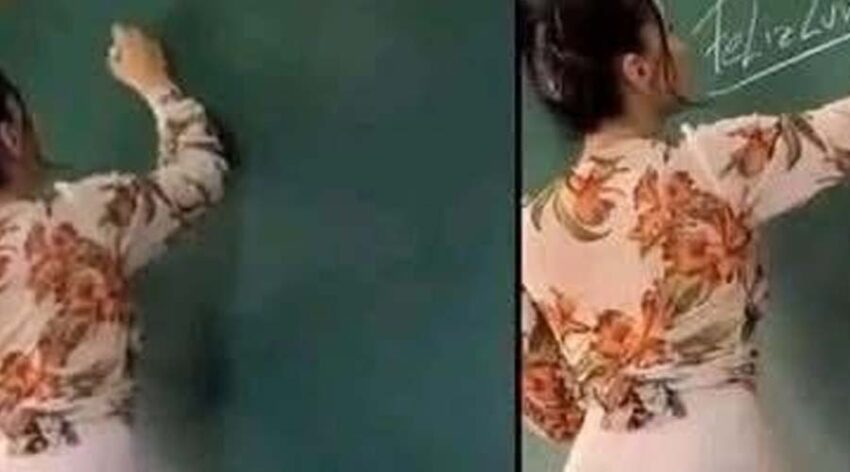
A student records a teacher during an ordinary school day, never imagining how widely the footage might spread or how quickly strangers could form opinions about the person on the screen. Within hours, a short clip can be copied, shared, discussed, and transformed into a viral story. What began as a moment inside a classroom may suddenly become a public controversy involving students, parents, educators, school administrators, and social media users who have never met the people involved.
The headline in the supplied image—“Teacher expelled for doing this kind of thing”—raises an important question about what happens when a teacher’s behavior is recorded and circulated online. The accompanying text suggests that a student recorded a teacher without anticipating the consequences on social media. However, the screenshot does not provide enough verified information to establish exactly what happened, whether the teacher was dismissed, what the recording showed, or how the school responded.
That distinction matters. A dramatic headline can attract attention, but a headline alone cannot establish the facts of a case. The broader situation nevertheless offers an opportunity to examine an increasingly familiar problem: how recording devices, online attention, privacy, professional responsibility, and public judgment intersect in modern education.
Teachers work in environments where their words, expressions, decisions, and interactions with students can be observed by many people. A teacher may spend an entire day managing lessons, answering questions, addressing disruptions, and helping students understand difficult material. Most of these interactions never leave the classroom. But when a student records one moment, the context surrounding it can become difficult to preserve.
A brief video may capture an unusual exchange, a heated disagreement, an awkward gesture, or a moment that viewers interpret differently depending on their expectations. Once the clip circulates, people may begin making assumptions about the teacher’s character, competence, or intentions. The same footage may be described in several different ways by different accounts, each adding its own caption or interpretation.
The consequences can be significant. A teacher may face questions from school leaders, concern from parents, criticism from strangers, or pressure to explain an incident before all the facts are known. Students may also experience consequences, particularly if the recording exposes classmates, reveals private information, or violates school rules.
At the same time, recording can sometimes document genuine misconduct and help bring a serious concern to the attention of the appropriate authorities. The challenge is not simply whether a student should ever record something at school. It is how to distinguish responsible documentation from harmful exposure, how to protect students and educators, and how to ensure that serious allegations are investigated fairly.
This article explores those questions, using the scenario suggested by the screenshot as a starting point without assuming unverified details about the specific teacher or student. It examines how school recordings spread, why context matters, what professional standards may require, and how schools and families can respond when a classroom video becomes a public controversy.
How an Ordinary Classroom Moment Can Become a Viral Story
Schools are full of small interactions that rarely attract attention outside the people directly involved. A teacher explains an assignment, asks a student to put away a phone, corrects an answer, or responds to an unexpected comment. These moments are part of ordinary educational life.
A recording can change the audience almost instantly.
Before a video is posted, the people who witnessed an event may have a shared understanding of what happened before and after it. They may know what was said, whether someone had been repeatedly disruptive, or whether a conversation was intended as a joke. Once the recording is separated from its original setting, viewers may see only a few seconds of an interaction.
A short clip can therefore become a story that is much larger than the footage itself. The person who uploads it may add a provocative caption, another account may crop the video, and a third may repost it with a different explanation. As the material travels, the original circumstances can become increasingly difficult to identify.
The power of a short recording
Video feels persuasive because viewers can see and hear at least part of an event. Yet a recording is still a limited representation of reality. The camera captures what falls within its frame, at the time recording begins and ends. It does not automatically explain what happened earlier, what happened afterward, or what the people involved understood about the situation.
For example, a clip might show a teacher speaking firmly to a student. Without additional context, one viewer might interpret the tone as appropriate classroom management, while another might regard it as unnecessarily harsh. The footage may be important evidence, but its meaning can depend on details that are not visible.
This does not mean that recordings should be dismissed. Video can document behavior that deserves scrutiny. It means that viewers should distinguish between what the footage clearly shows and what they infer from it.
Why captions can shape public reaction
Online captions frequently encourage an immediate emotional response. Phrases suggesting that a teacher was “caught,” “exposed,” or “expelled” invite readers to expect wrongdoing before they know the underlying facts.
A caption may accurately summarize a verified event, but it may also exaggerate, omit qualifications, or describe an allegation as if it were an established conclusion. When users share the post without checking the source, the wording can spread faster than any later correction.
The screenshot in this case uses a dramatic headline, but it does not establish the circumstances of the recording or the outcome for the teacher. Responsible reporting therefore requires restraint: the headline can be discussed, but the alleged dismissal should not be treated as confirmed without reliable supporting information.
The speed of online attention
Social platforms make it possible for a video to reach a large audience in a very short time. A post can be copied by accounts that have no connection to the original school. Users may comment on the people shown, speculate about their motives, and circulate the clip in communities far beyond its original audience.
The process can create a sense that everyone knows what happened, even when most viewers have seen only the same short excerpt. Repetition is not proof, and the number of shares does not establish whether an allegation is accurate.
For the teacher, the sudden attention may be frightening and professionally damaging. For the student who recorded the incident, the response may also be unexpected. The student might have intended to share a funny moment, seek support from friends, document a concern, or draw attention to conduct they believed was inappropriate. Without verified information, it would be unfair to assign a motive.
The central lesson is simple: a video can be important evidence, but virality is not a substitute for investigation.
Why a Teacher’s Conduct Can Attract Serious Consequences
Teachers hold positions of responsibility. They are expected to teach, supervise students, maintain an appropriate learning environment, and follow the professional standards established by their school or education system. Because they work with young people, their conduct is subject to expectations that may differ from those applied in many other workplaces.
However, a serious consequence such as suspension or dismissal should not be assumed merely because a video becomes popular. Whether disciplinary action is justified depends on the actual conduct, the available evidence, the applicable policies, and the procedures governing the school.
Professional boundaries in the classroom
A classroom is not only a place where academic knowledge is transferred. It is also an environment in which students should be able to learn without intimidation, discrimination, harassment, or inappropriate treatment.
Teachers are generally expected to communicate respectfully, apply classroom rules fairly, and exercise authority responsibly. They may need to correct disruptive behavior, enforce deadlines, or address conflict, but those responsibilities do not give them unlimited freedom in how they treat students.
An educator’s words and actions can affect a student’s confidence, sense of safety, and willingness to participate. For this reason, many schools establish rules concerning professional communication, student welfare, appropriate physical contact, confidentiality, and responses to misconduct.
If a recording appears to show behavior that violates those standards, administrators may need to review it. The seriousness of the issue depends on what actually occurred. An awkward moment, a disagreement, an inappropriate remark, and a serious breach of student safety are not equivalent situations.
The difference between an allegation and a finding
A video may raise a legitimate concern without answering every question necessary for a formal decision. School leaders may need to establish the identities of the people involved, determine whether the footage has been edited, obtain statements from witnesses, and examine relevant policies.
The teacher should have an appropriate opportunity to respond to allegations. Students who may have been affected should also be heard in a way that protects their welfare and privacy.
Depending on the circumstances, the outcome could involve no formal action, additional guidance, a warning, further training, temporary removal from duties, suspension, or dismissal. These are possibilities, not predictions about the specific incident shown in the screenshot.
The appropriate response should reflect the evidence and the seriousness of the conduct rather than the volume of online criticism.
Why dismissal cannot be inferred from a headline
Employment decisions are generally governed by local law, school policies, contracts, and procedural requirements. Public institutions and private schools may follow different rules, and those rules vary between jurisdictions.
A school may investigate a complaint without immediately deciding that the teacher has committed misconduct. It may also need to protect the identities of students and respect employment confidentiality.
Consequently, the claim that a teacher was expelled or dismissed should be supported by a reliable statement or credible reporting before it is repeated as fact.
A dramatic headline can generate interest, but readers deserve to know whether the story describes a confirmed decision, an allegation, a temporary suspension, or simply an online rumor.
The Student Who Presses Record: What Might Be Behind the Decision?
The screenshot’s accompanying text suggests that a student recorded a teacher without imagining what the footage would cause on social media. That framing raises questions about the student’s expectations, responsibilities, and understanding of how digital content travels.
The student’s reasons cannot be established from the image alone. There are, however, several common situations in which a student might consider recording an interaction.
Recording out of curiosity or amusement
Students routinely use phones to capture everyday experiences, and a classroom may sometimes become the setting for an unusual or funny moment. A student might record an exchange because it seems entertaining or because they expect friends to find it amusing.
The consequences may not be obvious at the time. A video shared within a small friendship group can be copied, uploaded elsewhere, or reposted with a new caption. The student may lose control over who sees the material and how it is interpreted.
A moment that initially seems harmless can become embarrassing for the people shown, particularly if the clip reveals personal information or presents an interaction in a humiliating way.
This is why students should think carefully before posting recordings of other people. Asking whether the material is necessary, whether it respects privacy, and whether the people shown could be harmed can prevent avoidable problems.
Recording because something feels wrong
Not every student recording is intended as entertainment. A student may believe that a teacher has behaved inappropriately and may want evidence of what occurred.
In such circumstances, documentation can sometimes be important. Students should not be expected to ignore serious misconduct merely because the person involved is an authority figure.
However, recording and publicly posting are different decisions. A student who wants to report a concern may be able to preserve relevant information and share it confidentially with a trusted adult, school safeguarding officer, administrator, or other appropriate authority.
The safest and most effective route depends on the situation and local rules. In an immediate safety emergency, getting help takes priority over attempting to create a recording.
Seeking validation from friends
Teenagers and adults alike may use social media to seek reassurance when they feel uncertain about an experience. Posting a video can seem like a quick way to ask others whether an interaction was acceptable.
But public responses do not necessarily provide reliable guidance. Commenters may lack context, and users may react emotionally to the caption rather than evaluate the event carefully.
A post can also attract hostile comments directed at the student, the teacher, or other people involved. The person who uploaded the video may find that the discussion has moved beyond the original concern and become difficult to control.
When students need help interpreting an uncomfortable interaction, a trusted adult or appropriate school professional may be better placed to provide support than a public comment section.
Not understanding how widely a video can travel
A student might assume that a video will be seen only by a few friends. Yet privacy settings, reposts, screen recordings, and copies shared outside the original platform can make that assumption unreliable.
Once a video is public, deleting the original post may not remove every copy. Other users may have saved the footage or uploaded it to different accounts.
This does not mean students should never use their phones to document important events. It means they should understand the possible consequences and choose a sharing method that fits the purpose.
If the goal is to report misconduct, sending relevant evidence through an appropriate confidential channel may be safer than broadcasting it to a large audience.
Recording in Schools: Privacy, Consent, and School Rules
The question of whether a student may record a teacher at school does not have one universal answer. Laws and policies vary according to the country, the type of school, the circumstances of the recording, and the way the material is used.
A student may be allowed to use a phone for some educational activities while being prohibited from recording other people without permission. In other settings, specific rules may apply to audio recordings, confidential conversations, examinations, or sensitive student information.
School policies may restrict phone use
Many schools establish rules about when students may use mobile phones, whether recording is permitted, and how devices should be handled during lessons.
These rules may aim to reduce distractions, prevent bullying, protect student privacy, and maintain a productive learning environment. Some schools allow recording when a teacher has authorized it for an educational purpose; others impose stricter limits.
A student who records during class may therefore be violating a school policy even if the recording itself does not reveal misconduct. Conversely, a policy violation does not automatically mean that the student intended to harm someone.
The school should assess the circumstances, including the reason for recording, the content captured, the way the footage was shared, and any harm that resulted.
Consent and privacy laws differ
Whether a recording is lawful may depend on local legislation. Rules governing audio recordings can differ from those governing photographs or silent video. Some jurisdictions have specific consent requirements, while others apply different standards depending on the setting and the expectation of privacy.
Schools may also have additional obligations concerning children, confidential information, and personal data.
Because the screenshot does not identify the country, school, or applicable legal system, it would be inaccurate to declare that the student either had or did not have a legal right to record the teacher.
Anyone involved in a real incident should consult the relevant school policies and, where necessary, qualified local legal advice.
A recording can expose people who never agreed to appear online
The teacher may not be the only person visible in a classroom video. Other students might appear in the background, and the recording could reveal names on a board, details of an assignment, private conversations, or other information that was never intended for public circulation.
If minors are involved, the privacy concerns can be especially serious. A student who did not participate in the original incident may nevertheless become identifiable through the video.
Before sharing classroom footage, people should consider whether others can be recognized, whether the material contains sensitive information, and whether publication is necessary to address the concern.
Responsible documentation does not require public humiliation
When a student believes that a serious problem has occurred, preserving evidence can be valuable. But the purpose of documenting an incident should be to establish what happened and obtain an appropriate response, not to encourage strangers to harass the people involved.
A responsible approach focuses on accuracy, privacy, and safety. It also recognizes that a recording can be relevant evidence without becoming entertainment for a large online audience.
The difference between reporting a concern and publicly shaming someone is important, especially in schools where students and staff must continue to work together after an incident has been addressed.
When a Video Reveals Genuine Misconduct
Although viral recordings can be misleading or incomplete, it would be equally wrong to assume that every controversial classroom video is harmless. Recording can sometimes reveal conduct that requires a serious response.
Schools need ways to receive complaints, protect students, and investigate concerns without relying exclusively on public attention.
Student safety must come first
If a recording appears to show violence, threats, harassment, discrimination, or another serious breach of student welfare, the priority should be to ensure that anyone at risk is safe.
Students should contact a trusted adult, school safeguarding personnel, or another appropriate authority. If there is an immediate threat of serious harm, emergency assistance may be necessary.
The response should not depend on whether a video has become popular. A serious allegation deserves attention even if only one person has seen the footage.
Likewise, a viral post should not automatically determine the outcome. School officials need to establish what happened and take appropriate steps based on the evidence.
Why original footage may matter
A recording may provide details that are difficult to remember accurately later, such as the wording of a statement, the sequence of an exchange, or the actions of people present.
However, the usefulness of the recording depends on its reliability and context. A short excerpt may omit relevant events, and editing may alter the impression created by the original interaction.
Where a formal investigation is appropriate, investigators may need to examine the original file, identify when and where it was recorded, and compare it with witness accounts and other evidence.
People should avoid modifying or publicly distributing potentially important material before obtaining guidance from the appropriate authority. The best process depends on local policies and the nature of the allegation.
Protecting students who report concerns
Students may hesitate to report inappropriate conduct because they fear retaliation, embarrassment, or disbelief. A school should provide clear ways to raise concerns and explain how those reports will be handled.
Confidential reporting options can help students seek assistance without immediately exposing themselves or their classmates to public scrutiny.
Schools should also explain that a report will be assessed fairly. A student should not be dismissed simply because the concern is uncomfortable or involves an adult in a position of authority.
At the same time, the school must avoid assuming that an allegation is proven before it has been investigated. Protecting students and treating staff fairly are compatible responsibilities, not competing goals.
Accountability should follow evidence
If an investigation establishes serious misconduct, appropriate disciplinary action may be necessary. Depending on the circumstances, that action could include formal warnings, restrictions on duties, suspension, dismissal, or referral to an external authority.
The specific response should be proportionate to the conduct and consistent with applicable rules.
If the evidence does not support the allegation, the school should avoid treating online pressure as a substitute for a proper finding. Correcting misinformation may also be necessary when public claims have harmed someone unfairly.
The purpose of accountability is to address the underlying conduct, protect the learning environment, and reduce the risk of recurrence—not simply to satisfy an online audience.
The Damage That Online Shaming Can Cause
Once a classroom recording becomes viral, the people shown may lose control over the story. Users can form strong opinions after watching only a few seconds of footage, and those opinions may be repeated thousands of times.
Online criticism can sometimes draw attention to a legitimate concern. But when the response becomes harassment, threats, or the circulation of private information, it can create additional harm that does little to resolve the original issue.
A teacher’s reputation can be affected quickly
Teaching depends on trust. Students and parents need confidence that educators can carry out their responsibilities, while teachers need a reasonable opportunity to do their work without being subjected to unfounded personal attacks.
A viral video can complicate that relationship. People may interpret a single moment as proof of a person’s entire character, even when the recording does not provide enough information to support such a conclusion.
A teacher may face hostile messages, intrusive inquiries, or criticism from people who do not know the full circumstances. The impact can extend beyond the workplace if the video identifies the teacher or circulates among family members and acquaintances.
If misconduct occurred, it should be addressed through an appropriate process. If the video is misleading, the person shown should not be denied a fair opportunity to explain the circumstances.
Students can also become targets
The student who recorded or uploaded the footage may receive unwanted attention as well. Some viewers may praise the student, while others may criticize the decision to record or share the material.
Other students shown in the footage may become identifiable and experience embarrassment or bullying. Even students who were not directly involved in the original interaction can be affected if classmates begin speculating about their roles.
These consequences are particularly concerning when the people involved are minors. Children and teenagers may not fully anticipate the long-term reach of online material, and public attention can follow them well beyond the original event.
Families may be drawn into the controversy
Parents and guardians may feel pressure to defend their children, demand explanations from a school, or respond to claims circulating online.
When information is incomplete, discussions can quickly become confrontational. People may accuse the school of covering up misconduct or assume that a teacher is guilty before an investigation has concluded.
Clear communication can help reduce unnecessary conflict. Schools should explain the procedures for raising concerns and provide updates when appropriate, while respecting privacy and confidentiality requirements.
Why deleting a post may not end the problem
A person who regrets uploading a video may remove the original post, but copies can remain on other accounts. Screen recordings, downloads, and reposts can make complete removal difficult.
This is one reason to think carefully before sharing sensitive footage. The potential audience may become much larger than expected, and the consequences may continue long after the original post disappears.
People who encounter a harmful or misleading video can help by avoiding unnecessary reposts, reporting abusive content through platform tools, and refusing to spread identifying details that are not relevant to a legitimate public interest.
The goal should be to resolve the underlying concern without creating additional victims of online harassment.
Why Context Matters More Than the Number of Views
A video with millions of views may appear more credible simply because so many people have watched it. But popularity does not establish accuracy.
Social media platforms are designed to circulate material that attracts attention, and emotional reactions can encourage further sharing. A dramatic clip may travel widely because it is surprising, controversial, or easy to understand—not necessarily because it provides a complete account of an event.
What viewers should ask before sharing
When a classroom video appears in a feed, readers can pause and ask several questions:
Does the post identify the original source of the recording?
Is the footage complete, or does it appear to be an excerpt?
Does the caption distinguish between confirmed facts and allegations?
Is there a reliable statement from the school or another relevant authority?
Could the post expose students or other people who have not consented to public attention?
Is sharing the video necessary to understand or address the concern?
These questions do not require viewers to become investigators. They simply encourage a more careful response before repeating a claim.
Watch for dramatic but unsupported conclusions
A headline stating that someone was dismissed, expelled, arrested, or punished describes a consequential outcome. Such a claim should be supported by reliable information.
The words “expelled” and “dismissed” also have different meanings in different contexts. A student may be expelled from a school, while a teacher may be suspended, dismissed, or removed from duties. A headline that uses these terms loosely can confuse readers about what actually happened.
In the screenshot provided here, the wording is dramatic, but the visible material does not establish a verified disciplinary outcome. The responsible approach is to discuss the broader issues without inventing details about the specific incident.
The importance of corrections
If a post contains incorrect information, people who shared it should correct their claims when reliable evidence becomes available. A correction may not reach everyone who saw the original, but it can reduce the continued spread of misinformation.
Platforms, publishers, schools, and individual users all have roles in promoting accurate information. No one needs to share every controversial clip, and no one should assume that a claim is true simply because it appears repeatedly.
A careful reader can remain concerned about student welfare while still insisting on evidence and fair treatment.
How Schools Can Respond When a Classroom Video Goes Viral
When a recording begins circulating online, school administrators may face pressure to respond immediately. Parents may demand answers, students may discuss the footage throughout the school, and staff may worry about what the incident means for the institution’s reputation.
A well-planned response should prioritize safety, fact-finding, privacy, and fair procedures rather than attempting to win a public argument.
Establish what is known
The first step is to identify the actual concern. Administrators should determine what the recording appears to show, who may have been involved, and whether anyone needs immediate protection or support.
They should distinguish information that is verified from claims that remain uncertain. A caption written by the person who uploaded the video may provide useful context, but it should not automatically be treated as a complete or impartial account.
Where appropriate, the school may need to review original footage, speak with witnesses, examine relevant records, and follow established reporting procedures.
Listen to students and staff
A fair investigation should provide appropriate opportunities for the people involved to explain what happened. Students who witnessed the event may have useful information, while the teacher should have an opportunity to respond to allegations.
The process should be conducted in a way that protects students from intimidation and avoids unnecessary exposure of personal details.
If the situation involves a safeguarding concern, the school may need to follow specific procedures and involve qualified personnel or external authorities. The precise response depends on the allegation and local requirements.
Communicate without exposing private information
Schools may need to reassure families that a concern has been received and is being handled appropriately. However, they may not be able to disclose every detail of an investigation, particularly when minors or confidential employment matters are involved.
A careful public statement can acknowledge the concern, explain the relevant process, and discourage speculation while avoiding premature conclusions.
Silence can sometimes create uncertainty, but releasing unverified information can cause further harm. The challenge is to communicate enough to maintain trust while respecting the rights and privacy of the people involved.
Take proportionate action
If misconduct is established, the school should take action consistent with its policies, the seriousness of the conduct, and applicable law. If the evidence is inconclusive, further review may be necessary.
Administrators should not base disciplinary decisions solely on the intensity of online reaction. Public pressure can highlight a problem, but it cannot replace a fair investigation.
Equally, the school should not dismiss a concern simply because it has attracted unwanted publicity. The underlying facts deserve careful attention regardless of how the issue first came to light.
Learn from the incident
After the immediate matter has been addressed, the school can review whether its policies and support systems are clear enough.
Questions may include whether students understand how to report concerns, whether staff receive adequate training, whether phone rules are consistently communicated, and whether the school has a plan for responding to viral content.
The aim should be to improve the learning environment and reduce the likelihood of similar problems, not merely to make the controversy disappear from social media.
The Role of Parents and Guardians
Parents and guardians can help young people understand the responsibilities that come with recording and sharing content. These conversations are most effective when they go beyond simply telling children not to use their phones.
Young people need to understand that digital decisions can affect real people, sometimes in ways that are difficult to reverse.
Teach children to pause before posting
Before uploading a classroom video, a student should consider why it is being shared and who might be affected.
If the footage shows a funny but private moment, posting it may embarrass someone unnecessarily. If it documents a serious concern, sharing it publicly may expose the student or other people to risks that could have been avoided through a confidential reporting route.
Parents can encourage children to ask themselves whether the post is necessary, accurate, respectful, and safe.
Explain the difference between evidence and entertainment
A recording can serve an important purpose when it documents a genuine safety concern or inappropriate conduct. But turning an incident into entertainment can distract from the underlying issue and expose people to ridicule.
Parents can explain that documenting a problem and publishing it for a large audience are separate decisions. A child who wants help should know that there are trusted adults and appropriate reporting channels available.
Encourage honest conversations
Young people may be reluctant to admit that they recorded or shared something they later regret. Responding only with anger may discourage them from seeking help when a problem occurs.
Parents can set clear boundaries while encouraging children to discuss mistakes honestly. If a video has caused harm, the family may need to consider removing the original post, reporting abusive reposts, contacting the school, or seeking other appropriate support.
Deleting a post may not remove every copy, but taking responsible steps can still limit further circulation.
Protect children’s own privacy
Parents should also model careful sharing. Posting a child’s school details, daily routine, personal conversations, or embarrassing moments can create risks even when the intention is affectionate or humorous.
Children benefit when adults demonstrate that privacy matters and that not every memorable moment needs to become public content.
The lesson applies to teachers, students, parents, and everyone else who uses recording devices: think about the person behind the image, not only the reaction the image might generate.
Social Media Literacy Is Now Part of School Safety
Digital literacy involves more than knowing how to operate a phone or use a social media platform. It includes understanding how information spreads, how context can be lost, and how online behavior affects people outside the screen.
A classroom recording can become a useful starting point for teaching these skills.
Understanding digital permanence
Students should understand that content can remain accessible even after the original uploader deletes it. Copies may be stored on other devices, shared in private groups, or uploaded to additional platforms.
This does not mean that every post will remain online forever. It means that users should not assume they can fully control what happens after publication.
Before sharing a recording, students can consider whether they would be comfortable with it being viewed by family members, school administrators, future employers, or people outside their immediate social circle.
Recognizing manipulation and missing context
Videos can be cropped, edited, slowed down, or combined with captions that influence how viewers interpret an event. Even an unedited clip can omit important information simply because the camera was not recording before or after the moment shown.
Students should learn to distinguish the visible evidence from the claims attached to it. They should also understand that a large number of comments does not guarantee that the comments are accurate.
These skills are useful far beyond school controversies. They help people evaluate news, political claims, product advertisements, celebrity stories, and other forms of online content.
Practicing respectful online behavior
A person who appears in a viral video remains a human being with relationships, responsibilities, and a life outside the recording. Criticism of conduct may be appropriate, but harassment, threats, and the publication of private information can cause harm without helping resolve the problem.
Students can learn to report content that raises genuine concerns while avoiding personal attacks and unnecessary reposting.
Schools can support this learning through clear rules, practical examples, and discussions about the consequences of online actions.
Giving students safe ways to speak up
Digital literacy must be accompanied by reliable reporting channels. If students believe that they have no safe way to raise concerns, they may turn to public posting because it appears to be the only method of getting attention.
Schools can reduce that risk by explaining whom students can contact, what happens after a report is made, and how confidentiality is handled.
A reporting system should take concerns seriously while protecting people from retaliation and ensuring that allegations are assessed fairly.
When students know that concerns can be heard and investigated, they are better equipped to distinguish between seeking help and seeking public attention.
What Viewers Can Learn From a Story Like This
The story suggested by the screenshot is not only about a teacher, a student, or a recording. It also reflects a wider change in how people experience public attention.
In the past, a classroom disagreement might have been witnessed by a limited group of people and discussed privately with school staff or family members. Today, a recording can reach thousands of viewers who have no direct knowledge of the situation.
That change creates opportunities for accountability, but it also makes responsible judgment more important.
Do not confuse popularity with proof
A video may be widely shared because it provokes anger, surprise, amusement, or sympathy. Those reactions are understandable, but they do not establish what happened before the recording began or what followed afterward.
Before accepting a dramatic claim, look for reliable reporting or an appropriate statement from the relevant institution. If no such information is available, recognize the uncertainty rather than filling the gaps with speculation.
Protect people while seeking answers
If a recording raises a genuine concern, it is reasonable to want the matter investigated. But sharing identifying details, encouraging harassment, or spreading unverified allegations can create new problems.
A responsible response focuses on the conduct that needs to be examined, the people who may need protection, and the process required to establish the facts.
Remember that mistakes and misconduct are not identical
A person may make an awkward remark, exercise poor judgment, violate a school rule, or engage in serious misconduct. These situations differ in their severity and may require different responses.
A fair process examines the circumstances rather than treating every controversy as proof of the worst possible interpretation.
This principle protects students as well as teachers. It allows legitimate concerns to be addressed without assuming that every person shown in a viral clip deserves public condemnation.
Consider the long-term consequences
A viral moment may last only a few seconds, but its consequences can continue for months or years. The teacher may face professional uncertainty, the student may experience unwanted attention, and other people shown in the recording may become targets of speculation.
Before sharing a clip, consider whether the post contributes useful information or simply increases exposure.
Sometimes the most responsible choice is to preserve evidence and report a concern through an appropriate channel rather than turn it into public entertainment.
A Balanced Conclusion: Accountability Without Rushing to Judgment
A student recording a teacher can create a situation that is far more complicated than a dramatic headline suggests. The footage may raise legitimate questions about professional conduct, privacy, school rules, and student welfare. It may also leave important details unanswered.
The supplied screenshot does not establish the precise incident, the identities of the people involved, or whether the teacher was actually dismissed. Those details should not be invented or repeated as confirmed facts.
What can be said is that classroom recordings deserve careful handling. Teachers have responsibilities to maintain professional standards and protect students. Students have a right to raise genuine concerns and seek help when something feels wrong. At the same time, everyone involved deserves a fair process, and privacy should be respected wherever possible.
When a video appears to reveal misconduct, the appropriate response is to preserve relevant evidence, report the concern through a suitable channel, and allow the matter to be investigated. If the evidence establishes wrongdoing, proportionate action may be necessary. If a claim is inaccurate or incomplete, corrections should be made rather than allowing an online narrative to determine someone’s reputation.
Parents and schools can help prevent harmful incidents by teaching digital responsibility, explaining reporting procedures, and setting clear expectations for recording and sharing content.
For viewers, the lesson is equally important: watch carefully, distinguish facts from assumptions, and think before sharing. A video can provide valuable evidence, but it cannot always tell the whole story.
Ultimately, the purpose of responding to a classroom controversy should be to protect students, uphold professional standards, and maintain a safe learning environment—not simply to satisfy the demands of an online audience.